

Tendency to scandal as a marketing strategyin textile fashion: the Zara case
Article Sidebar
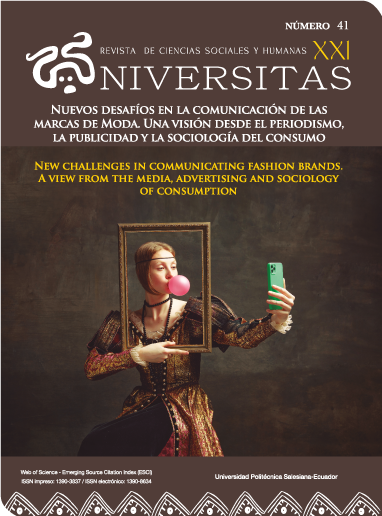
Main Article Content
Abstract
the last decade, various unorthodox tactics have gained prominence, notably the use of scandal. This article seeks to demonstrate the existence of a tendency to scandal as a marketing strategy developed
by the Zara brand during the decade from 2014 to 2023; and demonstrate that it is correlated with increased sales. Using a mixed methodology, a case study is carried out based on content analysis by designing a database on ten Zara launches, at the rate of one product per year in the last decade. These launches stood out for their countercultural advertising aimed at certain consumer segments. Furthermore,
the multivariate correlation between sales and scandal factors was calculated. The results show
the trend towards the brand’s annual scandal through tables and data triangulation, supported by graphs that represent the level of annual sales, the volume of followers on social networks, news of scandals and geographical distribution. The study concludes that the Zara brand used controlled scandal as a marketing strategy in the last decade. This tactic is characteristic of the network society, which bases its
decisions on recommendations or events rather than on traditional advertising, thus achieving a high
effectiveness ratio.
Article Details
Universitas-XXI Journal aligns with the principles of open access and academic collaboration by adopting the Creative Commons Attribution-NonCommercial-ShareAlike 4.0 International License (CC BY-NC-SA 4.0). This license ensures that published content can be used and shared widely under the following conditions:
Attribution: Authors and the journal must be appropriately credited as the original creators of the content, with full reference and a link to the publication provided.
Non-commercial use: Content may not be used for commercial purposes, preserving its academic and educational intent.
ShareAlike: Derivative works must be distributed under the same terms as this license, promoting the creation of accessible and equitable knowledge.
By implementing this license, the Universitas-XXI Journal strengthens its commitment to disseminating high-quality research, providing free access to knowledge, and fostering a collaborative environment among researchers, educators, and students worldwide.
This decision reflects core values of responsibility, ethics, and transparency in academia, ensuring that intellectual contributions serve as a foundation for new research and projects while respecting the rights of authors and the scientific community.
For more information about this license, please visit the following link: https://creativecommons.org/licenses/by-nc-sa/4.0/"
References
Ballester, E. et al. (2021). Engaging consumers through firm-generated content con Instagram. Spanish Journal of Marketing – ESIC, 25(3), 355-373. doi: https://doi.org/10.1108/SJME-11-2020-0189
Belanche, D. et al. (2013). Comunicación commercial y boca-oído electrónico en sitios web corporativos: un análisis desde la perspectiva del marketing de relaciones. Investigaciones Europeas de Dirección y Economía de la Empresa, 19(1), 31-41. doi: http://dx.doi.org/10.1016/j.iedee.2012.10.002
Berger, P. y Luckmann, T. (1966). The social construction of reality. Doubleday.
Brogdon, R. (2024). Traditional marketing is not dead in veterinary practice. Veterinary Clinics of North America: Small Animal Practica, 24(2), 369-379. doi: https://doi.org/10.1016/j.cvsm.2023.10.004
Caro, M. y Sicilia, M. (2014). Las emociones y la resistencia al cambio de las actitudes. Spanish Journal of Marketing – ESIC, 18(1), 17-31. doi: https://doi.org/10.1016/S1138-1442(14)60003-6
Casais, B. y Veloso, A. (2024). Digital Marketing. Reference Module in Social Sciences, Vol. ahead-of-print (N. º ahead-of-print). doi: https://doi.org/10.1016/B978-0-443-13701-3.00227-9
Casalá, L. et al. (2013). La construcción de lealtad en comunidades virtuales de marca. Revista Europea de Dirección y Economía de la Empresa, 22(1), 53-60. doi: http://dx.doi.org/10.1016/j.redee.2011.10.001
Ceballos, L. y Villegas, J. (2014). El uso de los arquetipos en la industria de la moda en Colombia. Estudios Gerenciales, 30(130), 48-54. doi: http://dx.doi.org/10.1016/j.estger.2014.01.012
Cho, M. et al. (2023). Contactless marketing management of fashion brands in the digital age. European Management Journal, 41(4), 512-520. doi: https://doi.org/10.1016/j.emj.2022.12.005
Collí, V. (2015). ¿Libertad de expresión o responsabilidad? ¿Cuándo en el caso de portales sobre noticias, de acuerdo con la Corte Europea de Derechos Humanos? Análisis y lecturas actuales. Revista Mexicana de Derecho Constitucional, (33), 195-210. doi: https://doi.org/10.1016/j.rmdc.2016.03.020
De Obesso, A. et al. (2012). El papel de la reputación, el boca-oreja, la confianza y la incertidumbre en la contratación de un banco. Investigaciones Europeas de Dirección y Economía de la Empresa, 18(3), 190-199. doi: http://dx.doi.org/10.1016/j.iedee.2012.05.006
Del Olmo, C. (2022). La polémica como estrategia publicitaria: el caso de C. Tangana. [Tesis de grado, Universidad de Valladolid]. Repositorio institucional de la Universidad de Valladolid. https://bit.ly/4bSVUTh
Ding, K. et al. (2024). Recommend or not: A comparative analysis of customer reviews to uncover factors influencing explicit online recommendation behavior in peer-to-peer accommodation. European Research on Management and Business Economics, 30(1), 58-71. doi: https://doi.org/10.1016/j.iedeen.2023.100236
Febra, L. et al. (2023). Reputation, return and risk. A new approach. European Research on Management and Business Economics, 29(1), 36-43. doi: https://doi.org/10.1016/j.iedeen.2022.100207
Fernández, J. (2015). Economía neo-schumpeteriana, innovación y política tecnológica. Cuadernos de Economía, 38(107), 79-89. doi: http://dx.doi.org/10.1016/j.cesjef.2015.03.001
Fontana, G. y Miranda, J. (2016). The business of fashion in the nineteenth and twentieth centuries. Economic History Research, 12(2), 68-75. doi: http://dx.doi.org/10.1016/j.ihe.2016.03.017
García, M. (2015). Analysis of the effects of ICTs in knowledge management and innovation: the case of Zara Group. Computers in Human Behavior, 51(B), 994-1002. doi: https://doi.org/10.1016/j.chb.2014.10.007
Garrido, E. et al. (2023). Consumer knowledge in marketing: a critical review and research agenda. Spanish Journal of Marketing – ESIC, Vol. ahead-of-print (N. º ahead-of-print). doi: https://doi.org/10.1108/SJME-07-2023-0187
Gázquez, J. y Jiménez, D. (2009). Situación actual y planteamientos futuros para la investigación de marketing en España. Investigaciones Europeas de Dirección y Economía de la Empresa, 15(1), 169-183. doi: https://doi.org/10.1016/S1135-2523(12)60084-7
Hoon, K. y Young, E. (2020). Fashion marketing trends in social media and sustainability in fashion management. Journal of Business Research, 117, 508-509. doi: https://doi.org/10.1016/j.jbusres.2020.06.001
Inditex (2024). Memoria anual del Grupo Inditex. https://bit.ly/4cepqCy
Kwame, G. et al. (2024). ICT adoption in the textile and jewelry industries for sustainable fashion: a systematic review. Scientific African, 24. doi: https://doi.org/10.1016/j.sciaf.2024.e02224
López, M. y Sicilia, M. (2013). Boca a boca tradicional vs. Electrónico. La participación como factor explicativo de la influencia del boca a boca electrónico. Spanish Journal of Marketing – ESIC, 17(1), 7-38. doi: https://doi.org/10.1016/S1138-1442(14)60017-6
López, Y. y Clemente, J. (2023). The satisfaction of the purchase experience at Zara: Methodological proposal. Communication & Methods, 5(1), 27-42. doi: https://doi.org/10.35951/v5i1.178
Lucchese, M. et al. (2023). Evaluación en especializaciones médicas: un estudio en una universidad argentina. Educación Médica, 24(2). doi: https://doi.org/10.1016/j.edumed.2023.100796
Margarida, A. y Martins, H. (2014). Customer loyalty through social networks: lessons from Zara on Facebook. Business Horizons, 57(6), 709-717. doi: https://doi.org/10.1016/j.bushor.2014.07.003
Martínez, A. (2008). Hacia un nuevo sistema de la moda: el modelo Zara. Revista Internacional de Sociología, 66(51), 105-122. doi: https://doi.org/10.3989/ris.2008.i51.111
Matute, J. et al. (2015). Las características del boca-oído electrónico y su influencia en la intención de recompra online. Revista Europea de Dirección y Economía de la Empresa, 24(2), 61-75. doi: https://doi.org/10.1016/j.redee.2015.03.002
Minian, I. et al. (2017). Cambio tecnológico y relocalización de la industria del vestido. Problemas del Desarrollo, 48(188), 139-164. doi: https://doi.org/10.1016/j.rpd.2017.01.007
Miranda, F. et al. (2015). Determinantes de la intención de uso de Facebook en el proceso de decision de compra. Investigaciones Europeas de Dirección y Economía de la Empresa, 21(1), 26-34. doi: http://dx.doi.org/10.1016/j.iedee.2014.05.001
Muñoz, P. et al. (2023). Retroalimentación como evaluación formativa desde la perspectiva docente en odontología: estudio de caso. Educación Médica, 24(2). doi: https://doi.org/10.1016/j.edumed.2022.100785
Navarro, M. et al. (2009). Efectos de la comunicación integrada de marketing a través de la consistencia estratégica: una propuesta teórica y metodológica. Estudios Gerenciales, 25(111), 35-57. doi: https://doi.org/10.1016/S0123-5923(09)70070-1
Orús, A. (2024). Porcentaje de las ventas de la empresa textil española Inditex en todo el mundo de 2014 a 2023, por áreas geográficas. Statista. https://bit.ly/3Xjra9e
Pellicer, M. (2018). ¿Por qué una publicidad ética? Las campañas más polémicas. Vivat Academia, 142, 97-108. doi: https://doi.org/10.15178/va.2018.142.97-107
Ripamonti, A. (2023). Advertising and Asymmetric Information: Evidences from Brazilian Stock Market. Estudios Gerenciales, 39(167), 173-180. doi: https://doi.org/10.18046/j.estger.2023.167.5489
Rubalcava, C. et al. (2019). La conciencia de marca en redes sociales: impacto en la comunicación boca a boca. Estudios Gerenciales, 35(152), 313-320. doi: https://doi.org/10.18046/j.estger.2019.152.3108
Taylor, S. y Bodgan, R. (1992). Introducción a los métodos cualitativos de investigación. Paidós.
Toca, C. (2013). El marketing al servicio de las organizaciones del tercer sector. Estudios Gerenciales, 29(129), 386-395. doi: https://doi.org/10.1016/j.estger.2013.11.004
Torró, L. (2019). Protoindustria y población en una comarca textil valenciana (1600-1800). Economic History Research, 15(1), 1-12. doi: https://doi.org/10.1016/j.ihe.2017.05.001
Ye, X. et al. (2024). Social media, relationship marketing and corporate ESG performance. Finance Research Letters, 63. doi: https://doi.org/10.1016/j.frl.2024.105288