

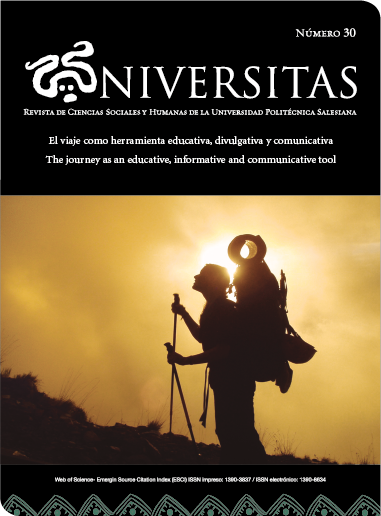
Travelling to learn and learning by travelling. Educational Strategies at advantaged social Argentinian schools
Article Sidebar
Main Article Content
Abstract
The article explores the repertoires and meanings that educational agents give to journeys in the institutional projects of their schools, considering that these organizations cater students that most certainly could travel on their own. In this sense, the basic proposition guiding this analysis is based on the fact that, due to the processes of universalization and school massification, educational institutions develop strategies of institutional differentiation to “capture” their public, and in those strategies, school trips take a fundamental place. Through a qualitative work nourished by interviews with institutional agents in international schools, that is, schools that adhere to the International Baccalaureate (IB) program or are binational institutions, where their degrees are valid for a second educational system, we study the main advantages and benefits represented by the inclusion of school trips in the curricula of these institutions. The analysis is complemented with institutional documents.
Article Details
Universitas-XXI Journal aligns with the principles of open access and academic collaboration by adopting the Creative Commons Attribution-NonCommercial-ShareAlike 4.0 International License (CC BY-NC-SA 4.0). This license ensures that published content can be used and shared widely under the following conditions:
Attribution: Authors and the journal must be appropriately credited as the original creators of the content, with full reference and a link to the publication provided.
Non-commercial use: Content may not be used for commercial purposes, preserving its academic and educational intent.
ShareAlike: Derivative works must be distributed under the same terms as this license, promoting the creation of accessible and equitable knowledge.
By implementing this license, the Universitas-XXI Journal strengthens its commitment to disseminating high-quality research, providing free access to knowledge, and fostering a collaborative environment among researchers, educators, and students worldwide.
This decision reflects core values of responsibility, ethics, and transparency in academia, ensuring that intellectual contributions serve as a foundation for new research and projects while respecting the rights of authors and the scientific community.
For more information about this license, please visit the following link: https://creativecommons.org/licenses/by-nc-sa/4.0/"
References
BALL, S. 1989. La micropoli?tica de la escuela: hacia una teori?a de la organizacio?n escolar. Barcelona: Paido?s.
BALL, S. 2012. Global Education Inc. New Policy networks and the Neoliberal Imaginary. London: Routledge.
BRASLAVSKY, C. 1985. La discriminación educativa en la Argentina. Buenos Aires: FLACSO, Grupo Editor Latinoamericano.
BECK, U., & BECK-GERNSHEIM, E. (2001). La individualización. Buenos Aires: Paidós.
BEECH, J. 2009. Policy spaces, mobile discourses, and the definition of educated identities. Comparative Education, 45(3), 347-364.
BEECH, J. 2011. Global Panaceas, Local Realities. International Agencies and the future of education. Berlín: Peter Lang.
BEECH, J., & BARRENECHEA, I. 2011. Pro-market educational governance: is Argentina a black swan? Critical Studies in Education, 523, 279-293
BILLIG, S. 2013. Impact of Participation in CAS on Students’ Civic mindedness and engagement. RMC Research Corporation, Denver.
BHAVNANI, J. 2013. Enhancing International Mindedness. IB Conference of the Americas, New Orleans.
BOURDIEU, P. 2000. Poder, derecho y clases sociales. Buenos Aires: Desclee.
CASTELLS, M. 2000. Grassrooting the space of flows. En: James Wheeler, Yuko Aoyama y Warf Barney (Eds.), Cities in the Telecommunications Age. The fracturing of Geographies (pp. 18-27). Nueva York: Routledge.
DOHERTY, C., LUKE, A., SHIELD, P., & HINCKMAN, C. 2012. Choosing your niche: the social ecology of the International Baccalaureate Diploma in Australia. International Studies in Sociology of Education, 22(4), 311-332.
ELIAS, N. 1983. El proceso de civilización. Buenos Aires: FCE.
ESPING ANDERSEN, G. 2002. Why we need a welfare state. EE.UU.: Oxford University Press.
GAMALLO, G. (2015). La “publificación” de las escuelas privadas en Argentina. Revista SAAP, 9(1), 43-74. ISSN 1666-7883.
LARRONDO, M., & MAYER, L. 2018. Ciudadanías juveniles y educación. Las otras desigualdades. Buenos Aires: Grupo Editor Universitario.
MAYER, L., & CATALANO, B. 2018. Internacionalizacio?n de la educacio?n y movilidad: reflexiones a partir del caso argentino. Universitas, 29, 19-41.
MAYER L., & NÚÑEZ, P. 2016. Desigualdades en la educacio?n juvenil en Ame?rica Latina. Temas, 87-88, 12-19.
MAYER, L. 2009. Hijos de la democracia. ¿Cómo viven y piensan los jóvenes? Buenos Aires: Paidós.
MAYER, L. 2012. La conflictividad escolar cotidiana. Estrategias para su minimización. Tesis de Doctorado. Manuscrito.
MITCHELL, K. 2003. Educating the national citizen in neoliberal times: from the multicultural self to the strategic cosmopolitan. Transactions of the Institute of British Geographers, 28(4), 387-403.
NARODOWSKI, M., & ANDRADA, M. 2001. The privatization of education in Argentina. Journal of Education Policy, 16(6), 585-595. Recuperado de https://goo.gl/pGxdzj
NARODOWSKI, M., MOSCHETTI, M., & GOTTAU, V. 2015. Education Privatization by Default and Socioeconomic Segregation in the City of Buenos Aires. Challenges for Equity and Social Cohesion. Paper presented at the 59th Annual Conference of the CIES, Washington, DC, USA.
NOGUEIRA, M. 2004a. Favorecimiento Economico e excelencia escolar: um mito em questio Revista Brasileira de Educacao, 6.
NOGUEIRA, M. 2004b. Viagens de estudios al exterior. En A. M. Almeida et al. (Comps), Circulacao Internacional e Formacao Intenelectual de las elites brasileiras. Universidad Estadual de Campinhas: Editora Unicamp.
PAZ DE ABRIL, D. 2007. Escuelas y educación para la ciudadanía global. Barcelona: Intermon OXFAM.
PERRENOUD, Ph. 2000. Construir competencias desde la escuela. Santiago de Chile: Dolmen Ediciones.
PERRENOUD, Ph. 2006. El oficio de alumno y el sentido del trabajo escolar. Madrid: Editorial Popular.
RESNIK, J. 2009. Multicultural Education: good for business bad for the State? IB curriculum and global capitalism. British Journal of Educational Studies, 57(3), 217- 244.
RESNIK, J. 2012. International education, international studies. Sociology on Education, 22(4), 285-289.
SASSEN, S. 2007. Territory, authority, rights: From medieval to global assemblages. Princeton, NJ: Princeton University Press.
SALTALAMACCHIA, H. 1992. La historia de vida: Reflexiones a partir de una experiencia de investigacio?n (Coleccio?n Investigaciones). Puerto Rico: Ediciones SIJUP.
SOUTHWELL, M. 2011. La educacio?n secundaria en Argentina. Notas sobre la historia de un formato. En G. Tiramonti (Dir.), Variaciones sobre la forma escolar: li?mites y posibilidades de la escuela media. Buenos Aires: FLACSO-Homo Sapiens.
TIRAMONTI, G. 2004. La trama de la desigualdad educativa. Mutaciones recientes en la escuela media. Buenos Aires: Manantial.
TIRAMONTI, G. 2008. Introducción. En: G. Tiramonti (Comp.), La escuela media en debate. Buenos Aires: Manantial.
TIRAMONTI, G., & ZIEGLER, S. 2008: La educación de las elites. Aspiraciones, estrategias y oportunidades. Buenos Aires: Paidós.
URRY, J., & LASH, S. 1998. Economía de signos y espacios. Sobre el capitalismo de la posorganización. Buenos Aires: Amorrortu
ZIEGLER, S., & NOBILE, M. 2012. Personalizacio?n y escuela secundaria: Dina?micas de escolarizacio?n en diferentes grupos sociales. Archivos de Ciencias de la Educacio?n, 6(6).