

Travel as an educational resource: Case study of the Tahina-Can Expedition
Article Sidebar
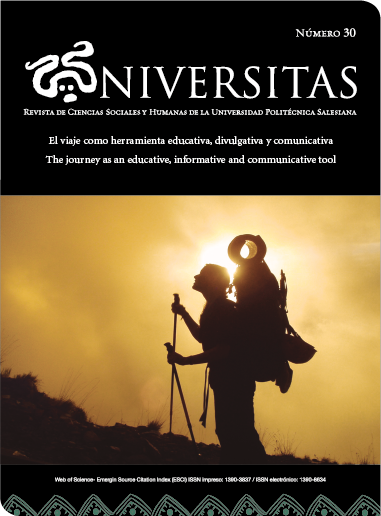
Main Article Content
Abstract
The work analyses the possibilities of travel as a resource and innovative educational method based on the case study of the Tahina-Can Expedition, a travel journalism project promoted by the Autonomous University of Barcelona (UAB). Since 2004, it has allowed about 700 students to participate in an academic expedition that brings together content production workshops in the field of digital writing, television, photography and radio. The initiative has obtained the first prize by the Telefónica Foundation in the category of "Learning on the Net". The study proposes the conceptualization of the trip as a constructivist practice that assumes the challenges of the 21st century student profile. Through the methodology of the case study, the article describes the particularities of the travel project, as well as it analyses its results and its impact. This is done through the technique of focus groups, which are developed with the participation of the expedition members who have taken part in the trips of Tahina-Can. The study concludes, among other aspects, that the trip is considered as an active learning practice and that constitutes a stimulus for the students. The experience enhances the commitment of the participants with their own learning process and it allows the advanced development of different professional journalistic roles and competences.
Article Details
Universitas-XXI Journal aligns with the principles of open access and academic collaboration by adopting the Creative Commons Attribution-NonCommercial-ShareAlike 4.0 International License (CC BY-NC-SA 4.0). This license ensures that published content can be used and shared widely under the following conditions:
Attribution: Authors and the journal must be appropriately credited as the original creators of the content, with full reference and a link to the publication provided.
Non-commercial use: Content may not be used for commercial purposes, preserving its academic and educational intent.
ShareAlike: Derivative works must be distributed under the same terms as this license, promoting the creation of accessible and equitable knowledge.
By implementing this license, the Universitas-XXI Journal strengthens its commitment to disseminating high-quality research, providing free access to knowledge, and fostering a collaborative environment among researchers, educators, and students worldwide.
This decision reflects core values of responsibility, ethics, and transparency in academia, ensuring that intellectual contributions serve as a foundation for new research and projects while respecting the rights of authors and the scientific community.
For more information about this license, please visit the following link: https://creativecommons.org/licenses/by-nc-sa/4.0/"
References
AMIGUET, L. 07/09/2017. Muchas universidades van a cerrar porque no hacen falta. La Vanguardia. Recuperado de https://goo.gl/APU1HF. (4-10-2018).
AUSUBEL, D.P., & SULLIVAN, E.V. 1983. El desarrollo infantil. Barcelona: Paidós.
BAUMAN, Z. 2003. Modernidad líquida. México: Fondo de Cultura Económica.
Berganza, M. R., & RUIZ, J. 2005. Investigar en comunicación: guía práctica de métodos y técnicas de investigación social en comunicación. Madrid: McGraw-Hill.
CANO, E. 2008. La evaluación por competencias en la educación superior. Profesorado. Revista de currículum y formación del profesorado, 12(3), 1-16. Recuperado de https://goo.gl/73HhPZ (5-11-2018).
Castaño, C.M., MAIZ, I., PALAZIO, G.J., & VILLARROEL, J.D. 2008. Prácticas educativas en entornos web 2.0. Madrid: Síntesis.
CASTELLS, M. 2003. La galaxia Internet. Barcelona: Mondadori.
CRENSHAW, D. 2010. The Myth of Multitasking: How ‘Doing It All’ Gets Nothing Done. San Francisco: Jossey-Bass.
DOOLITTLE, P.E., & CAMP, W. G. 1999. Constructivism: The career and technical education perspective. Journal of Career and Technical Education, 16(1), 23-46. Recuperado de https://goo.gl/2tirdm (14-10-2018).
DRISCOLL, M.P. 2005. Psychology of learning for instruction. Boston, MA: Pearson Education, Inc.
FARRERAS, C. 23/04/2016. La mitad de las universidades desaparecerán en diez años. La Vanguardia. Recuperado de https://goo.gl/tB4tjU (5-5-2018).
FERNÁNDEZ ENGUITA, M. 2016. La educación en la encrucijada. Madrid: Fundación Santillana.
FERNÁNDEZ, M. 02/06/2018. Si las universidades no evolucionamos, vamos a desaparecer. Infobae. Recuperado de https://goo.gl/tQ5NBE (10-6-2018).
FRANCESE, P. 2003. Trend Ticker: Ahead of the Next Wave. Recuperado de https://bit.ly/1vfypdp (29-5-2018).
GARCÍA AVILÉS, J. A., & MARTÍNEZ, O. 2009. Competencias en la formación universitaria de periodistas a través de nuevas tecnologías. Revista de la Facultad de Ciencias Sociales y Jurídicas de Elche, 1(4), 239-250. Recuperado de https://goo.gl/w1twh9 (10-11-2018).
GERRING, J. 2007. Case Study Research. Principles and practices. Nueva York: Cambridge University Press.
GILLHAM, B. 2000. Case study research methods. London: Continuum.
HERNÁNDEZ, R; FERNÁNDEZ, R., & BAPTISTA, P. 2006. Metodología de la investigación. Bogotá: McGraw-Hill.
KOHLBERG, L. 1992. Sicología del desarrollo moral. Bilbao: Desclée de Brouwer S.A.
LÉVY, P. 2007. Cibercultura: la cultura de la sociedad digital. Barcelona: Anthropos.
LIN, M. 22/06/2012. The gap between journalism education and the (changing) journalism profession. MulinBlog: A digital journalism blog. Recuperado de https://goo.gl/JuHpKW (22-4-2018).
LÓPEZ, X. 2010. La formación de los periodistas en el siglo XXI en Brasil, España, Portugal y Puerto Rico. Revista Latina de Comunicación Social, 65, 231-243.
LÓPEZ, X. 2012. La formación de los periodistas para los entornos digitales actuales. Revista de Comunicación, 11, 178-195. Recuperado de https://goo.gl/5Zt2cN (12-11-2018).
MATSA, K. E. & MITCHELL, A. 2014. 8 Keys Takeaways about Social Media and News. Pew Research Center. Journalism & Media, 26 marzo. Disponible en: https://goo.gl/mPUxHj (12-6-2018).
MAYER, R.E. 1999. Designing instruction for constructivist learning. En C. Reigeluth, (Ed.), Instructional-design theories and models (pp. 141-159). Mahwah: Lawrence ErlbaumAssociates.
MCLOUGHLIN, C., & LEE, M. 2008. The Three P’s of Pedagogy for the Networked Society: Personalisation, participation, and productivity, International Journal of Teaching and Learning in Higher Education, 20(1), 10-27. Recuperado de https://goo.gl/voxEGz (1-11-2018).
MERTENS, D.M. 2005. Research and evaluation in Education and Psychology: Integrating diversity with quantitative, qualitative and mixed methods. Thousand Oaks: Sage.
MEDINA GALLEGO, C. 2003. Didáctica para la transformación de la vida escolar. Bogotá: Colciencias, IPAC, Fundación Social, Universidad Nacional.
NIGHTINGALE, P. & O’NEIL, M. 1994. Achieving Quality Learning in Higher Education. Londres: Kogan Page.
PASTOR, L. 2010. Funiversity. Los medios de comunicación cambian la universidad. Barcelona: Editorial UOC.
PAVLIK, J. 2005. El periodismo y los nuevos medios de comunicación. Barcelona: Paidós.
PEMPEK, T.A., YERMOLAYEVA, Y.A., & CALVERT, S.L. 2009. College students’ social networking experiences on Facebook. Journal of Applied Developmental Psychology, 30(3), 227-238. https://doi.org/10.1016/j.appdev.2008.12.010
PÉREZ-TORNERO, J.M. & VARIS, T. 2012. Alfabetización mediática y nuevo humanismo, Barcelona: UNESCO - UOC Press.
PÉREZ-TORNERO, J.M., TEJEDOR, S., SIMELIO, N., & MARÍN, B. 2015. Estudiantes universitarios ante los retos formativos de las Redes Sociales: el caso de Colombia. Estudios sobre el Mensaje Periodístico, 21(1), 509-521. doi: 10.5209/rev_ESMP.2015.v21.n1.49108
PÉREZ-TORNERO, J.M., & TEJEDOR, S. (Eds.) 2016. Ideas para aprender a aprender. Manual de innovación educativa y tecnología. Barcelona: Editorial UOC.
PIAGET, J. (1973). La representación del mundo en el niño. Madrid: Morata.
PISCITELLI, A., ADAIME, I., & BINDER, I. (Comp.) 2010. El Proyecto Facebook y la posuniversidad. Sistemas operativos sociales y entornos abiertos de aprendizaje. Madrid: Fundación Telefónica, Ariel.
PRENSKY, M. 2007. Digital Game-Based Learning. Minnesota: Paragon.
ROBINSON, K. 2006. “Do Schools Kill Creativity?” Ted Talks. Recuperado de https://goo.gl/UV3uLa (4-5-2018).
ROBLYER, M., MCDANIEL, M., WEBB, M., HERMAN, J., & WITTY, J. 2010. Findings on Facebook in higher education: A comparison of colleague faculty and student uses and perceptions of social networkings sites. The Internet and Higher Education, 3(13), 134-140. https://doi.org/10.1016/j.iheduc.2010.03.002
RUANO, L.E., CONGOTE, E.L., & TORRES, A.E. 2016. Comunicación e interacción por el uso de dispositivos tecnológicos y redes sociales virtuales en estudiantes universitarios. Revista Ibérica de Sistemas y Tecnologías de Información, 19, 15-31. http://dx.doi.org/10.17013/risti.19.15-31
SÁNCHEZ-GARCÍA, P., CAMPOS, E., & BERROCAL, S. 2015. Las funciones inalterables del periodista ante los perfiles multimedia emergentes. Revista Latina de Comunicación Social, 70, 187-208. https://doi.org/10.4185/RLCS-2015-1042
SÁNCHEZ-GARCÍA, P. 2017. Periodistas (In)formados. Un siglo de enseñanza periodística en España: historia y tendencias. Madrid: Universitas.
STINSON, S. 1997. A question of fun: adolescent engagement in dance education. Dance Research Journal, 29(2), 49-69. https://doi.org/10.2307/1478734
TARCIA, L., & MARINHO, S. P. 2008. Challenges and New Ways of Teaching Journalism in Times of Media Convergence. Brazilian Journalism Research, 4(2), 25-53. https://doi.org/10.25200/BJR.v4n2.2008.148
TEJEDOR, S. 2007. La enseñanza del ciberperiodismo. De la alfabetización digital a la alfabetización ciberperiodística. Sevilla: Comunicación Social.
TEJEDOR CALVO, S., & CERVI, L. 2017. Análisis de los estudios de Periodismo y Comunicación en las principales universidades del mundo. Competencias, objetivos y asignaturas. Revista Latina de Comunicación Social, 72, 1626-1647. https://doi.org/10.4185/RLCS-2017-1238
TEJEDOR, S., GIRALDO LUQUE, S., & CARNIEL BUGS, R. 2018. Las redes sociales como salida professional para los estudiantes de comunicación de España y América Latina. OBS Observatorio, 12(1), 183-198. http://dx.doi.org/10.15847/obsOBS12120181194
TOFFLER, A. 1980. The Third Wave. EEUU: Bantam Books.
TORRES, A. 25/10/2016. La mayoría de universidades del mundo va a desaparecer. El País. Recuperado de https://goo.gl/Wc85ud (5-6-2018).
TRAMULLAS, J. 2016. Hannibal ad portas, o los futuros perfiles profesionales de la información. El profesional de la información, 25(2),157-162. https://doi.org/10.3145/epi.2016.mar.01
TRILLING, B., & FADEL, C. 2009. 21st Century Skills: Learning for Life in Our Times. San Francisco: Jossey-Bass.
TUÑEZ, M., MARTÍNEZ, Y., & ABEJÓN, P. 2010. Nuevos entornos, nuevas demandas, nuevos periodistas. Estudios sobre el Mensaje Periodístico, 16, 79-94. Recuperado de https://goo.gl/yJJtK3 (5-10-2018).
UNITED STATES GENERAL ACCOUNTING OFFICE. 1990. Case Study Evaluations. Washington: GAO.
VYGOTSKY, L. 1978. Mind in society: The development of higher psychological processes. Cambridge: Harvard University Press.
WAYCOTT, J., BENNETT, S., KENNEDEY, G., DALGAMO, B., & GRAY, K. 2010. Digital divides? Student and Staff perceptions of information and communication technologies. Computers & Education, 54(4), 1202-1211. https://doi.org/10.1016/j.compedu.2009.11.006