

Exploring trends in the public sphere: scientometrics and systematic review
Article Sidebar
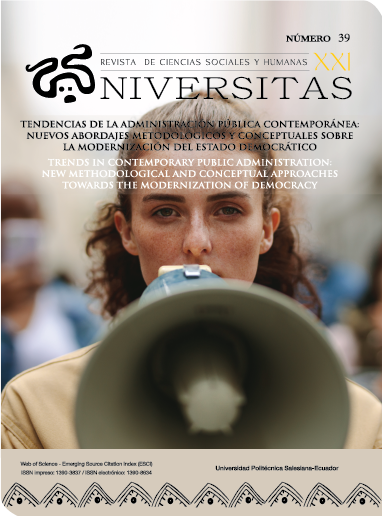
Main Article Content
Abstract
In this research, it was shed light on the imperative of ensuring effective government services and sustainable policies in the context of modernity. The study utilized a combination of scientometric analysis and systematic literature review to explore the current landscape of public administration and management. The analysis of the latest Scopus publications revealed a noticeable increase in research production over the past five years. There were identified three categories of trends: consolidated, intermediate, and emerging. Prominent themes included governance, transparency, corruption, e-government, and sustainability, while emerging trends encompassed public health, big data, open government, digital transformation, and smart cities. The findings emphasize the critical role of effective governance and citizen participation in shaping health-related policies, as well as the strategic adoption of technologies to improve service delivery. Looking ahead, it is proposed further investigation into emerging and intermediate trends, along with addressing identified thematic gaps such as public-private and international collaboration for sustainable governance, addressing health disparities in vulnerable communities and the role of higher education to develop ethical leaders. Moreover, the impact of information and communication technologies (ICTs) on achieving developmental goals in developing countries merits in-depth exploration. This research contributes valuable insights for policymakers, academics, and practitioners seeking to enhance public administration practices and meet the evolving needs of society.
Article Details
Universitas-XXI Journal aligns with the principles of open access and academic collaboration by adopting the Creative Commons Attribution-NonCommercial-ShareAlike 4.0 International License (CC BY-NC-SA 4.0). This license ensures that published content can be used and shared widely under the following conditions:
Attribution: Authors and the journal must be appropriately credited as the original creators of the content, with full reference and a link to the publication provided.
Non-commercial use: Content may not be used for commercial purposes, preserving its academic and educational intent.
ShareAlike: Derivative works must be distributed under the same terms as this license, promoting the creation of accessible and equitable knowledge.
By implementing this license, the Universitas-XXI Journal strengthens its commitment to disseminating high-quality research, providing free access to knowledge, and fostering a collaborative environment among researchers, educators, and students worldwide.
This decision reflects core values of responsibility, ethics, and transparency in academia, ensuring that intellectual contributions serve as a foundation for new research and projects while respecting the rights of authors and the scientific community.
For more information about this license, please visit the following link: https://creativecommons.org/licenses/by-nc-sa/4.0/"
References
Adomaviciute, D. 2018. University’s role and influence for professional development in public administration area. Journal of the Knowledge Economy, 9, 703-719. https://doi.org/10.1007/s13132-016-0360-1
Alcaide, C., Alcaide, L. y Rodríguez, M. 2022. Strategic alignment of open government initiatives in Andalusia. International Review of Administrative Sciences, 00208523221086125. https://doi.org/10.1177/00208523221086125
Appe, S., Rubaii, N. y Whigham, K. 2021. Expanding the reach of representativeness, discretion, and collaboration: The unrealized potential of public administration research in atrocity prevention. Public Administration Review, 81(1), 81-90. https://doi.org/10.1111/puar.13296
Aranibar, E., Huachani, D. y Zúñiga, M. 2022. Emprendimiento femenino en el Perú: puntos fuertes y débiles para su sostenibilidad en el tiempo. Fides et Ratio, 23(23), 199-224. https://doi.org/10.55739/fer.v23i23.115
Battisti, A., Valese, M. y Natta, H. 2022. Indicators as Mediators for Environmental Decision Making: The Case Study of Alessandria. Land, 11(5), 607. https://doi.org/10.3390/land11050607
Biscione, A. y Muco, K. 2021. The impact of corruption and good governance on the economic growth of the Balkan countries. Transition Studies Review, 28(2), 81. https://doi.org/10.14665/1614-4007-28-2-005
Boffardi, R. 2022. How efficient is the Italian health system? Evidence on the role of political-institutional dynamics. Socio-Economic Planning Sciences, 84, 101388. https://doi.org/10.1016/j.seps.2022.101388
Boudreau, C. 2021. Reuse of open data in Quebec: from economic development to government transparency. International Review of Administrative Sciences, 87(4), 855-869. https://doi.org/10.1177/0020852319884628
Caldas, R. 2021. Providencias sanitárias de financas públicas e tributárias federais pátrias em tempos de deflagracao de pandemia: Um retrato do endividamento público em meio a necessidade de preservacao do sistema de saúde e retomada economica. Revista Jurídica 64(2), 71-103. http://dx.doi.org/10.26668/revistajur.2316-753X.v2i64.5102
Capasso, S., Cicatiello, L., De Simone, E. y Santoro, L. 2022. Corruption and tax revenues: evidence from Italian regions. Annals of Public and Cooperative Economics, 93(4), 1129-1152. https://doi.org/10.1111/apce.12356
Castillo, C., Viu-Roig, M. y Alvarez-Palau, E. 2022. COVID-19 lockdown as an opportunity to rethink urban freight distribution: Lessons from the Barcelona metropolitan area. Transportation Research Interdisciplinary Perspectives, 14, 100605. https://doi.org/10.1016/j.trip.2022.100605
Cevallos, M., Blacio, G. y Maldonado, J. 2022. Indicios sobre el estado situacional de la descentralización en Ecuador. Revista Derecho del Estado, (51), 167-195. https://doi.org/10.18601/01229893.n51.06
Corburn, J., Vlahov, D., Mberu, B., Riley, L., Caiaffa, W., Rashid, S., Ko, A., Patel, S., Jukur, S., Martínez, E., Jayasinghe, S., ... y Ayad, H. 2020. Slum health: arresting COVID-19 and improving well-being in urban informal settlements. Journal of urban health, 97, 348-357. https://doi.org/10.1007/s11524-020-00438-6
Dolamore, S. 2021. Detecting empathy in public organizations: Creating a more relational public administration. Administrative Theory & Praxis, 43(1), 58-81. https://doi.org/10.1080/10841806.2019.1700458
Donina, D. y Paleari, S. 2019. New public management: global reform script or conceptual stretching? Analysis of university governance structures in the Napoleonic administrative tradition. Higher Education, 78, 193-219. https://doi.org/10.1007/s10734-018-0338-y
Elliott, I., Bottom, K., Carmichael, P., Liddle, J., Martin, S. y Pyper, R. 2022. The fragmentation of public administration: Differentiated and decentered governance in the (dis)United Kingdom. Public Administration, 100(1), 98-115. https://doi.org/10.1111/padm.12803
Fleischer, J. y Reiners, N. 2021. Connecting international relations and public administration: Toward a joint research agenda for the study of international bureaucracy. International Studies Review, 23(4), 1230-1247. https://doi.org/10.1093/isr/viaa097
Ford, M. 2021. Considering social equity in a new public management reform: Evidence from Milwaukee, Wisconsin. Public Integrity, 23(4), 369-384. https://doi.org/10.1080/10999922.2021.1908730
Gabarro, C. 2021. Entre tri gestionnaire et tri professionnel: Réorientation et éviction des pauvres à l’Assurance maladie. Sociétés contemporaines, 123(3), 79-109. https://doi.org/10.3917/soco.123.0079
Gatto, A. y Sadik, E. 2022. Governance matters. Fieldwork on participatory budgeting, voting, and development from Campania, Italy. Journal of Public Affairs, 22, e2769. https://doi.org/10.1002/pa.2769
Goncalves, R. y Domingos, I. 2021. Blockchain governance: Disruptive technology for controlling corruption in public health. Revista Juridica, 31-49. https://doi.org/10.21902/revistajur.2316-753X.v4i66.5065
Greer, S., King, E., da Fonseca, E. y Peralta, A. 2020. The comparative politics of COVID-19: The need to understand government responses. Global public health, 15(9), 1413-1416. https://doi.org/10.1080/17441692.2020.1783340
Hue, T. y Tung-Wen, M. 2022. Democratic governance: Examining the Influence of citizen participation on local government performance in Vietnam. International Journal of Public Administration, 45(1), 4-22. https://doi.org/10.1080/01900692.2021.1939713
Kapoor, K., Tamilmani, K., Rana, N., Patil, P., Dwivedi, Y. y Nerur, S. 2018. Advances in social media research: Past, present and future. Information Systems Frontiers, 20, 531-558. https://doi.org/10.1007/s10796-017-9810-y
Kim, M. y Charbonneau, É. 2020. Caught between volunteerism and professionalism: Support by nonprofit leaders for the donative labor hypothesis. Review of Public Personnel Administration, 40(2), 327-349. https://doi.org/10.1177/0734371X18816139
Kim, P. 2021. South Koreas fast response to coronavirus disease: implications on public policy and public management theory. Public Management Review, 23(12), 1736-1747. https://doi.org/10.1080/14719037.2020.1766266
Lanzaro, J. y Ramos, C. 2021. Decentralization and co-participation in the public sector: a historical feature of Uruguayan pluralist democracy. International Journal of Public Administration, 44(1), 14-29. https://doi.org/10.1080/01900692.2020.1750029
Longo, J. 2022. When artificial intelligence meets real public administration. Canadian Public Administration, 65(2), 384-388. https://doi.org/10.1111/capa.12465
Lund, C. 2022. Professional Development Leadership in Public Organizations: A Refined Conceptualization. Public Personnel Management, 51(4), 516-537. https://doi.org/10.1177/00910260221118576
Macedo, S., Valadares, J., Mendes, W. y Miranda, M. 2022. Perceptions on Access to Information and Corruption in Municipal Public Management: Two Sides of the Same Coin. Brazilian Journal of Public Policy, 12, 59. https://doi.org/10.5102/rbpp.v12i3.7901
Mahmood, H., Hassan, S., Tanveer, M. y Furqan, M. 2022. Rule of law, control of corruption and CO2 emissions in Pakistan. International Journal of Energy Economics and Policy, 12(4), 72-77. https://doi.org/10.32479/ijeep.13098
Mangia, C., Ferretto, G., Russo, A., Cervino, M. y Portaluri, M. 2022. Participation and facilitation in environment and health contexts: The case study of San Donaci. Epidemiologia e Prevenzione, 46(5-6), 382-386. https://doi.org/10.19191/ep22.5-6.a563.099
McMullin, C. 2021. Challenging the necessity of New Public Governance: Co-production by third sector organizations under different models of public management. Public Administration, 99(1), 5-22. https://doi.org/10.1111/padm.12672
Mériade, L. y Rochette, C. 2022. Governance tensions in the healthcare sector: a contrasting case study in France. BMC Health Services Research, 22(1), 1-13. https://doi.org/10.1186/s12913-021-07401-4
Mykytyuk, P., Semenets-Orlova, I., Blishchuk, K., Skoryk, H., Pidlisna, T. y Trebyk, L. 2021. Outsourcing as a tool of strategic planning in public administration. Studies of Applied Economics, 39(3). https://doi.org/10.25115/eea.v39i3.4718
Nicolaescu, A. y López, F. 2021. External vs. governmental auditing: insights from Spain. International Journal of Accounting, Auditing and Performance Evaluation, 17(3-4), 276-299. https://doi.org/10.1504/IJAAPE.2021.121499
ONeill, M. 2022a. Introduction: Special issue on curriculum design in public administration education: Challenges and perspectives. Teaching Public Administration, 40(3), 299-302. https://doi.org/10.1177/01447394221103954
ONeill, M. 2022b. MPA/MPP programmes and the future of work: Does MPA curriculum align with civil service requirements. Teaching Public Administration, 40(3), 388-409. https://doi.org/10.1177/0144739420984503
Ostransky, J. y Aznar, F. 2021. Investment treaties and national governance in India: Rearrangements, empowerment, and discipline. Leiden Journal of International Law, 34(2), 373-396. https://doi.org/10.1017/S0922156521000029
Overton, M., Larson, S., Carlson, L. y Kleinschmit, S. (2022). Public data primacy: the changing landscape of public service delivery as big data gets bigger. Global Public Policy and Governance, 2(4), 381-399. https://doi.org/10.1007/s43508-022-00052-z
Park, N., Cho, M. y Lee, J. 2021. Building a culture of innovation: How do agency leadership and management systems promote innovative activities within the government? Australian Journal of Public Administration, 80(3), 453-473. https://doi.org/10.1111/1467-8500.12474
Pecaric, M. 2020. Regulatory cybernetics: adaptability and probability in the public administration’s regulations. NISPAcee Journal of Public Administration and Policy, 13(1), 133-156. https://doi.org/10.2478/nispa-2020-0006
Perez, J. 2021. Digital Planning: A Challenge for Public Administrations. Revista General de Derecho Administrativo, 57, 46-46. https://laadministracionaldia.inap.es/noticia.asp?id=1511979
Rezapour, M. y Elmshaeuser, S. 2022. Artificial intelligence-based analytics for impacts of COVID-19 and online learning on college students’ mental health. PLoS One, 17(11), e0276767. https://doi.org/10.1371/journal.pone.0276767
Ríos, A., Guillamon, M., Egea-Martínez, J. y Benito, B. 2022. Influye una mayor transparencia en la mejor gestión de los recursos públicos? El ejemplo de los ayuntamientos españoles. CIRIEC-España, (106), 267-298. https://doi.org/10.7203/CIRIEC-E.106.18983
Robert, E., Zongo, S., Rajan, D. y Ridde, V. 2022. Contributing to collaborative health governance in Africa: a realist evaluation of the Universal Health Coverage Partnership. BMC Health Services Research, 22(1), 1-19. https://doi.org/10.1186/s12913-022-08120-0
Rubaii, N., Whigham, K. y Appe, S. 2021. The public administration imperative of applying an atrocity prevention lens to COVID-19 responses: Leveraging the global pandemic for positive structural change and greater social equity. Administrative Theory & Praxis, 43(3), 321-332. https://doi.org/10.1080/10841806.2020.1829260
Salnikova, O., Lagodiienko, V., Ivanchenkova, L., Kopytko, V., Kulak, N. y Usachenko, O. 2019. Evaluation of the effectiveness of implementation blockchain technology in public administration. IJITEE, 8(9), 1710-1713. http://doi.org/10.35940/ijitee.I8531.078919
Silva, A., Veiga, A., Cruz, O., Bastos, L. y Gomes, M. 2022. Severe acute respiratory infection surveillance in Brazil: the role of public, private and philanthropic healthcare units. Health Policy and Planning, 37(9), 1075-1085. https://doi.org/10.1093/heapol/czac050
Simonet, D. 2022. Centralization of health policy decisions, conversion to austerity, and public defiance in contemporary France. Journal of Public Affairs, 22(4), e2634. https://doi.org/10.1002/pa.2634
Sousa, M., Cardoso, F., Faria, L., Nacife, J., Barbosa, K. y Cruz, J. 2021. Gestao de Processos no Setor Público: técnicas, ferramentas, lacunas e agenda de pesquisa. RISTI, (E45), 35-56. https://www.researchgate.net/publication/359402606
Steffek, J. y Wegmann, P. 2021. The standardization of Good Governance in the age of reflexive modernity. Global Studies Quarterly, 1(4), ksab029. https://doi.org/10.1093/isagsq/ksab029
Stentella, D. 2022. Azienda pubblica e finanziamento pubblico dei partiti politici. Azienda pubblica e finanziamento pubblico dei partiti politici, 233-253. https://doi.org/10.3280/EP2022-002002
Sweeting, K. 2022. Strategies to foster engagement, empathy, equity, and ethics in public service: A conceptual model for public and nonprofit administrators. Public Integrity, 24(4-5), 432-447. https://doi.org/10.1080/10999922.2021.2014202
Toleikiene, R., Rybnikova, I. y Jukneviciene, V. 2020. Whether and how does the crisis-induced situation change e-leadership in the public sector? Evidence from Lithuanian public administration. Transylvanian Review of Administrative Sciences, 16(SI), 149-166. http://dx.doi.org/10.24193/tras.SI2020.9
Torfing, J., Sorensen, E. y Roiseland, A. 2019. Transforming the public sector into an arena for co-creation: Barriers, drivers, benefits, and ways forward. Administration & Society, 51(5), 795-825. https://doi.org/10.1177/0095399716680057
Tran, Y., Nguyen, N. y Hoang, T. 2022. How do innovation and financial reporting influence public sector performance in a transition market? Journal of Accounting in Emerging Economies, 12(4), 645-662. https://doi.org/10.1108/JAEE-06-2021-0180
Vallbona, M. 2022. Gobernanza sostenible en los espacios públicos. Cuadernos de Geografía, 31(1), 164-176. https://doi.org/10.15446/rcdg.v31n1.87168
Wang, H., Xiong, W., Wu, G. y Zhu, D. 2018. Public-private partnership in Public Administration discipline: a literature review. Public management review, 20(2), 293-316. https://doi.org/10.1080/14719037.2017.1313445
Widanti, N. 2022. Public Service Accountability Approach in Following changes in The New paradigm Of public administration. Res Militaris, 12, 3445-3454. http://repo.unr.ac.id/id/eprint/712
Willems, J., Schmidthuber, L., Vogel, D., Ebinger, F. y Vanderelst, D. 2022. Ethics of robotized public services: The role of robot design and its actions. Government Information Quarterly, 39(2), 101683. https://doi.org/10.1016/j.giq.2022.101683
Wirtz, B. W., Daiser, P. y Mermann, M. 2018. Social media as a leverage strategy for open government: an exploratory study. International Journal of Public Administration, 41(8), 590-603. https://doi.org/10.1080/01900692.2017.1289388
Wong, N., Ho, K., Wang, M. y Hsieh, C. 2022. Strong government responses? Reflections on the management of COVID-19 in Hong Kong and Taiwan. International Journal of Public Sector Management, 35(4), 428-440. https://doi.org/10.1108/IJPSM-06-2021-0158
Yang, Y. y Wu, F. 2022. The sustainability of the Project-Driven Innovation of grassroots Governance: Influencing factors and combination paths. Sustainability, 14(24), 16862. https://doi.org/10.3390/su142416862