

Study of the Instagram communications strategy of sports startups in Spain
Article Sidebar
Main Article Content
Abstract
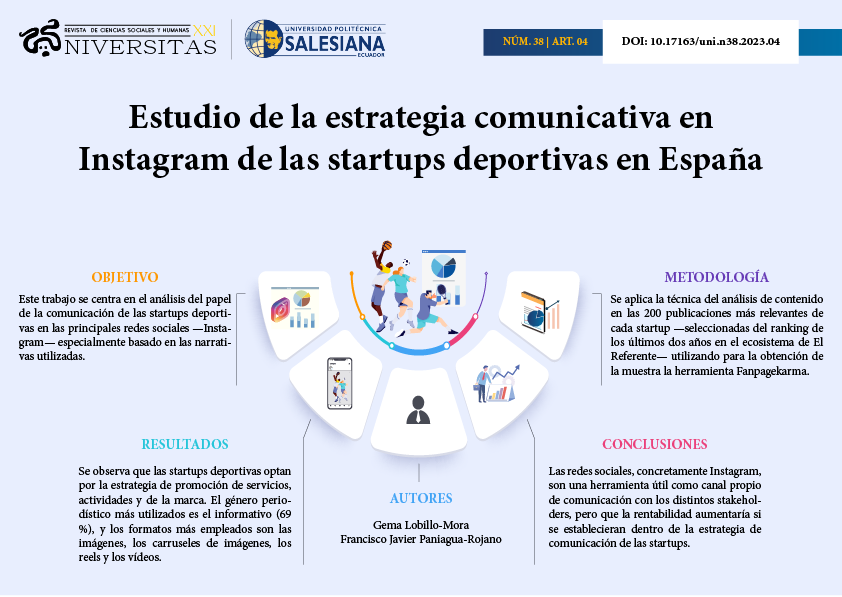
This paper focuses on the analysis of the communication role of sports startups in the main social net-
works -Instagram- especially based on the narratives used. Due to the great importance of digital communication for business development, the main objective of this research is to find out how digital communication works in these emerging companies. The content analysis technique is applied to the 200 most relevant publications of each startup -selected from the ranking of the last two years in the ecosystem of El Referente- using the Fanpagekarma tool to obtain the sample. The study of the publications
of these sports startups is complemented with a qualitative examination of the strategies followed, most frequent formats and the topics that dominate the agenda of these entities through the social network.
Among the most noteworthy results, it is observed that sports start-ups opt for the promotion strategy
-mainly of services, activities and the brand-. In terms of journalistic genres on social networks, the
most used by these companies is news (69 %), while the most used formats are images, image carousels,
reels and videos. The predominant agenda on Instagram in the sector focuses on #fitness, #personaltrai-
ner, brands, #sport, #health and #nutrition
Article Details
Universitas-XXI Journal aligns with the principles of open access and academic collaboration by adopting the Creative Commons Attribution-NonCommercial-ShareAlike 4.0 International License (CC BY-NC-SA 4.0). This license ensures that published content can be used and shared widely under the following conditions:
Attribution: Authors and the journal must be appropriately credited as the original creators of the content, with full reference and a link to the publication provided.
Non-commercial use: Content may not be used for commercial purposes, preserving its academic and educational intent.
ShareAlike: Derivative works must be distributed under the same terms as this license, promoting the creation of accessible and equitable knowledge.
By implementing this license, the Universitas-XXI Journal strengthens its commitment to disseminating high-quality research, providing free access to knowledge, and fostering a collaborative environment among researchers, educators, and students worldwide.
This decision reflects core values of responsibility, ethics, and transparency in academia, ensuring that intellectual contributions serve as a foundation for new research and projects while respecting the rights of authors and the scientific community.
For more information about this license, please visit the following link: https://creativecommons.org/licenses/by-nc-sa/4.0/"
References
Ala-Kortesmaa, S., Laapotti, T., & Mikkola, L. (2022). Narrative Start-up Identity Construction as Strategic Communication. International Journal of Strategic Communication, 16(2), 222–238. https://doi.org/10.1080/1553118X.2022.2027772
Alemán, I. I., Torralba, P. Y. G., & Alemán, N. I. (2021). Panorama y contexto del emprendimiento juvenil en España. In Economia, empresa y justicia. Nuevos retos para el futuro (pp. 1727-1749). Dykinson
Barba-Sánchez, V; Mitre-Aranda, M. y del Brío-González, J. (2022) The entrepreneurial intention of university students: An environmental perspective. European Research on Management and Business Economics, Volume 28, Issue 2,100184, https://doi.org/10.1016/j.iedeen.2021.100184
Barral, P., & Barral, L. M. (2014). ¿Por qué la gente financia proyectos vía crowdunding? www.inteligenciaetica.com
Behl, A., Dutta, P., Sheorey, P., & Singh, R. K. (2020). Examining the role of dialogic communication and trust in donation-based crowdfunding tasks using information quality perspective. TQM Journal. https://doi.org/10.1108/TQM-06-2020-0139
Bengesi, K. M. K., and I. Roux. 2014. “Strategic Entrepreneurial Response of Small and Medium Enterprises in Developing Economies.” International Journal of Business and Management 9 (2): 153–165
Block, J., Hornuf, L., & Moritz, A. (2018). Which updates during an equity crowdfunding campaign increase crowd participation? Small Business Economics, 50(1), 3–27. https://doi.org/10.1007/s11187-017-9876-4
Chaudhri, V., Pridmore, J., & Mauck, C. (2022). Assembling the Start-up Brand: A Process Framework for Understanding Strategic Communication Challenges. International Journal of Strategic Communication, 16(2), 206–221. https://doi.org/10.1080/1553118X.2021.1976784
Coll-Rubio, P., & Carbonell, J. M. (2022). Growth Communication Strategies in the Digital Age. American Behavioral Scientist, 000276422211327. https://doi.org/10.1177/00027642221132798
De Crescenzo, V., Monfort, A., Felício, J. A., & Ribeiro-Navarrete, S. (2022). Communication and the role of third-party endorsement in social crowdfunding. Service Industries Journal, 42(9–10), 770–797. https://doi.org/10.1080/02642069.2021.1963437
Dorfleitner, G., Hornuf, L., & Weber, M. (2018). Dynamics of investor communication in equity crowdfunding. Electronic Markets, 28(4), 523–540. https://doi.org/10.1007/s12525-018-0294-5
Elikan, D., & Pigneur, Y. (2019). A visual tool for identity communication strategy. Journal of Small Business and Enterprise Development, 26(6–7), 831–854. https://doi.org/10.1108/JSBED-04-2019-0141
Escartín, D.; Marimon, À.; Rius, A., Vilaseca, X. & Vives, À. (2020). Startup: Concepto y ciclo de vida. Revista de Contabilidad y Dirección, 30, 13-21.
Global Entrepreneurship Monitor (2015). Observatorio del Emprendimiento de España; Instituto de Empresa Cátedra Najeti. Editorial de la Universidad de Cantabria Observatorio del Emprendimiento de España 2021/22 Autores Ana Fernández Laviada, Nuria Calvo, Mahsa Samsami, Isabel Neira, Yago Atrio y Esther Barros.
Godulla, A., & Me, L. R. (2022). Start-up and Entrepreneurial Communication _ Enhanced Reader. International Journal of Strategic Communication, 16(2), 127–133.
Gómez Zuluaga, M. & Botero Morales, J (2016). Startup y spinoff: una comparación desde las etapas para la creación de proyectos empresariales. Revista ciencias estratégicas.Vol.24 (No. 36). Doi: rces.v24n36.a7
Gossel, B. M. (2022). Analogies in Entrepreneurial Communication and Strategic Communication_ Definition, Delimitation of _ Enhanced Reader. International Journal of Strategic Communication, 16(2), 134156.
Grebelsky-Lichtman, T., & Avnimelech, G. (2018). Immediacy Communication and Success in Crowdfunding Campaigns: A Multimodal Communication Approach. In International Journal of Communication (Vol. 12). http://ijoc.org
Gutiérrez García, E. (2006) Comunicación institucional financiera. EUNSA. Ediciones Universidad de Navarra, S.A, Navarra
Igartua, J.J. (2006): Métodos cuantitativos de investigación en comunicación. Barcelona: Bosch.
Informa D&B S.A.U. (2022). Las empresas StartUp en España
Ji, Y. G., Chen, Z. F., & Men, L. R. (2022). Carving Start-up Character: Effects of Symmetrical Communication on Start-up Corporate Character, Customer-Start-up Identification, and Customer Advocacy. International Journal of Strategic Communication, 16(2), 239–254. https://doi.org/10.1080/1553118X.2021.2014502
Kim, M. J., & Petrick, J. F. (2021). The Effect of Herding Behaviors on Dual-Route Processing of Communications Aimed at Tourism Crowdfunding Ventures. Journal of Travel Research, 60(5), 947–964. https://doi.org/10.1177/0047287520919515
Koehler, K. (2014). Dialogue and Relationship Building in Online Financial Communications. International Journal of Strategic Communication, 8(3), 177–195. https://doi.org/10.1080/1553118X.2014.905477
Kraus, S., Richter, C., Brem, A., Cheng, C. F., & Chang, M. L. (2016). Strategies for reward-based crowdfunding campaigns. Journal of Innovation and Knowledge, 1(1), 13–23. https://doi.org/10.1016/j.jik.2016.01.010
Krippendorff, K. (2002): Metodología de análisis de contenido: Teoría y práctica. Barcelona: Paidós.
Levenshus, A. B., Lemon, L. L., Childers, C., & Cho, M. (2019). “I thought they’d do more”: conflicting expectations of crowdfunding communication. Journal of Communication Management, 23(2), 123–141. https://doi.org/10.1108/JCOM-03-2018-0024
Liang, X., Hu, X., & Jiang, J. (2020). Research on the effects of information description on crowdfunding success within a sustainable economy-the perspective of information communication. Sustainability (Switzerland), 12(2). https://doi.org/10.3390/su12020650
López Lita, R. (2004). La Comunicación financiera. En J. C. Losada Díaz, Gestión de la comunicación en las organizaciones (págs. 127-153). Madrid: Ariel Comunicación.
Manfredi Sánchez, J.L.; Rojas Torrijos, J.L, y Herranz de la Casa, J.M. (2015). Periodismo emprendedor: el periodismo deportivo en España. Revista Latina de Comunicación Social, 70, pp. 69 a 90. http://www.revistalatinacs.org/070/paper/1035-UC/05es.html DOI: 10.4185/RLCS-2015-1035
Men, L. R., Chen, Z. F., & Ji, Y. G. (2021). Cultivating Relationships with Startup Employees: The Role of Entrepreneurs’ Leadership Communication. Management Communication Quarterly, 35(4), 518–545. https://doi.org/10.1177/08933189211017918
Morán, Y. R. (2017). La estrategia de comunicación de las startups en España (Vol. 435). Editorial UOC.
Moritz, A., Block, J., & Lutz, E. (2015). Investor communication in equity-based crowdfunding: a qualitative-empirical study. Qualitative Research in Financial Markets, 7(3), 309–342. https://doi.org/10.1108/QRFM-07-2014-0021
Palmieri, R., Mercuri, C., & Mazzali-Lurati, S. (2022). Persuasive Reasons in Crowdfunding Campaigns: Comparing Argumentative Strategies in Successful and Unsuccessful Projects on Kickstarter. International Journal of Strategic Communication, 16(2), 332–355. https://doi.org/10.1080/1553118X.2021.2008942
Park, S. Y., & Loo, B. T. (2022). The Use of Crowdfunding and Social Media Platforms in Strategic Start-up Communication: A Big-data Analysis. International Journal of Strategic Communication, 16(2), 313–331. https://doi.org/10.1080/1553118X.2022.2032079
Piñuel, R. J. (2002). Epistemología, métodos y técnicas del análisis de contenido. Sociolinguistic Studies, 3(1), 1-42
Sánchez, J.J. (2005): “Análisis de contenido cuantitativo de medios”, en Berganza, M y Ruiz, J.A. (coords.), Investigar en Comunicación. Madrid: McGraw Hill
Sloan, L. & Quan-Haase, A., (Eds.). (2022). The SAGE handbook of social media research methods. Sage.
Ratten, V., y Tajeddini, K. (2019). Entrepreneurship and sport business research: Synthesis and lessons: Introduction to the special journal issue. International Journal of Sport Management and Marketing, 19(1/2), 1-7.
Ratten, V., & Thompson, A. J. (2020). Digital sport entrepreneurial ecosystems. Thunderbird International Business Review, 62(5), 565-578.
Román Morán, Y. (2017) La estrategia de comunicación de las startups en España. UOC, Barcelona.
Romero Martínez, A. M. y Milone, M. (2016) El Emprendimiento en España: Intención Emprendedora, Motivaciones y Obstáculos Journal of Globalization, Competitiveness & Governability / Revista de Globalización, Competitividad y Gobernabilidad / Revista de Globalização, Competitividade e Governabilidade, vol. 10, núm. 1, enero-abril, 2016, pp. 95-109 Portal Universia S.A. Boadilla del Monte, España
Rubio, P. C., & Micó, J. L. (2019). La planificación estratégica de la comunicación en la era digital. Los casos de estudio de Wallapop, Westwing y Fotocasa. Vivat Academia. Revista de Comunicación, 125-138.
Sánchez Oliver, A.J., García Fernández, J., Grimaldi Puyana, M. y Feria Madueño, A. (2017). Oportunidades de emprendimiento: Evaluación de las tendencias relacionadas con la actividad física y el deporte del ACSM. Journal of Sports Economics & Management, 7 (1), 2-13.
Schoonraad, N. (2000). Stockholders or stakeholders? The role of Financial Communication. Communicatio, 26(2), 73–80. https://doi.org/10.1080/02500160008537915
Sengupta, A. (2011). Network strategy and access to business finance: Indian entrepreneurs in the information and communication technology industry. Journal of Entrepreneurship, 20(1), 103–126. https://doi.org/10.1177/097135571002000105
Shi, W., & Weber, M. (2021). The impact of entrepreneurs’ prior experience and communication networks on perceived knowledge access. Journal of Knowledge Management, 25(5), 1406–1426. https://doi.org/10.1108/JKM-05-2020-0365
Sivachandran Narayanan, D. N. y Murali Sambasivan, J. A. H. (2020) Antecedents and outcomes of the knowledge management process (KMP) in Malaysian SMEs. Journal of Small Business & Entrepreneurship 0:0, pages 1-27
Stam, W., S. Arzlanian, and T. Elfring. 2014. “Social Capital of Entrepreneurs and Small Firm Performance: A Meta-Analysis of Contextual and Methodological Moderators.” Journal of Business Venturing 29 (1): 152–173.
Weinberger-Villarán, Karen-E. (2019). Componentes del Ecosistema de Emprendimiento de Lima que Inciden en Crecimiento y Desarrollo de Startups. Journal of technology management & innovation, 14(4), 119-136. https://dx.doi.org/10.4067/S0718-27242019000400119
Wolf, C., Godulla, A., Beck, L., & Neubert, L. S. (2022). The Role of Internal Communication in Start-ups: State of Research and Practical Approaches. International Journal of Strategic Communication, 16(2), 255–272. https://doi.org/10.1080/1553118X.2021.2023544
Ziyae, B., y Toutifar Tehranpour, M. M. (2019). The Effect of Entrepreneurial Orientation and Electronic Readiness on the Performance of Sport Startups. Journal of Sport Management, 11(4), 705-721