

Indigenous perspectivism
Article Sidebar
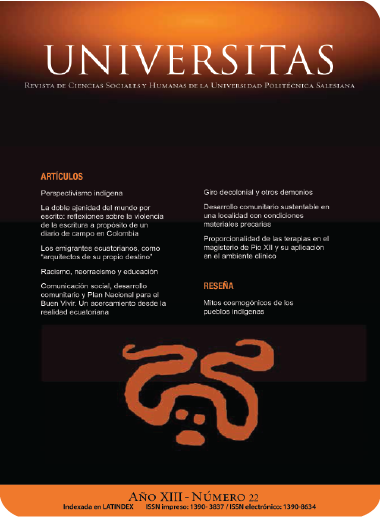
Main Article Content
Abstract
The core of perspectivism –as the key assertion underlying this work– claims that social movements construct their own reality from their principles and program, and the resulting reality and discourses concern the set of everything that exists, from nature to technology including those strictly social elements. This view of perspectivism, however, will constitute a limited novelty, already seen in other processes. It is important to add –what is fundamental, that which is its essence in the strategic sense of the word– that the construction of such ontological perspective –and no only cognitive– is based on “devouring” the other culture, and the other civilization, with which it is confronted. Only then it will have a full sense of the diverse components of perspectivism that are analyzed here as structuring elements for social movements: performativity –that has been mentioned before– vincularity and aspectuality.
Therefore, the central thesis is that when indigenous people live and narrate their experiences from their own perspective, they are not only representing themselves, but also effectively creating their cultures; they allow the emergence and the continuity of their ways of life. In this sense we move pass the thesis of Jose SanchezPraga, to move from recognition to the constitution of indigenous communities.
Article Details
Universitas-XXI Journal aligns with the principles of open access and academic collaboration by adopting the Creative Commons Attribution-NonCommercial-ShareAlike 4.0 International License (CC BY-NC-SA 4.0). This license ensures that published content can be used and shared widely under the following conditions:
Attribution: Authors and the journal must be appropriately credited as the original creators of the content, with full reference and a link to the publication provided.
Non-commercial use: Content may not be used for commercial purposes, preserving its academic and educational intent.
ShareAlike: Derivative works must be distributed under the same terms as this license, promoting the creation of accessible and equitable knowledge.
By implementing this license, the Universitas-XXI Journal strengthens its commitment to disseminating high-quality research, providing free access to knowledge, and fostering a collaborative environment among researchers, educators, and students worldwide.
This decision reflects core values of responsibility, ethics, and transparency in academia, ensuring that intellectual contributions serve as a foundation for new research and projects while respecting the rights of authors and the scientific community.
For more information about this license, please visit the following link: https://creativecommons.org/licenses/by-nc-sa/4.0/"