

Citizen participation and open government in the digital age: an AI perspective
Article Sidebar
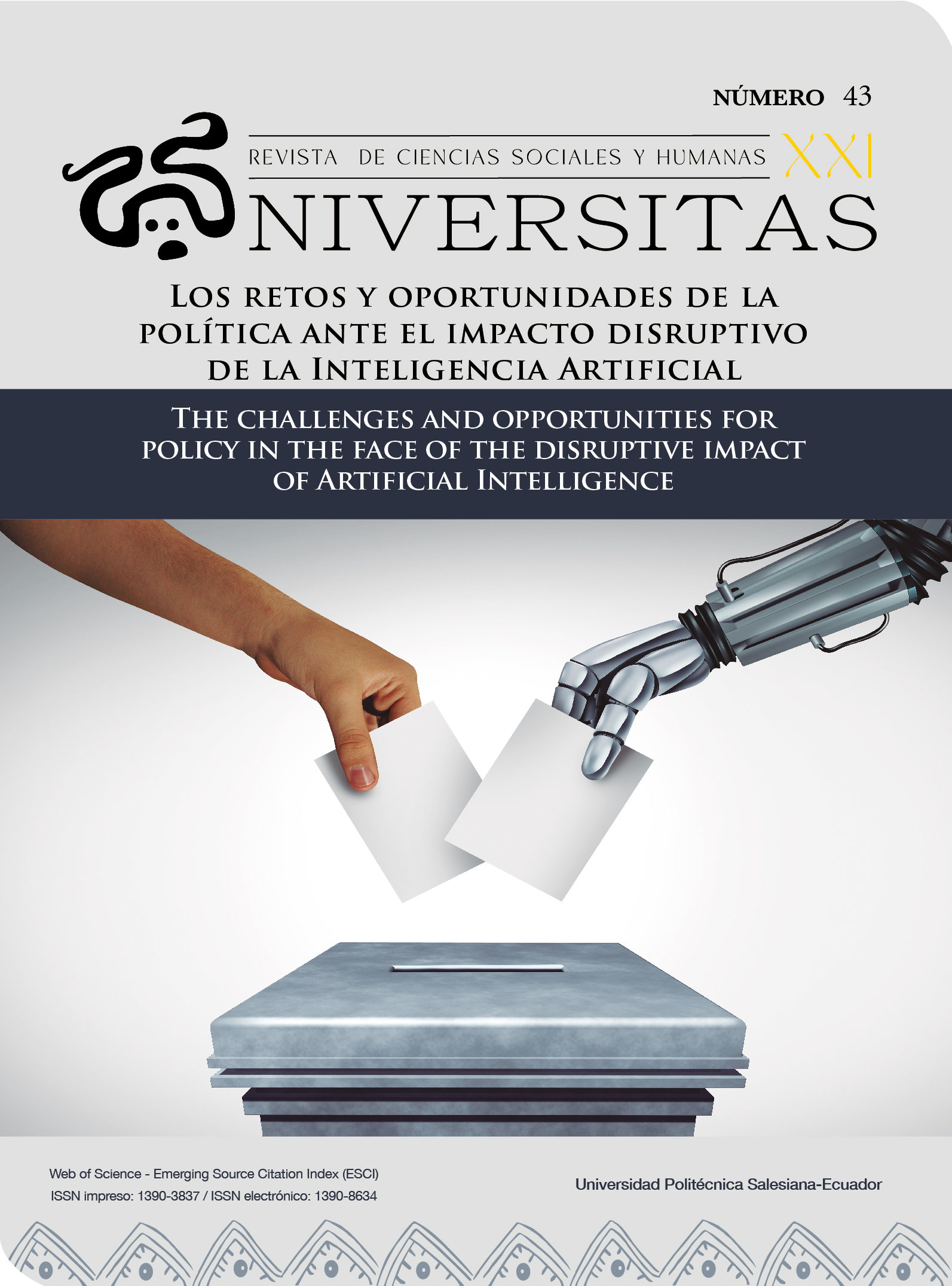
Main Article Content
Abstract
The incorporation of technological tools into people’s lives has generated changes, both in their daily activities (such as working, studying, obtaining information, entertaining, shopping, etc.) and in their forms of social interaction with other actors, such as with the State (its character as governed people). Thus, such tools (the internet, big data, artificial intelligence, etc.) determine—in part—the form of interaction between those governed and those who govern and are used as strategies to streamline processes and service administration, while maintaining democratic and open government principles.
Currently, within these tools, Artificial Intelligence represents a paradigm similar to that of the internet (at the time of its emergence and rise) due to the implications it can have on the way we govern. However, how does AI impact participation and governance? Thus, this paper aims to analyze and explain the transformation of citizen participation and open government through the use of new information and communication technologies (such as AI). It employs a qualitative documentary approach based on a review of specialized literature and statistical data. It establishes that the use of AI in government and citizen participation represents potential opportunities, but also challenges and risks, as its changes will continue to be constant.
Article Details
Universitas-XXI Journal aligns with the principles of open access and academic collaboration by adopting the Creative Commons Attribution-NonCommercial-ShareAlike 4.0 International License (CC BY-NC-SA 4.0). This license ensures that published content can be used and shared widely under the following conditions:
Attribution: Authors and the journal must be appropriately credited as the original creators of the content, with full reference and a link to the publication provided.
Non-commercial use: Content may not be used for commercial purposes, preserving its academic and educational intent.
ShareAlike: Derivative works must be distributed under the same terms as this license, promoting the creation of accessible and equitable knowledge.
By implementing this license, the Universitas-XXI Journal strengthens its commitment to disseminating high-quality research, providing free access to knowledge, and fostering a collaborative environment among researchers, educators, and students worldwide.
This decision reflects core values of responsibility, ethics, and transparency in academia, ensuring that intellectual contributions serve as a foundation for new research and projects while respecting the rights of authors and the scientific community.
For more information about this license, please visit the following link: https://creativecommons.org/licenses/by-nc-sa/4.0/"
References
Aluja, T. (2001). La minería de datos, entre la estadística y la inteligencia artificial. Qüestiió, 25(3), 479-489. https://bit.ly/3IJjUye
América Digital. (2024, marzo 5). Conoce e-Estonia, el gobierno más digitalizado del mundo. https://bit.ly/3UrIAOo
Arnstein, S. R. (1969). A ladder of citizen participation. Journal of the American Institute of Planners, 35(4), 216-224. https://bit.ly/45hKCqv
BBC News Mundo. (2023). Las 3 etapas de la IA, en cuál estamos y por qué muchos piensan que la tercera puede ser fatal. https://bit.ly/3GR2Fus
Benoit, K. (2024). AI and Data Science for Public Policy. LSE Public Policy Review, LSE Public Policy Review,3(3). https://doi.org/10.31389/lseppr.115
Bravo, F. A. (2024, 19 de noviembre). Inteligencia Artificial: Definición, Evolución, Regulación e impacto (parte I). Blog jurídico-Tech. Universidad Externado de Colombia. https://bit.ly/3GR2Fus
Bunge, M. (2002). Ser, Saber, Hacer. Editorial Paidós.
Castillo Aucancela, A. M. (2021). La era del big data y open data en la administración pública. Revista Eurolatinoamericana de Derecho Administrativo, 8(1), 61-76. https://doi.org/10.14409/redoeda.v8i1.9520
Centro de Investigación y Docencia Económicas, A. C. (CIDE) (2025a). Antígena - Algoritmos CIDE. https://bit.ly/4eZU6Ke
Centro de Investigación y Docencia Económicas, A. C. (CIDE) (2025b). Esperanza - Algoritmos CIDE. https://bit.ly/46Yeae1
Centro de Investigación y Docencia Económicas, A. C. (CIDE) (2025c). Identificación de mantos acuíferos - Algoritmos CIDE. https://bit.ly/4kOzNB3
Centro de Investigación y Docencia Económicas, A. C. (CIDE) (2025d). Mujer Segura - Algoritmos CIDE. https://bit.ly/4kRsQPo
Colomer, J. M. (2006). Grandes imperios, pequeñas naciones. Editorial Anagrama.
Corona, J. (2016a). Apuntes sobre métodos de investigación. Medisur, 14(1). https://bit.ly/4f6k7ru
Cortés Olivo, D. (2019). La incorporación de la inteligencia artificial en el poder público. La política en el mundo inteligente. Revista Conjeturas Sociológicas, 7(19), 1-21. https://bit.ly/45i0klq
DataReportal (2024, 23 de febrero). Reporte 2024 sobre el entorno digital en México. https://bit.ly/417lqAu
De la Garza, D. J. y Gómez, C. (2024). Inteligencia Artificial y big data: nuevos paradigmas de la Comunicación Política y la Gobernanza Digital. Más Poder Local, 56(56), 9–26. https://doi.org/10.56151/maspoderlocal.214
Diario Oficial de la Federación (2021). Acuerdo por el que se expide la Estrategia Digital Nacional 2021-2024. https://bit.ly/44JaQlN
Downie, A. y O´Brien, Keith (2024). ¿Qué es la IA en el gobierno? IBM. https://bit.ly/46nezqn
Fajardo, E. y Serrano, H. S. (2022). Redes sociales y construcción de la ciudadanía digital. Revista Boletín Redipe, 11(9), 157-171. https://doi.org/10.36260/rbr.v11i9.1888
Gil, E. (2016). Big data, privacidad y protección de datos. Agencia Española de Protección de Datos. https://bit.ly/3IZrPaI
Gobierno de México (2025). Plan Nacional de Desarrollo 2025-2030. https://bit.ly/45o0A1t
Guadarrama, A. (2025). Estrategia de Política Digital en el Estado de México: avances y retos. Revista IAPEM, 119, 101-122. https://bit.ly/4m61Dtn
iap2. (2025). Valores Fundamentales, Ética, Espectro – Los 3 Pilares de la Participación Pública - Asociación Internacional para la Participación Pública. https://bit.ly/414a1l3
Instituto Nacional de Estadística y Geografía (INEGI) (2020). Censo Nacional de Gobierno, Seguridad Pública y Sistema Penitenciario Estatales 2020. https://bit.ly/3IYPjgb
Instituto Nacional de Estadística y Geografía (INEGI) (2023). Encuesta Nacional de Calidad e Impacto Gubernamental ENCIG - 2023. https://bit.ly/3UuUBm4
López de Mántaras, R. y Meseguer, P. (2017). ¿Qué sabemos de? Inteligencia Artificial. CSIC Consejo Superior de Investigaciones Científicas. https://bit.ly/3TQKg3R
Macías Ibarra, G. A. yBaca Morales, A. (2022). Gobierno electrónico o gobierno abierto en México: entre el instrumento y un nuevo modelo de gestión pública. Revista Mexicana de Análisis Político y Administración Pública, 11(21), 53-80. https://doi.org/10.15174/remap.v11i21.378
Malik, P., Kavita, D. y Singal, K. (2020). Ai initiatives by indian government: journey towards becoming global technology leader. Journal of Critical Reviews, 4921-4930. https://bit.ly/4f76Sab
Mariñez Navarro, F. y Valenzuela Mendoza, R. E. (2013). Gobierno abierto: ¿Más informaciones? ¿Más gobierno? ¿Más sociedad? ¿En qué consiste? Propuestas para los gobiernos locales. (Primera). Miguel Ángel Porrúa.
Martínez Devia, A. (2019). La inteligencia artificial, el big data y la era digital: ¿una amenaza para los datos personales? Revista La Propiedad Inmaterial, 27, 5-23. https://doi.org/10.18601/16571959.n27.01.
Nebrija. (s/f). Introducción a la Inteligencia Introducción a la Inteligencia Artificial. Universidad de Nebrija. https://bit.ly/416YDEY
Newman, V. y Ángel, M. P. (2019). Rendición de cuentas de Google y otros negocios en Colombia: la protección de datos personales en la era digital. Bogotá: Centro de Estudios de Derecho, Justicia y Sociedad, Dejusticia.
Olivé, L. (2014). Hacia una sociedad del conocimiento en el México multicultural. https://bit.ly/4mceP00
Ordóñez, J. y Martínez Mejía, M. N. (2024). Reflexiones en torno al cosmopolitismo desde una perspectiva democrática para la defensa de una ciudadanía global. Boletín Mexicano de Derecho Comparado, 57(170), 235-260. https://doi.org/10.22201/iij.24484873e.2024.170
Petrone, P. (2023). Inteligencia artificial y redes neuronales artificiales. Revista Colombiana de Cirugia, 38(3), 407-412. https://doi.org/10.30944/20117582.2342
Rabotnikof, N. (2000). “Público-Privado”. En Léxico de la política (pp. 604-607). Fondo de Cultura Económica.
Ravel Cuevas, D. P. (2022). “Presentación”. En Democracia y redes sociales (pp. 7-12). INE.
Richard, M. (2010). Evolution of an On-line Education Community of Practice. En Renninger y Shumar (eds.), Building virtual communities: Learning change in cyberspace (pp. 129-158).
Serrano Rodríguez, A. (2015). La participación ciudadana en México. Estudios Políticos, novena época (34), 93-116. https://bit.ly/3TU6L7X
Statista. (2025). Internet and social media users in the world 2025. https://bit.ly/44KWiC7
Tribunal de Contas Da União (TCU) (2024). El TCU es la única institución que hace un uso avanzado de la inteligencia artificial generativa, según la OCDE. https://bit.ly/4nYAwm1
Tribunal de Contas Da União (TCU) (2024). El TCU es la única institución que hace un uso avanzado de la inteligencia artificial generativa, según la OCDE. https://bit.ly/4nYAwm1