

Relationship between the female management profile, market orientation and organizational performance. Validation of a measuring instrument
Article Sidebar
Main Article Content
Abstract
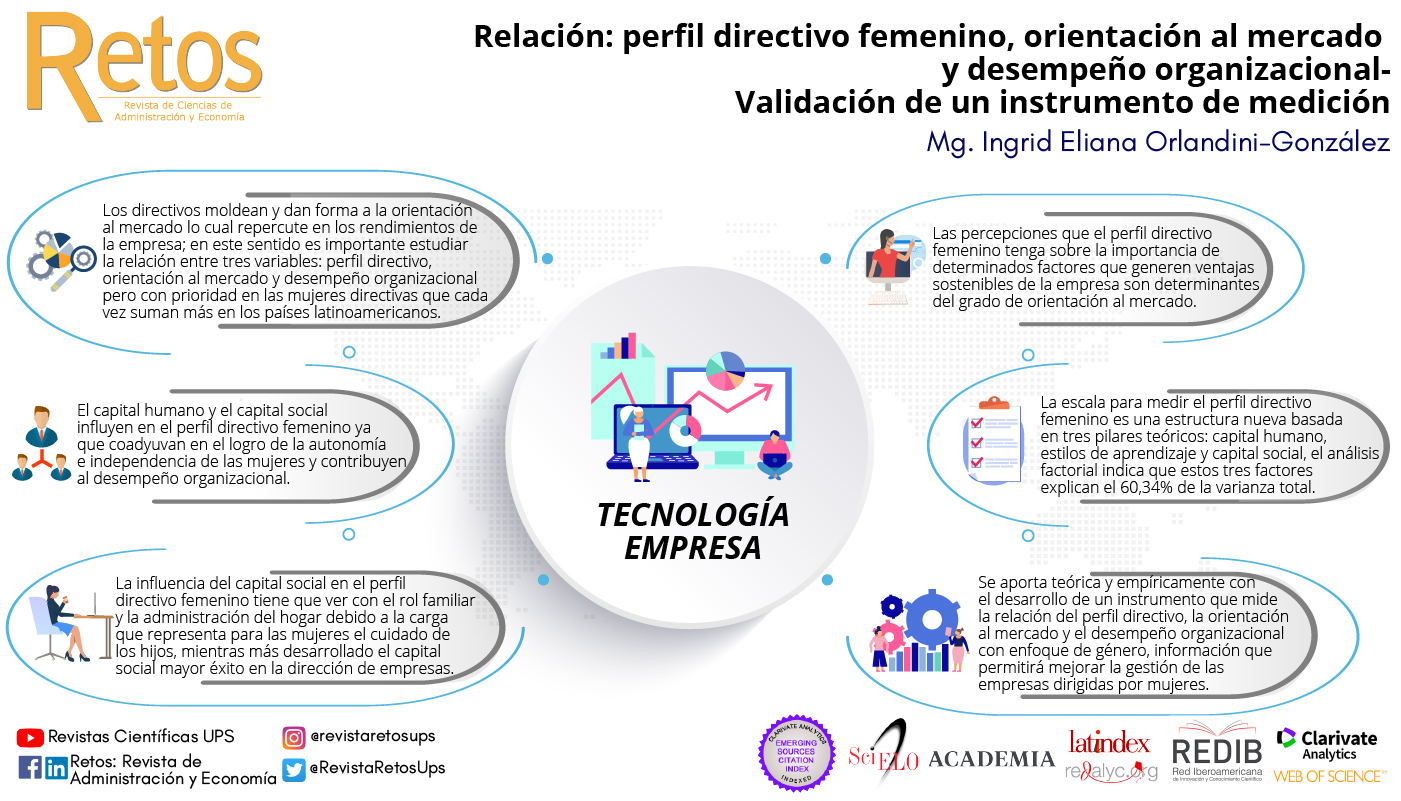
The management profile with a gender perspective has been studied considering the sociodemographic characteristics of women, analyzing the competences and abilities or from an entrepreneurial orientation approach; however, few studies have delved into the explanation of constructs that condition the female managerial profile, such as human capital and social capital. Even less is explained the relationship of this profile with variables such as market orientation and organizational performance. For this reason, this paper aims to demonstrate the results of the development and validation of an instrument for measuring the relationship of three variables. For this purpose, a quantitative methodology was used, through a non-experimental design, a census of 190 female managers was carried out in hotel companies in the cities of Sucre and Potosí in southern Bolivia. A Likert scale survey was applied with 41 items; the data were processed through an exploratory factor analysis and a reliability analysis in SPSS version 22 software. The results obtained demonstrated the theoretical and empirical validity of the instrument; In this way, an adequate instrument was obtained to get information on the three variables and the relationship between the female management profile, market orientation and organizational performance was validated.
Article Details
Authorship: The list of authors signing must include only those people who have contributed intellectually to the development of the work. Collaboration in the collection of data is not, by itself, a sufficient criterion of authorship. "Retos" declines any responsibility for possible conflicts arising from the authorship of the works that are published.
Copyright: The Salesian Polytechnic University preserves the copyrights of the published articles, and favors and allows their reuse under the Creative Commons Attribution-NonCommercial-ShareAlike 3.0 Ecuador license. They may be copied, used, disseminated, transmitted and publicly displayed, provided that: i) the authorship and the original source of their publication (journal, editorial and work URL) are cited; (Ii) are not used for commercial purposes; Iii) mention the existence and specifications of this license.
References
ALDANA-BERNAL, J. C., Y BERNAL-TORRES, C. A. (2019). El Capital Social y la Integración de Procesos en la Gestión de las Cadenas de Abastecimiento en el Sector Real en Colombia. Información tecnológica, 30(5), 249-262.
ALSOS, G. A., Y LJUNGGREN, E. (2017). The role of gender in entrepreneur–investor relationships: A signaling theory approach. Entrepreneurship Theory and Practice, 41(4), 567-590.
ÁLVAREZ, C., NOGUERA, M., Y URBANO, D. (2017). Condicionantes del entorno y emprendimiento femenino. Un estudio cuantitativo en España. Economía industrial, No. 383, 43-52.
ARIAS, M. L., JARAMILLO, C. M., Y CALDERÓN, H. G. (2014). Análisis y propuesta de un modelo pedagógico para el aprendizaje organizacional: Central Hidroeléctrica de Caldas-CHEC. Entramado, 10(2), 112-127.
BAÙ, M., SIEGER, P., EDDLESTON, K. A., Y CHIRICO, F. (2017). Fail but Try Again? The Effects of Age, Gender, and Multiple-Owner Experience on Failed Entrepreneurs' Reentry. Entrepreneurship: Theory & Practice, 41(6), 909-941. doi:10.1111/etap.12233.
BEHRENS, J., Y PATZELT, H. (2016). Corporate Entrepreneurship Managers' Project Terminations: Integrating Portfolio?Level, Individual?Level, and Firm?Level Effects. Entrepreneurship Theory and Practice, 40(4), 815-842.
BERKHOUT, P., HARTOG, J., Y PRAAG, M. (2016). Entrepreneurship and Financial Incentives of Return, Risk, and Skew. Entrepreneurship: Theory & Practice, 40(2), 249-268.
BIZRI, R. M. (2017). Refugee-entrepreneurship: a social capital perspective. Entrepreneurship & Regional Development, 29:9-10, 847-868.
BUCKTOWAR, R., KOCAK, A., Y PADACHI, K. (2015). Entrepreneurial Orientation, Market Orientation And Networking: Impact On Innovation And Firm Performance. Journal Of Developmental Entrepreneurship, 20(4).
CARTER, N., BRUSH, C., GREENE, P., GATEWOOD, E., Y HART, M. (2003). Women entrepreneurs who break through to equity financing: the influence of human, social and financial capital. Venture Capital: an international journal of entrepreneurial finance, 5(1), 1-28.
DARMADI, S. (2013). Do women in top management affect firm performance? Evidence from Indonesia. . Corporate Governance: The international journal of business in society, 13(3), 288-304.
DE LA FUENTE, F. S. (2011). Análisis factorial. Madrid: Universidad Autónoma de Madrid.
DE LA MORA, A. E., ALARCÓN, G., Y LÓPEZ, J. F. (2020). Capital social y disponibilidad de mano de obra calificada como impulsores de la competitividad de las empresas que forman parte de clústeres aeroespaciales. El caso de México. Información tecnológica, 31(1) https://dx.doi.org/10.4067/S0718-07642020000100171, 171-182.
ECHEVERRI, O. J. (2015). Perfil competitivo de los gerentes de las PYMES de Manizales en los sectores de inyección de plástico y metalmecánica. Manizales, Caldas: Universidad Pontificia Bolivariana De Medellín Extensión Universidad Católica De Manizales.
FLABBI, L., MACIS, M., MORO, A., Y SCHIVARDI, F. (2014). Do female executives make a difference? The impact of female leadership on gender gaps and firm performance. National Bureau of Economic Research. DP10228.
FLORES, N. A., OJEDA, V. F., LEE KIM, H., Y RAMÍREZ, C. E. (2016). Impacto de la Orientación Emprendedora en el Desempeño Empresarial: El caso de las empresas de Software en Yucatán, México. FAEDPYME International Review // Vol. 5 N° 9 doi:10.15558/fir.v5i9.117, 25-34.
GÓMEZ, R. J., VILLARREAL, S. M., Y VILLARREAL, S. F. (2015). Las incapacidades de aprendizaje organizacional y su relación con los estilos de aprendizaje organizacional en la Mipyme. Contaduría y administración, 60(3), 686-702.
HAMBRICK, D. C., Y MASON, P. A. (1984). Upper echelons: The organization as a reflection of its top managers. Academy of management review, 9(2) http://links.stor.org/sici?sii?sici0363-7425%28198404%299%, 193-206.
HOBSON, K., Y ESSEX, S. (2001). Sustainable tourism: A view from accommodation businesses. Service Industries Journal, 21(4), 133-146.
HUGGINS, R., PROKOP, D., Y THOMPSON, P. (2017). Entrepreneurship and the determinants of firm survival within regions: human capital, growth motivation and locational conditions. Entrepreneurship & Regional Development, 29:3-4, 357-389.
JAWORSKI, B., Y KOHLI, A. (1993). Market Orientation: Antecedents and Consequences. Journal of Marketing, 57 (3), 53-70.
KANG, M. (2010). Measuring social media credibility: A study on a measure of blog credibility. Institute for Public Relations, 59-68.
KANTIS, H., ANGELELLI, P., Y GATTO, F. (2001). Nuevos emprendimientos y emprendedores: de qué depende su creación y supervivencia. Explorando el caso argentino. UNGS-LITTEC, DT, 2.
KHEDHAOURIA, A., GUR?U, C., Y TORRÈS, O. (2015). Creativity, self-efficacy, and small-firm performance: the mediating role of entrepreneurial orientation. Small Business Economics, 44(3). https://doi.org/10.1007/s11187-014-9608-y, 485-504.
KOHLI, A. K., Y JAWORSKI, B. J. (1990). Market orientation: the construct, research propositions, and managerial implications. The Journal of Marketing, 1-18.
LEE, D. Y., Y TSANG, E. W. (2001). The effects of entrepreneurial personality, background and network activities on venture growth. Journal of management studies, 38(4), 583-602.
LIÑÁN, F., Y SANTOS, F. (2006). La influencia del capital social sobre los empresarios potenciales. Estudios de Economía Aplicada, Vol. 24, 459-489.
LOJPUR, A., ALEKSI?, A., VLAHOVI?, S., BACH, M. P., Y PEKOVI?, S. (2015). Examining determinants of leadership style among montenegrin managers. Naše gospodarstvo/Our economy, 61(1), 13-24.
LOMBERG, C., URBIG, D., STÖCKMANN, C., MARINO, L. D., Y DICKSON, P. H. (2017). Entrepreneurial Orientation: The Dimensions' Shared Effects in Explaining Firm Performance. Entrepreneurship: Theory & Practice, 41(6), 973-998. doi:10.1111/etap.12237.
LU, J., Y HERREMANS, I. (2019). Board gender diversity and environmental performance: An industries perspective. Bus Strat Env.1–16. https://doi.org/10.1002/, 1-16.
MATTEO, C. A. (2012). REVISTA VENEZOLANA DE ESTUDIOS DE LA MUJER. VOL. 17/N°38, 39-66.
MCKELVIE, A., WIKLUND, J., Y BRATTSTRÖM, A. (2018). Externally acquired or internally generated? Knowledge development and perceived environmental dynamism in new venture innovation. Entrepreneurship Theory and Practice, 42(1) https://doi.org/10.1177/1042258717747056, 24-46.
MILLÁN, J. M., CONGREGADO, E., Y ROMÁN, C. (2014). Entrepreneurship persistence with and without personnel: The role of human capital and previous unemployment. International Entrepreneurship and Management Journal, 10(1), 187-206.
MORALES, C. C. (2011). Perfil De La Mujer En La Alta Dirección En Colombia. Bogotá: Universidad Del Rosario.
MORALES, G. S., Y PINEDA, Z. U. (2015). Factores del perfil del emprendedor y de la gestión del servicio que inciden en la supervivencia empresarial: casos del oriente de Antioquia (Colombia). Morales-Gualdrón, S. T., & Pineda Zapata, U. (2015). Factores del perfil del emprendedor y de la gestión del serviPensamiento & Gestión, (38), 176-207.
MORRIS, M. H., MIYASAKI, N. N., WATTERS, C. E., Y COOMBES, S. M. (2006). The dilemma of growth: Understanding venture size choices of women entrepreneurs. Journal of Small Business Management, 44(2), 221-244.
NARVER, J. C., Y SLATER, S. F. (1990). The effect of a market orientation on business profitability. The Journal of marketing, 20-35.
ORLANDINI, I. E. (2020). El perfil directivo femenino y su relación con la orientación al mercado y el desempeño organizacional. Información Tecnológica, 31(3)., 241-248.
OSPINA, J. M., Y PÉREZ, G. (2013). A Measure of Market Orientation: Development and Validation in a Different Cultural Context. Innovar, 23(49), 41-49.
SHRADER, C. B., BLACKBURN, V. B., Y ILES, P. (1997). Women in management and firm financial performance: An exploratory study. Journal of managerial issues, 355-372.
SMITH, N., SMITH, V., Y VERNER, M. (2006). Do women in top management affect firm performance? A panel study of 2,500 Danish firms. International Journal of productivity and Performance management, 55(7), 569-593.
TORREJÓN, M. C. (2016). Perfiles competenciales y éxito emprendedor. Implicaciones para los inversores en Capital Riesgo. Revista Española de Capital Riesgo N.º 2, 27-47.
VECIANA, J. M., APONTE, M., Y URBANO, D. (2005). University students’ attitudes towards entrepreneurship: A two countries comparison. . The International Entrepreneurship and Management Journal, 1(2), 165-182.
VENTURA, F. R., Y QUERO, G. M. (2012). Factores explicativos de la intención de emprender en la mujer. Aspectos diferenciales en la población universitaria según la variable género. Cuadernos de gestión, 127-149.
WEBSTER, J. F. (1988). The rediscovery of the marketing concept. Business horizons, 31(3), 29-39.
WIKLUND, J., DAVIDSSON, P., AUDRETSCH, D. B., Y KARLSSON, C. (2011). The future of entrepreneurship research. Entrepreneurship Theory and Practice, 35(1), 1-9.
ULLMAN, J. B. Structural equation modeling: Reviewing the basics and moving forward. Journal of personality assessment, 87(1), 35-50 (2006).
YNZUNZA, C. C., Y IZAR, L. J. (2013). Estrategia, Orientación al Mercado y Desempeño Organizacional. Conciencia Tecnológica, 5-11.