

Financial anxiety in Mexican corporate government:effect of self-efficacy and neuroticism
Article Sidebar
Main Article Content
Abstract
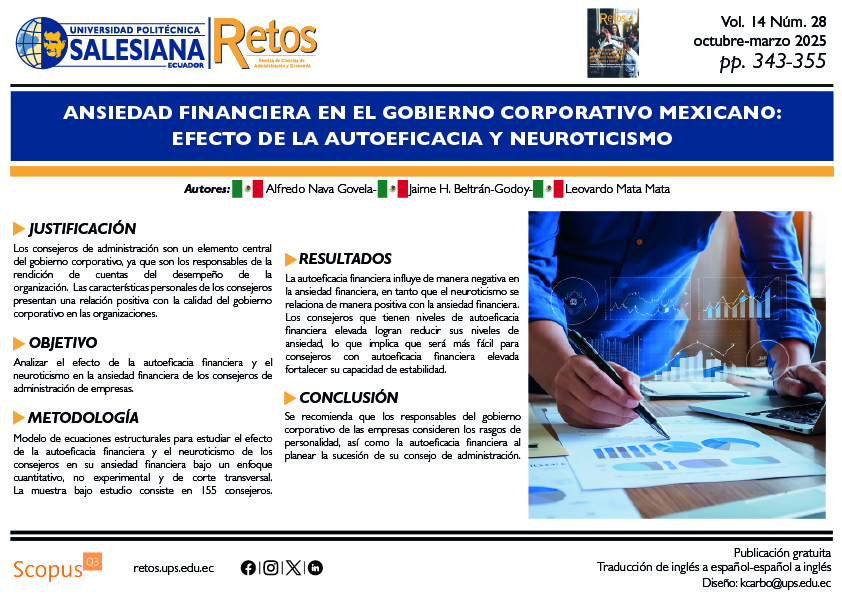
financial anxiety affects board members in their judgment concerning strategic decisions for their organizations. Both, financial self-effi-
cacy and neuroticism bear on the financial anxiety of board members. By applying a structural equation model, this paper analyzes the effect of
both factors on the financial anxiety of board members in public, private, and non-profit corporations in Mexico. The approach of the structural
equation model is quantitative, non-experimental, and cross-sectional; and is based on a sample of 155 board members of Mexican institutions.
The results show that financial self-efficacy affects negatively financial anxiety; whereas higher degrees of neuroticism affect positively financial
anxiety. Following these results, it is advisable to consider these personality traits as relevant criteria for the selection of board members in Mexican
institutions. Corporate governance policies and practices should also be developed to ameliorate the effect of neuroticism and incentivize the effect
of financial self-efficacy in the judgments of board members regarding organizational strategy. The methodology of this study is useful for boards
in institutions of other countries.
Article Details

This work is licensed under a Creative Commons Attribution-NonCommercial-ShareAlike 4.0 International License.
Authorship: The list of authors signing must include only those people who have contributed intellectually to the development of the work. Collaboration in the collection of data is not, by itself, a sufficient criterion of authorship. "Retos" declines any responsibility for possible conflicts arising from the authorship of the works that are published.
Copyright: The Salesian Polytechnic University preserves the copyrights of the published articles, and favors and allows their reuse under the Creative Commons Attribution-NonCommercial-ShareAlike 3.0 Ecuador license. They may be copied, used, disseminated, transmitted and publicly displayed, provided that: i) the authorship and the original source of their publication (journal, editorial and work URL) are cited; (Ii) are not used for commercial purposes; Iii) mention the existence and specifications of this license.
References
Acock, A. C. (2013). Discovering structural equation modeling using Stata. Stata Press Books.
Aidt, T. y Rauh, C. (2018). The Big Five personality traits and partisanship in England. Electoral Studies, 54, 1-21. https://doi.org/10.1016/j.electstud.2018.04.017
Amin, Q. A. y Farquhar, S. S. (2021). The relationship between corporate governance and firm financial performance: an empirical investigation of an emerging market. International Journal of Business Governance and Ethics, 15(2), 215-232. https://doi.org/10.1504/IJBGE.2021.113940
Archuleta, K. L., Dale, A. y Spann, S. M. (2013). College students and financial distress: Exploring debt, financial satisfaction, and financial anxiety. Journal of Financial Counseling and Planning, 24(2), 50-62. https://bit.ly/4g3ggeU
Bandura, A. y Locke, E. A. (2003). Negative self efficacy and goal effects revisited. Journal of applied psychology, 88(1), 87. https://doi.org/10.1037/0021-9010.88.1.87
Bezemer, P. J., Pugliese, A., Nicholson, G. y Zattoni, A. (2023). Toward a synthesis of the board strategy relationship: A literature review and future research agenda. Corporate Governance: an international review, 31(1), 178-197. https://doi.org/https://doi.org/10.1111/corg.12481
Borghans, L., Heckman, J. J., Golsteyn, B. H. y Meijers, H. (2009). Gender differences in risk aversion and ambiguity aversion. Journal of the European Economic Association, 7(2-3), 649-658. https://doi.org/10.1162/JEEA.2009.7.2-3.649
Charitou, A., Georgiou, I. y Soteriou, A. C. (2016). Corporate governance, board composition, director expertise, and value: The case of quality excellence. Multinational Finance Journal, 20(3), 181-236. https://doi.org/10.17578/20-3-1
Cueva Estrada, J., Sumba Nacipucha, N., Duarte Duarte, W. (2021). Marketing de contenidos y decisión de compra de los consumidores Generación Z en Ecuador. ECA Sinergia, 12(2), 25-37. Universidad Técnica de Manabí Ecuador. https://doi.org/10.33936/eca_sinergia.v12i2.3459
Croasmun, J. T. y Ostrom, L. (2011). Using likert-type scales in the social sciences. Journal of adult education, 40(1), 19-22. https://bit.ly/4cQU0lr
Dickson, T. y Mulligan, E. P. (2023). Financial anxiety, financial self efficacy, and general social supports: Reliability of assessments. Preimpresión; no ha sido revisada por una revista.
Ekinci, N. y Koc, H. (2023). Grit, general self efficacy, and life satisfaction: The mediating role of hope. Journal of Community Psychology, 51(3), 1288-1299.
https://doi.org/10.1002/jcop.22962
Fachrudin, K. A., Pirzada, K. e Iman, M. F. (2022). The role of financial behavior in mediating the influence of socioeconomic characteristics and neurotic personality traits on financial satisfaction. Cogent Business & Management, 9(1), 2080152. https://doi.org/10.1080/23311975.2022.2080152
Fahed Sreih, J. (2009). An exploratory study on a new corporate governance mechanism. Management Research News, 32(1), 50-61. https://doi.org/10.1108/01409170910922023
Farrell, L., Fry, T. R. L. y Risse, L. (2016). The significance of financial self-efficacy in explaining women s personal finance behavior. Journal of Economic Psychology, 54, 85-99. https://doi.org/10.1016/j.joep.2015.07.001
Gicnac, G., Gerrans, P. y Andersen, C. (2023). Financial literacy mediates the effect between verbal intelligence and financial anxiety. Personality and Individual Differences, 203. https://doi.org/10.1016/j.paid.2022.112025
Guenzel, M. y Malmendier, U. (2020). Behavioral corporate finance: The life cycle of a CEO career (No. w27635). National Bureau of Economic Research.
Hair Jr., J. F., Sarstedt, M., Hopkins, L. y Kuppelwieser, V. G. (2014). Partial least squares structural equation modeling (PLS-SEM): An emerging tool in business research. European business review, 26(2), 106-121. https://doi.org/10.1108/EBR-10-2013-0128
Hair, J. F. (2021). Reflections on SEM: An introspective, idiosyncratic journey to composite-based structural equation modeling. ACM SIGMIS Database: The DATABASE for Advances in Information Systems, 52(SI), 101-113. https://doi.org/10.1145/3505639.3505646
Hassan Kariri, H. D., Edrees Somaili, H., Hadi Omair, A., Mansour, M. E.-S. I. y Radwan, O. A. (2023). The impact of psychological capital on job satisfaction among employees with individuals social responsibility as a mediator. SAGE Open, 13(4). https://doi.org/10.1177/21582440231218263
Huerta-Soto, R., Ramírez-Asís, E., Norabuena Figueroa, R. y Valderrama Plasencia, L. (2023). Autoeficacia emprendedora y desempeño de micro y pequeñas empresas peruanas. Revista Venezolana de Gerencia, 28(102), 751-768. https://doi.org/10.52080/rvgluz.28.102.19
Ikizer, G., Kowal, M., Aldemir, I. D., Jeftic, A., Memisoglu-Sanli, A., Najmussaqib, A., Lacko, D., Eichel, K., Turk, F., Chrona, S., Ahmed, O., Rasmussen, J., Kumaga, R., Uddin, M., Reynoso-Alcántara, V., Pankowski, D. y Coll-Martín, T. (2022). Big Five traits predict stress and loneliness during the COVID 19 pandemic: Evidence for the role of neuroticism. Personality and individual differences, 190, 111531. https://doi.org/10.1016/j.paid.2022.111531
Lartey, S. A., Montgomery, C. L., Olson, J. K. y Cummings, G. G. (2023). Leadership self efficacy and nurses aspiration to leadership: An evolutionary concept analysis. International Journal of Nursing Studies, 143, 104496. https://doi.org/10.1016/j.ijnurstu.2023.104496
Lee, J. M., Rabbani, A. y Heo, W. (2023). Examining financial anxiety focusing on interactions between financial knowledge and financial self efficacy. Journal of Financial Therapy, 14(1), 2. https://doi.org/10.4148/1944-9771.1279
Lone, U. M. y Bhat, S. A. (2024). Impact of financial literacy on financial well being: a mediational role of financial self efficacy. Journal of Financial Services Marketing, 29(1), 122-137. https://doi.org/https://doi.org/10.1057/s41264-022-00183-8
Lown, J. M. (2011). Development and validation of a financial self efficacy scale. Journal of Financial Counseling and Planning, 22(2), 54. https://doi.org/10.1891/1052-3073.30.1.142
Mendenhall, W., Scheaffer, R. L. y Lyman Ott, R. (2006). Elementos de muestreo. Ediciones Paraninfo, SA.
Meza, E. (2023, 4 de septiembre). Mujeres ocupan sólo el 12% de los consejos de administración de las empresas más relevantes de México. El Economista, 10. https://bit.ly/3T8gYgY
Molins, F. y Serrano, M. Á. (2023). La relación entre el distrés psicológico derivado del COVID 19 y la aversión a las pérdidas es modulada por el rasgo de alexitimia. Retos Revista de Ciencias de la Administración y Economía, 13(25), 35-47. https://doi.org/10.17163/ret.n25.2023.03
Montford, W. y Goldsmith, R. E. (2015). How gender and financial self efficacy influence investment risk taking. International Journal of Consumer Studies, 40(1), 101-106. https://doi.org/10.1111/ijcs.12219
Novikova, I. A., Bychkova, P. A., Novikov, A. L. y Shlyakhta, D. A. (2022). Personality traits and academic motivation as predictors of attitudes towards digital educational technologies among Russian university students. RUDN Journal of Psychology and Pedagogics, 19(4), 689-716. https://doi.org/10.1007/978-3-030-93715-7_20
Nyhus, E. K. y Webley, P. (2001). The role of personality in household saving and borrowing behaviour. European journal of personality, 15(S1), S85-S103. https://doi.org/10.1002/per.422
Rojas-Torres, L. (2020). Robustez de los índices de ajuste del análisis factorial confirmatorio a los valores extremos. Revista de matemática: teoría y aplicaciones, 27(2), 383-404. https://doi.org/10.15517/rmta.v27i2.33677
Ng, W. y Kang, S. H. (2022). Predictors of well being during the COVID 19 pandemic: The importance of financial satisfaction and neuroticism. Journal of Community Psychology, 50(7), 2771-2789. https://doi.org/10.1002/jcop.22795
Okoye, N. (2013). The personality of company directors and behavioural risks in corporate governance: bridging the unidentified gap. International Journal of Disclosure and Governance, 10, 261-286. https://doi.org/10.1057/jdg.2013.17
Paulus, D. J., Vanwoerden, S., Norton, P. J. y Sharp, C. (2016). From neuroticism to anxiety: Examining unique contributions of three transdiagnostic vulnerability factors. Personality and Individual Differences, 94, 38-43. https://doi.org/https://doi.org/10.1016/j.paid.2016.01.012
Pérez-Martínez, A. y Rodríguez-Fernández, A. (2022). Economía conductual: su influencia en la predicción de resultados deportivos. Retos Revista de Ciencias de la Administración y Economía, 12(23), 125-138. https://doi.org/10.17163/ret.n23.2022.08
Rocha, P. (2024). Cultural correlates of personality: a global perspective with insights from 22 nations. Cross-Cultural Research, 0(0). https://doi.org/10.1177/10693971241264363
Rudi, J. H., Serido, J. y Shim, S. (2020). Unidirectional and bidirectional relationships between financial parenting and financial self efficacy: Does student loan status matter? Journal of Family Psychology, 34(8), 949. https://doi.org/10.1037/fam0000658
Sánchez-Anguita Muñoz, Á., Pulido López, M. F. y Conde Vieitez, J. (2018). Self efficacy and anxiety in female hospital healthcare workers. Ansiedad y Estrés, 24(2-3), 99-104. https://doi.org/https://doi.org/10.1016/j.anyes.2018.08.002
Shin, J., Lee, H. J., Park, H., Hong, Y., Song, Y. K., Yoon, D. U. y Oh, S. (2023). Perfectionism, test anxiety, and neuroticism determines high academic performance: a cross-sectional study. BMC psychology, 11(1), 410. https://doi.org/10.1186/s40359-023-01369-y
Shank, T., Paul Hill, R. y Stang, J. (2013). Do investors benefit from good corporate governance? Corporate Governance: The international journal of business in society, 13(4), 384-396. https://doi.org/10.1108/CG-03-2010-0027
Shi, D., Lee, T. y Maydeu-Olivares, A. (2019). Understanding the model size effect on SEM fit indices. Educational and psychological measurement, 79(2), 310-334. https://doi.org/10.1177/0013164418783530
Shrestha, N. (2021). Factor analysis as a tool for survey analysis. American Journal of Applied Mathematics and Statistics, 9(1), 4-11. https://doi.org/10.12691/ajams-9-1-2
Soto, C. J. y John, O. P. (2017). The next Big Five Inventory (BFI-2): Developing and assessing a hierarchical model with 15 facets to enhance bandwidth, fidelity, and predictive power. Journal of personality and social psychology, 113(1), 117. https://doi.org/10.1037/pspp0000096
Toledo-Fernández, A., Pérez-Matus, S. y Villalobos-Gallegos, L. (2022). The Big Five Inventory-2: Confirmatory factor analysis and latent profiles in a Mexican sample. Suma Psicológica, 29(2), 119-128. https://doi.org/10.14349/sumapsi.2022.v29.n2.4
Vinograd, M., Williams, A., Sun, M., Bobova, L., Wolitzky-Taylor, K. B., Vrshek-Schallhorn, S., Mineka, S., Zinbarg, R. E. y Craske, M. G. (2020). Neuroticism and Interpretive Bias as Risk Factors for Anxiety and Depression. Clinical Psychological Science, 8(4), 641-656. https://doi.org/10.1177/2167702620906145
Woods, C. M. y Edwards, M. C. (2007). 12 factor analysis and related methods. Handbook of statistics, 27, 367-394. https://doi.org/10.1016/S0169-7161(07)27012-9