

Human resource analytics for change and happiness management
Article Sidebar
Main Article Content
Abstract
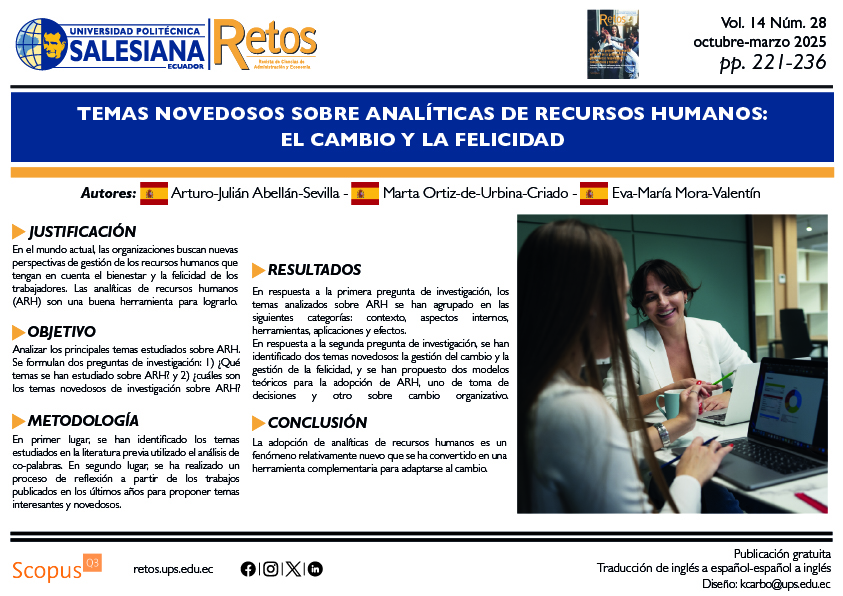
owadays, companies are in a constant process of change, and they need to be flexible and innovative and take care of the well-being of their employees. Events such as the pandemic COVID19 have highlighted the need to consider new perspectives to address Human Resources Management. Human Resource Analytics (HRA) are tools that help to understand and implement better Human Resources policies and strategies. However, many of the literature reviews on HRA only analyse what has been published up to 2021 and, moreover, do not usually consider
different time periods for the identification of the issues studied, which would help to better understand the evolution of the issues. Therefore,
the aim of this paper is to present a structured and period-based picture of the main Human Resource Analytics themes studied and to propose
new themes for future research. The results obtained have been grouped into the following thematic categories: context, internal aspects, tools,
applications and effects. From these results, two novel themes have been identified: change management and happiness management. And two
theoretical models for the adoption of HRA have been proposed, one on decision-making and one on organisational change. These models can
serve as a starting point for future research and have a direct application for decision making in companies.
Article Details

This work is licensed under a Creative Commons Attribution-NonCommercial-ShareAlike 4.0 International License.
Authorship: The list of authors signing must include only those people who have contributed intellectually to the development of the work. Collaboration in the collection of data is not, by itself, a sufficient criterion of authorship. "Retos" declines any responsibility for possible conflicts arising from the authorship of the works that are published.
Copyright: The Salesian Polytechnic University preserves the copyrights of the published articles, and favors and allows their reuse under the Creative Commons Attribution-NonCommercial-ShareAlike 3.0 Ecuador license. They may be copied, used, disseminated, transmitted and publicly displayed, provided that: i) the authorship and the original source of their publication (journal, editorial and work URL) are cited; (Ii) are not used for commercial purposes; Iii) mention the existence and specifications of this license.
References
Abellán-Sevilla, A.-J. y Ortiz-de-Urbina-Criado, M. (2023). Smart human resource analytics for happiness management. Journal of Management Development, 42(6), 514-525. https://doi.org/10.1108/JMD-03-2023-0064
Al Ariss, A., Cascio, W.F. y Paauwe, J. (2014), Talent management: current theories and future research directions. Journal of World Business, 49(2), 173-179. https://doi.org/10.1016/j.jwb.2013.11.001
Álvarez-Gutiérrez, F.J., Stone, D.L., Castaño, A.M. and García-Izquierdo, A.L. (2022). Human resources analytics: a systematic review from a sustainable management approach. Journal of Work and Organizational Psychology, 38(3), 129-147. https://doi.org/10.5093/jwop2022a18
Arora, M., Prakash, A., Dixit, S., Mittal, A. y Singh, S. (2023). A critical review of HR analytics: visualization and bibliometric analysis approach. Information Discovery and Delivery, 51(3), 267-282. https://doi.org/10.1108/IDD-05-2022-0038
Ben-Gal, H.C. (2019). An ROI-based review of HR analytics: practical implementation tools. Personnel Review, 48(6), 1429-1448. https://doi.org/10.1108/PR-11-2017-0362
Brandt, P.M. y Herzberg, P.Y. (2020). Is a cover letter still needed? Using LIWC to predict application success”, International Journal of Selection and Assessment, 28(4), 417-429. https://doi.org/10.1111/ijsa.12299
Chang, Y.-L. y Ke, J. (2024). Socially responsible artificial intelligence empowered people analytics: a novel framework towards sustainability. Human Resource Development Review, 23(1), 88-120. https://doi.org/10.1177/15344843231200930
Chatterjee, S., Chaudhuri, R., Vrontis, D. y Siachou, E. (2021). Examining the dark side of human resource analytics: an empirical investigation using the privacy calculus approach. International Journal of Manpower, 43(1), 52-74. https://doi.org/10.1108/IJM-02-2021-0087
Cobo, M.J., López-Herrera, A.G., Herrera-Viedma, E. y Herrera, F. (2011). Science mapping software tools: review, analysis, and cooperative study among tools. Journal of the American Society for Information Science and Technology, 62(7), 1382-1402. https://doi.org/10.1002/asi.21525
Cobo, M.J., López-Herrera, A.G., Herrera-Viedma, E. y Herrera, F. (2012). SciMAT: a new science mapping analysis software tool. Journal of the American Society for Information Science and Technology, 63(8), 1609-1630. https://doi.org/10.1002/asi.22688
Cobo, M.J., Jürgens, B., Herrero-Solana, V., Martínez, M.A., y Herrera-Viedma, E. (2018). Industry 4.0: a perspective based on bibliometric analysis. Procedia Computer Science, 139, 364-371. https://doi.org/10.1016/j.procs.2018.10.278
Coolen, P., van den Heuvel, S., Van De Voorde, K. y Paauwe, J. (2023). Understanding the adoption and institutionalization of workforce analytics: A systematic literature review and research agenda. Human Resource Management Review, 33(4), 100985. https://doi.org/10.1016/j.hrmr.2023.100985
Coron, C. (2022). Quantifying human resource management: a literature review. Personnel Review, 51(4), 1386-1409. https://doi.org/10.1108/PR-05-2020-0322
Dahlbom, P., Siikanen, N., Sajasalo, P. y Jarvenpää, M. (2020). Big data and HR analytics in the digital era. Baltic Journal of Management, 15(1), 120-138. https://doi.org/10.1108/BJM-11-2018-0393
Díaz-García, G.A. Ortiz-de-Urbina-Criado, M. y Ravina-Ripoll, R. (2023). Happy leadership, now more than ever. International Journal of Happiness and Development, in press, https://doi.org/10.1504/IJHD.2023.10060264
Edwards, M.R., Charlwood, A., Guenole, N. y Marler, J. (2022). HR analytics: an emerging field finding its place in the world alongside simmering ethical challenges. Human Resource Management Journal, https://doi.org/10.1111/1748-8583.12435
Ellmer, M. y Reichel, A. (2021). Staying close to business: the role of epistemic alignment in rendering HR analytics outputs relevant to decision-makers. The International Journal of Human Resource Management, 32(12), 2622-2642. https://doi.org/10.1080/09585192.2021.1886148
Espegren, Y. y Hugosson, M. (2023). HR analytics-as-practice: a systematic literature review. Journal of Organizational Effectiveness: People and Performance, https://doi.org/10.1108/JOEPP-11-2022-0345
Falletta, S.V. y Combs, W.L. (2021). The HR analytics cycle: a seven- step process for building evidence-based and ethical HR analytics capabilities. Journal of Work-Applied Management, 13(1), 51-68. https://doi.org/10.1108/JWAM-03-2020-0020
Fernández, V. y Gallardo-Gallardo, E. (2021). Tackling the HR digitalization challenge: key factors and barriers to HR analytics adoption. Competitiveness Review, 31(1), 162-187. https://doi.org/10.1108/CR-12-2019-0163
Fu, N., Keegan, A. y McCartney, S. (2023). The duality of HR analysts' storytelling: showcasing and curbing. Human Resource Management Journal, 33(2), 261-286. https://doi.org/10.1111/1748-8583.12466
Ghasemaghaei, M. (2020). Improving organizational performance through the use of big data. Journal of Computer Information Systems, 60(5), 395-408. https://doi.org/10.1080/08874417.2018.1496805
Greasley, K. y Thomas, P. (2020). HR analytics: the onto-epistemology and politics of metricised HRM. Human Resource Management Journal, 30(4), 494-507. https://doi.org/10.1111/1748-8583.12283
Guenole, N., Ferrar, J. y Feinzig, S. (2017). The power of people: learn how successful organizations use workforce analytics to improve business performance, Pearson Education, Inc, USA.
Gurusinghe, R.N., Arachchige, B.J.H. y Dayarathna, D. (2021). Predictive HR analytics and talent management: a conceptual framework. Journal of Management Analytics, 8(2), 195-221. https://doi.org/ 10.1080/23270012.2021.1899857
Hewett, R. y Shantz, A. (2021). A theory of HR co-creation. Human Resource Management Review, 31(4), 100823. https://doi.org/10.1016/j.hrmr.2021.100823
Hussain, T., Lei, S., Akram, T., Haider, M.J., Hussain, S.H. y Ali, M. (2018). Kurt Lewin's change model: a critical review of the role of leadership and employee involvement in organizational change. Journal of Innovation & Knowledge, 3(3), 123-127. https://doi.org/10.1016/j.jik.2016.07.002
Jiang, Y. y Akdere, M. (2022). An operational conceptualization of human resource analytics: implications for in human resource development. Industrial and Commercial Training, 54(1), 183-200. https://doi.org/10.1108/ICT-04-2021-0028
Kiran, P.R., Chaubey, A. y Shastri, R.K. (2023). Role of HR analytics and attrition on organisational performance: a literature review leveraging the SCM-TBFO framework. Benchmarking: An International Journal, https://doi.org/10.1108/BIJ-06-2023-0412
Lee J.Y. y Lee Y. (2023). Integrative literature review on people analytics and implications from the perspective of human resource development. Human Resource Development Review, 23(1), 58-87. https://doi.org/10.1177/15344843231217181
Lewin, K. (1951). Field theory in social science: selected theoretical papers, Dorwin Cartwright.
Margherita, A. (2022). Human resources analytics: a systematization of research topics and directions for future research. Human Resource Management Review, 32(2), 100795. https://doi.org/ 10.1016/j.hrmr.2020.100795
Markman, G.D. (2022). Will your study make the world a better place? Journal of Management Studies, 59(6), 1597-1603. https://doi.org/10.1111/joms.12843
Marler, J.H. y Boudreau, J.W. (2017). An evidence-based review of HR analytics. The International Journal of Human Resource Management, 28(1), 3-26. https://doi.org/10.1080/09585192.2016.1244699
Martinko, M.J., Harvey, P. y Dasborough, M.T. (2011). Attribution theory in the organizational sciences: a case of unrealized potential. Journal of Organizational Behavior, 32(1), 144-149. https://doi.org/10.1002/job.690
McCartney, S. y Fu, N. (2022a). Promise versus reality: a systematic review of the ongoing debates in people analytics. Journal of Organizational Effectiveness: People and Performance, 9(2), 281-311. https://doi.org/10.1108/JOEPP-01-2021-0013
McCartney, S. y Fu, N. (2022b). Bridging the gap: why, how and when HR analytics can impact organizational performance. Management Decision, 60(13), 25-47. https://doi.org/10.1108/MD-12-2020-1581
McCartney, S., Murphy, C. and McCarthy, J. (2020). 21st century HR: a competency model for the emerging role of HR analysts. Personnel Review, 50(6), 1495-1513. https://doi.org/10.1108/pr-12-2019-0670
Moral-Muñoz, J.A., Herrera-Viedma, E., Santisteban-Espejo, A. y Cobo, M.J. (2020). Software tools for conducting bibliometric analysis in science: An up-to-date review. El profesional de la información, 29(1), e290103. https://doi.org/10.3145/epi.2020.ene.03
Pessach, D., Singer, G., Avrahami, D., Ben-Gal, H.C., Shmueli, E. y Ben-Gal, I. (2020). Employees recruitment: a prescriptive analytics approach via machine learning and mathematical programming. Decision Support Systems, 134, 113290. https://doi.org/10.1016/j.dss.2020.113290
Peeters, T., Paauwe, J. y Van De Voorde, K. (2020). People analytics effectiveness: developing a framework. Journal of Organizational Effectiveness: People and Performance, 7(2), 203-219. https://doi.org/10.1108/JOEPP-04-2020-0071
Polzer, J.T. (2022). The rise of people analytics and the future of organizational research. Research in Organizational Behavior, 42, 100181. https://doi.org/10.1016/j.riob.2023.100181
Pongpisutsopa, S., Thammaboosadee, S. y Chuckpaiwong R. (2020). Factors affecting HR analytics adoption: a systematic review using literature weighted scoring approach. Asia Pacific Journal of Information Systems, 3(4), 847-878. https://doi.org/10.14329/apjis.2020.30.4.847
Qamar, Y. y Samad, T.A. (2022). Human resource analytics: a review and bibliometric análisis. Personnel Review, 51(1), 251-283. https://doi.org/10.1108/PR-04-2020-0247
Ramachandran, R., Babu, V. y Murugesan, V.P. (2023). Human resource analytics revisited: a systematic literature review of its adoption, global acceptance and implementation. Benchmarking: An International Journal, https://doi.org/10.1108/BIJ-04-2022-0272
Ravina-Ripoll, R., Foncubierta- Rodríguez, M.J. y López-Sánchez, J.A. (2021). Certification Happiness Management: an integral instrument for human resources management in post-COVID-19 era. International Journal of Business Environment, 12(3), 287-299. https://doi.org/10.1504/IJBE.2021.116606
Ravina-Ripoll, R., Galván-Vela, E., Sorzano-Rodríguez, D.M. y Ruíz-Corrales, M. (2023). Mapping intrapreneurship through the dimensions of happiness at work and internal communication. Corporate Communications: An International Journal, 28(2), 230-248, https://doi.org/10.1108/CCIJ-03-2022-0037.
Ravina-Ripoll, R., Marchena-Domínguez, J. y Montañés-Del-Río, M.Á. (2019a). Happiness management in the age of industry 4.0. Retos: Revista de Ciencias Administrativas y Económicas, 9(18),189-202. DOI: https://doi.org/10.17163/ret.n18.2019.01
Ravina-Ripoll, R., Tobar-Pesantez, L.B. y Marchena-Domínguez, J. (2019b). Happiness Management: A Lighthouse for Social Wellbeing, Creativity and Sustainability, Peter Lang, Bern, Berlin, Bruxelles, New York, Oxford, Warszawa, Wien, http://dx.doi.org/10.3726/b15813.
Ravina-Ripoll, R., Villena-Manzanares, F. y Gutiérrez-Montoya, G. A. (2017). Una aproximación teórica para mejorar los resultados de innovación en las empresas desde la perspectiva del “Happiness Management”. RETOS. Revista de Ciencias de la Administración y Economía, 7(14), 113-129. http://dx.doi.org/10.17163/ret.n14.2017.06
Robbins, S.P. y Judge, T.A. (2018). Organizational behavior (What's new in management). Pearson, USA. 18th ed.
Sánchez-Bayón, A. (2020). Una Historia de RR.HH. y su transformación digital: Del fordismo al talentismo y la gestión de la felicidad. Revista de la Asociacion Española de Especialistas en Medicina del Trabajo, 29(3), 177-256. https://goo.su/JBF9b
Singh, T. y Malhotra, S. (2020). Workforce analytics: increasing managerial efficiency in human resource. International Journal of Scientific and Technology Research, 9(1), 3260-3266. Available at: https://goo.su/NuteE
Singh, S. y Muduli, A. (2021). Factors influencing information sharing intention for human resource analytics. Economic Studies Journal, 3, 115-133. Available at: https://goo.su/b59buL
Sung, S.Y. y Choi, J.N. (2014). Multiple dimensions of human resource development and organizational performance. Journal of Organizational Behavior, 35(6), 851-870. https://doi.org/10.1002/job.1933
Sripathi, K. y Madhavaiah, A. (2018). Are HR professionals ready to adopt HR analytics? A study on analytical skills of HR professionals. Journal of Advance Research in Dynamical & Control Systems, 10(08-Special Issue), 303-308. Available at: https://goo.su/cMN7V
Strohmeier, S., Collet, J. y Kabst, R. (2022). (How) do advanced data and analyses enable HR analytics success? A neo-configurational análisis. Baltic Journal of Management, 17(3), 285-303. https://doi.org/10.1108/BJM-05-2021-0188
Thakral, P., Srivastava, P.R., Dash, S.S., Jasimuddin, S.M. y Zhang, Z. (2023). Trends in the thematic landscape of HR analytics research: a structural topic modeling approach. Management Decision, 61(12), 3665-3690. https://doi.org/10.1108/MD-01-2023-0080
van den Heuvel, S. y Bondarouk, T. (2017). The rise (and fall?) of HR analytics: a study into the future application, value, structure, and system support. Journal of Organizational Effectiveness: People and Performance, 4(2), 157-178. https://doi.org/10.1108/JOEPP-03-2017-0022
Vargas, R., Yurova, Y.V., Ruppel, C.P., Tworoger, L.C. y Greenwood, R. (2018). Individual adoption of HR analytics: a fine-grained view of the early stages leading to adoption. The International Journal of Human Resource Management, 29(22), 3046-3067. https://doi.org/10.1080/09585192.2018.1446181
Wang, L., Zhou, Y., Sanders, S., Marler, J.H. y Zou, Y. (2024). Determinants of effective HR analytics Implementation: An In-Depth review and a dynamic framework for future research. Journal of Business Research, Volume 170, 114312. https://doi.org/10.1016/j.jbusres.2023.114312.
Werbel, J. y Balkin, D.B. (2010). Are human resource practices linked to employee misconduct?: a rational choice perspective. Human Resource Management Review, 20(4), 317-326. https://doi.org/10.1016/j.hrmr.2009.10.002
Wiblen, S. y Marler, J.H. (2021). Digitalised talent management and automated talent decisions: the implications for HR professionals. The International Journal of Human Resource Management, 32(12), 2592-2621, https://doi.org/10.1080/09585192.2021.1886149
Wirges, F. y Neyer, A.K. (2023). Towards a process-oriented understanding of HR analytics: implementation and application. Review of Managerial Science, 17, 2077-2108. https://doi.org/10.1007/s11846-022-00574-0
Yoon S.W., Han S.-H. y Chae C. (2023). People analytics and human resource development – research landscape and future needs based on bibliometrics and scoping review. Human Resource Development Review, vol. 23, n. 1. 30–57. DOI: 10.1177/15344843231209362
Zeidan, S. y Itani, N. (2020). HR analytics and organizational effectiveness. International Journal on Emerging Technologies, 11(2), 683-688. Available at: https://goo.su/GL3OC2C
Zubac, A., Dasborough, M., Hughes, K., Jiang, Z., Kirkpatrick, S., Martinsons, M.G., Tucker, D. y Zwikael, O. (2021). The strategy and change interface: understanding “enabling” processes and cognitions. Management Decision, 59(3), 481-505. https://doi.org/10.1108/MD-03-2021-083