

Risk aversion making economic decisions, certainly effect and probabilities estimation
Article Sidebar
Main Article Content
Abstract
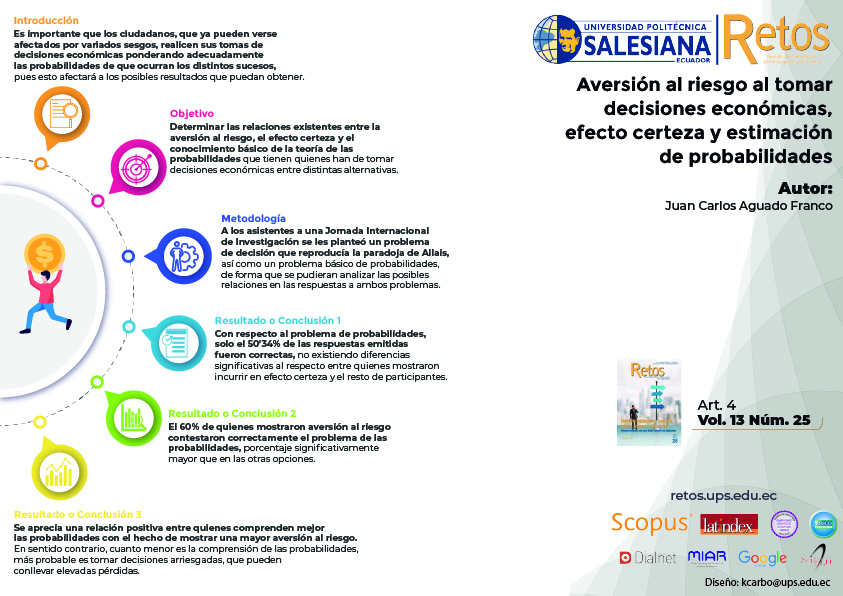
It has been empirically observed that the principles of utility theory are frequently violated in decision-making in risky environments. This led to the formulation of the prospect theory. In prospect theory, in addition to taking into account the different consideration of gains and losses
(losses loom larger than gains), as well as the risk posture of decision-makers (risk aversion for gains and risk seeking for losses), the certainty
effect is framed. According to the certainty effect, decision makers tend to underestimate payments that are merely probable, compared to those
that are obtained with certainty. Allais demonstrated the irrationality that occurs in decision making in this context. On the other hand, to make
risky decisions, it is necessary to know how the probabilities work. In order to determine the relationships between risk aversion, the certainty
effect, and basic knowledge of probability theory, an experimental study was designed. In this study, it was verified, using a formulation based on the Allais paradox, that those who have greater knowledge of the principles of probability show greater aversion to risk. However, the fact of
incurring in the certainty effect is a circumstance that is not significantly affected by said knowledge.
Article Details

This work is licensed under a Creative Commons Attribution-NonCommercial-ShareAlike 4.0 International License.
Authorship: The list of authors signing must include only those people who have contributed intellectually to the development of the work. Collaboration in the collection of data is not, by itself, a sufficient criterion of authorship. "Retos" declines any responsibility for possible conflicts arising from the authorship of the works that are published.
Copyright: The Salesian Polytechnic University preserves the copyrights of the published articles, and favors and allows their reuse under the Creative Commons Attribution-NonCommercial-ShareAlike 3.0 Ecuador license. They may be copied, used, disseminated, transmitted and publicly displayed, provided that: i) the authorship and the original source of their publication (journal, editorial and work URL) are cited; (Ii) are not used for commercial purposes; Iii) mention the existence and specifications of this license.
References
Allais, M. (1953). Le Comportement de l’Homme Rationnel devant le Risque: Critique des Postulats et Axiomes de l Ecole Americaine. Econometrica: journal of the Econometric Society, 21(4), 503-546. https://doi.org/10.2307/1907921
Babcock, B. A. (2015). Using cumulative prospect theory to explain anomalous crop insurance coverage choice. American Journal of Agricultural Economics, 97(5), 1371-1384. https://doi.org/10.1093/ajae/aav032
Barberis, N. C. (2013). Thirty years of Prospect Theory in economics: A review and assessment. The Journal of Economic Perspectives: A Journal of the American Economic Association, 27(1), 173-196. https://doi.org/10.1257/jep.27.1.173
Barberis, N., Mukherjee, A. y Wang, B. (2016). Prospect theory and stock returns: An empirical test. The review of financial studies, 29(11), 3068-3107. https://doi.org/10.1093/rfs/hhw049
Bendickson, J., Solomon, S. J. y Fang, X. (2017). Prospect theory: The impact of relative distances. Journal of Managerial Issues, 29(2), 155-168. http://bit.ly/3ktEo2x
Berlinger, E. (2015). Risk appetite. Penzugyi Szemle/Public Finance Quarterly-Journal of Public Finance, 60(1), 49-62.
Bernoulli, D. (1738). Specimen theoriae novae de mensura sortis. Commentarii Academiae Scientiarum Imperalis Petropolitanae, 5, 175-192.
Bernoulli, D. (1954). Exposition of a new theory on the measurement of risk. Econometrica: Journal of the Econometric Society, 22(1), 23. https://doi.org/10.2307/1909829
Bhootra, A. y Hur, J. (2015). High idiosyncratic volatility and low returns: A prospect theory explanation. Financial Management, 44(2), 295-322. https://doi.org/10.1111/fima.12057
Bruhin, A., Manai, M. y Santos-Pinto, L. (2022). Risk and rationality: The relative importance of probability weighting and choice set dependence. Journal of Risk and Uncertainty, 65(2), 139-184. https://doi.org/10.1007/s11166-022-09392-x
Buisson, F. (2016). Prospect theory and loss aversion in the housing market. The Journal of Real Estate Research, 38(2), 229-250. https://doi.org/10.1080/10835547.2016.12091444
Camerer, C. F. (1989). An experimental test of several generalized utility theories. Journal of Risk and Uncertainty, 2(1), 61-104. https://doi.org/10.1007/bf00055711
Chávez-Santana, L., Ruiz-Mafé, C. y Curras-Pérez, R. (2021). Efectos de los usos y gratificaciones de Facebook en la elección de destinos turísticos. Revista de Ciencias Sociales, 3, 120-138. https://doi.org/10.31876/rcs.v27i3.36760
Clark, W. A. V. y Lisowski, W. (2017). Prospect theory and the decision to move or stay. Proceedings of the National Academy of Sciences of the United States of America, 114(36), E7432-E7440. https://doi.org/10.1073/pnas.1708505114
Ebert, S. y Strack, P. (2015). Until the Bitter End: On prospect theory in a dynamic context. American Economic Review, 105(4), 1618-1633. https://doi.org/10.1257/aer.20130896
Estrin, S., Mickiewicz, T. y Rebmann, A. (2017). Prospect theory and the effects of bankruptcy laws on entrepreneurial aspirations. Small Business Economics, 48(4), 977-997. https://doi.org/10.1007/s11187-016-9810-1
Feng, H. y He, K. (2017). China’s institutional challenges to the international order. Strategic Studies Quarterly, 11(4), 23-49. http://www.jstor.org/stable/26271633
Grishina, N., Lucas, C. A. y Date, P. (2017). Prospect theory-based portfolio optimization: an empirical study and analysis using intelligent algorithms. Quantitative Finance, 17(3), 353-367. https://doi.org/10.1080/14697688.2016.1149611
Holmes, R. M., Jr, Bromiley, P., Devers, C. E., Holcomb, T. R. y McGuire, J. B. (2011). Management theory applications of prospect theory: Accomplishments, challenges, and opportunities. Journal of Management, 37(4), 1069-1107. https://doi.org/10.1177/0149206310394863
Kahneman, D. (2011). Thinking, fast and slow. Penguin Books.
Kahneman, D., Slovic, P. y Tversky, A. (eds.) (1982). Judgment under uncertainty: Heuristics and biases. Cambridge University Press.
Kahneman, D. y Tversky, A. (1979). Prospect theory: An analysis of decision under risk. Econometrica: Journal of the Econometric Society, 47(2), 263. https://doi.org/10.2307/1914185
Kusev, P., van Schaik, P., Martin, R., Hall, L. Y Johansson, P. (2020). Preference reversals during risk elicitation. Journal of Experimental Psychology General, 149(3), 585-589. https://doi.org/10.1037/xge0000655
Kusev, P., van Schaik, P., Teal, J., Martin, R., Hall, L. y Johansson, P. (2022). How false feedback influences decision-makers risk preferences. Journal of Behavioral Decision Making, 35(5). https://doi.org/10.1002/bdm.2278
Linde, J. y Vis, B. (2017). Do politicians take risks like the rest of us? An experimental test of prospect theory under MPs. Political Psychology, 38(1), 101-117. https://doi.org/10.1111/pops.12335
Long, X. y Nasiry, J. (2015). Prospect theory explains newsvendor behavior: The role of reference points. Management Science, 61(12), 3009-3012. https://doi.org/10.1287/mnsc.2014.2050
López, R., Calvo, J. L. y De la Torre, I. (2022). Teoría de juegos conductual y psicológica: una revisión sistemática. Retos Revista de Ciencias de la Administración y Economía, 12(24), 308-328. https://doi.org/10.17163/ret.n24.2022.07
López, R., Calvo, J. L. y De la Torre, I. (2023). Relación entre personalidad y toma de decisiones en los juegos económicos. Revista Venezolana de Gerencia, 28(101), 11-28. https://doi.org/10.52080/rvgluz.28.101.2
Machina, M. J. (1987). Choice under uncertainty: Problems solved and unsolved. The Journal of Economic Perspectives: A Journal of the American Economic Association, 1(1), 121-154. https://doi.org/10.1257/jep.1.1.121
Merigó, J. M., Rocafort, A. y Aznar-Alarcón, J. P. (2016). Bibliometric overview of business & economics research. Journal of Business Economics and Management, 17(3), 397-413. https://doi.org/10.3846/16111699.2013.807868
Morrison, P. y Clark, W. A. V. (2016). Loss aversion and duration of residence. Demographic Research, 35, 1079-1100. https://doi.org/10.4054/demres.2016.35.36
Niv-Solomon, A. (2016). When risky decisions are not surprising: An application of prospect theory to the Israeli war decision in 2006. Cooperation and Conflict, 51(4), 484-503. https://doi.org/10.1177/0010836716640837
Pérez-Martínez, A. y Rodríguez-Fernández, A. (2022). Economía conductual: su influencia en la predicción de resultados deportivos. Retos Revista de Ciencias de la Administración y Economía, 12(23), 125-138. https://doi.org/10.17163/ret.n23.2022.08
Rieger, M. O. y Wang, M. (2006). Cumulative prospect theory and the St. Petersburg paradox. Economic Theory, 28(3), 665-679. https://doi.org/10.1007/s00199-005-0641-6
Schmidt, U. (2016). Insurance demand under prospect theory: A graphical analysis. The Journal of Risk and Insurance, 83(1), 77-89. http://www.jstor.org/stable/43998253
Slovic, P. y Tversky, A. (1974). Who accepts Savages axiom? Behavioral Science, 19(6), 368-373. https://doi.org/10.1002/bs.3830190603
Starmer, C. (2000). Developments in non-expected utility theory: The hunt for a descriptive theory of choice under risk. Journal of Economic Literature, 38(2), 332-382. https://doi.org/10.1257/jel.38.2.332
Stein, J. G. (2017). The micro-foundations of international relations theory: Psychology and behavioral economics. International Organization, 71(S1), S249-S263. https://doi.org/10.1017/s0020818316000436
Tversky, A. y Kahneman, D. (1986). Rational choice and the framing of decisions. The Journal of Business, 59(S4), S251. https://doi.org/10.1086/296365
Tversky, A. y Kahneman, D. (1991). Loss aversion in riskless choice: A reference dependent model. Quarterly Journal of Economics, 107(4). https://bit.ly/3md3QK1
Tversky, A. y Kahneman, D. (1992). Advances in prospect theory: Cumulative representation of uncertainty. Journal of Risk and Uncertainty, 5(4), 297-323. https://doi.org/10.1007/bf00122574
Von Neumann, J. y Morgenstern, O. (1944). Theory of games and economic behavior. Princeton University Press.
Wakker, P. P. (2010). Prospect theory for risk and ambiguity. Cambridge University Press.