

Behaviors chosen or forced to choose: Norms and values assumed by executives
Article Sidebar
Main Article Content
Abstract
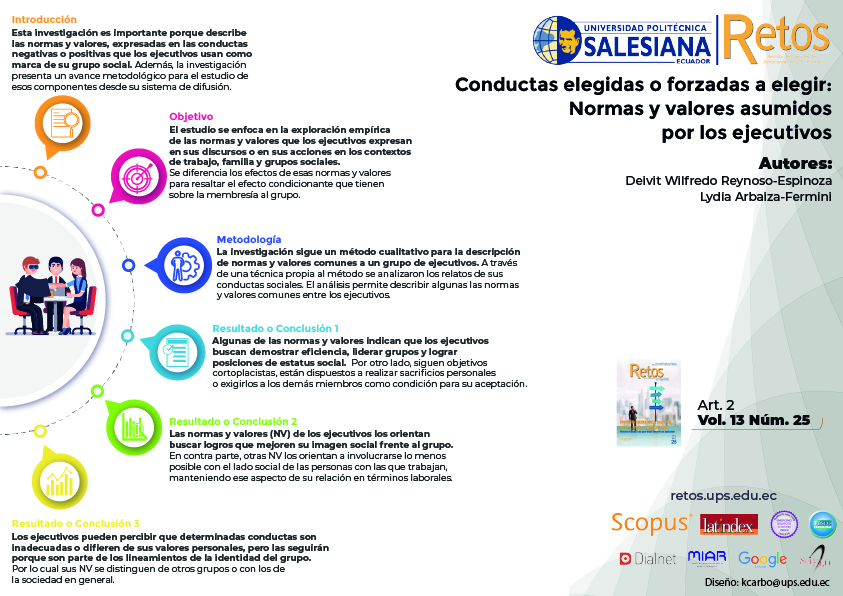
This research explores and describes some of the values and norms that business executives use to choose their behaviors in work, social and family environments. Using qualitative methodology, data collection was conducted with the support of the projective technique called "life history". The coding and analysis of the applied technique allowed the reporting of norms and values that are in use by executives. Fifty-three executives from companies from different sectors participated in this research. The analyzes show that the executives follow and align their behaviors to norms and values that demonstrate their memberships with the groups. These guidelines have positive and, in others, negative effects for themselves, their family, their co-workers and their friends. Among the first, it stands out that executives seek to demonstrate and demand the profitable use of time, achieve their development and growth of the organization, and achieve leadership positions. Frames of reference for their behaviors with non-positive or ambiguous effects are also observed. Among these, it is shown that executives present as norms and values being willing to sacrifice their family time for the company's objectives, tolerating conditions of mistreatment and mistreatment, and staying on the sidelines or getting involved as little as possible with the people with whom they work.
Article Details

This work is licensed under a Creative Commons Attribution-NonCommercial-ShareAlike 4.0 International License.
Authorship: The list of authors signing must include only those people who have contributed intellectually to the development of the work. Collaboration in the collection of data is not, by itself, a sufficient criterion of authorship. "Retos" declines any responsibility for possible conflicts arising from the authorship of the works that are published.
Copyright: The Salesian Polytechnic University preserves the copyrights of the published articles, and favors and allows their reuse under the Creative Commons Attribution-NonCommercial-ShareAlike 3.0 Ecuador license. They may be copied, used, disseminated, transmitted and publicly displayed, provided that: i) the authorship and the original source of their publication (journal, editorial and work URL) are cited; (Ii) are not used for commercial purposes; Iii) mention the existence and specifications of this license.
References
Albanese, G., De Blasio, G., & Sestito, P. (2016). My parents taught Me. Evidence on the family transmission of values. Journal of Population Economics, 29(2), 571–592. https://doi.org/10.1007/s00148-015-0574-8
Andrés Guzmán, R., Rodríguez-Sickert, C., & Rowthorn, R. (2007). When in Rome, do as the Romans do: the coevolution of altruistic punishment, conformist learning, and cooperation. Evolution and Human Behavior, 28(2), 112–117. https://doi.org/10.1016/J.EVOLHUMBEHAV.2006.08.002
Ashforth, B. E., & Kreiner, G. E. (2002). Normalizing emotion in organizations: Making the extraordinary seem ordinary. Human Resource Management Review, 12(2), 215–235. https://doi.org/10.1016/S1053-4822(02)00047-5
Barreto, M., & Ellemers, N. (2000). You can’t always do what you want: Social identity and self-presentational determinants of the choice to work for a low-status group. Personality and Social Psychology Bulletin, 26(8), 891–906. https://doi.org/10.1177/01461672002610001
Barsade, S. G., & Gibson, D. E. (2007). Why does affect matter in organizations? Academy of Management Perspectives, 21(1), 36–59. https://doi.org/10.5465/AMP.2007.24286163
Beji, R., Yousfi, O., Loukil, N., & Omri, A. (2020). Board Diversity and Corporate Social Responsibility: Empirical Evidence from France. Journal of Business Ethics. https://doi.org/10.1007/s10551-020-04522-4
Bicchieri, C. (2002). Covenants without swords: Group identity, norms, and communication in social dilemmas. Rationality and Society, Vol. 14, pp. 192–228. https://doi.org/10.1177/1043463102014002003
Bicchieri, C., & Chavez, A. (2010). Behaving as expected: Public information and fairness norms. Journal of Behavioral Decision Making, 23(2), 161–178. https://doi.org/10.1002/bdm.648
Bicchieri, C., & Xiao, E. (2009). Do the right thing: But only if others do so. Journal of Behavioral Decision Making, 22(2), 191–208. https://doi.org/10.1002/bdm.621
Brown, A. D. (2015). Identities and Identity Work in Organizations. International Journal of Management Reviews, 17(1), 20–40. https://doi.org/10.1111/ijmr.12035
Brown, M. A. (2011). Values - A Necessary but Neglected Ingredient of Motivation on the Job. Academy of Management Review, 1(4), 15–23. https://doi.org/10.5465/amr.1976.4396236
Bruhn, J. G. (2009). The functionality of gray area ethics in organizations. Journal of Business Ethics, 89(2), 205–214. https://doi.org/10.1007/s10551-008-9994-7
Cambrea, D. R., Tenuta, P., & Vastola, V. (2019). Female directors and corporate cash holdings: monitoring vs executive roles. Management Decision, 58(2), 295–312. https://doi.org/10.1108/MD-11-2018-1289
Castro Solano, A., & Nader, M. (2006). La evaluación de los valores humanos con el Portrait Values Questionnaire de Schwartz. Interdisciplinaria, 23(2), 155–174. Retrieved from http://bit.ly/3XRRzYk
Cialdini, R., Li, Y. J., Samper, A., & Wellman, N. (2021). How Bad Apples Promote Bad Barrels: Unethical Leader Behavior and the Selective Attrition Effect. Journal of Business Ethics, 168(4), 861–880. https://doi.org/10.1007/s10551-019-04252-2
Copeland, R., & Potwarka, L. R. (2016). Individual and contextual factors in ethical decision making: A case study of the most significant doping scandal in Canadian university sports history. Sport Management Review, 19(1), 61–68. https://doi.org/10.1016/j.smr.2015.08.004
Daniel, E., Bilgin, A. S., Brezina, I., Strohmeier, C. E., & Vainre, M. (2015). Values and helping behavior: A study in four cultures. International Journal of Psychology, 50(3), 186–192. https://doi.org/10.1002/ijop.12086
Earle, J. S., Spicer, A., & Peter, K. S. (2010). The normalization of deviant organizational practices: Wage arrears in Russia, 1991-98. Academy of Management Journal, 53(2), 218–237. https://doi.org/10.5465/amj.2010.49387426
Ellemers, N., Pagliaro, S., & Barreto, M. (2013). Morality and behavioural regulation in groups: A social identity approach. European Review of Social Psychology, 24(1), 160–193. https://doi.org/10.1080/10463283.2013.841490
Gelbrich, K., Stedham, Y., & Gäthke, D. (2016). Cultural Discrepancy and National Corruption: Investigating the Difference between Cultural Values and Practices and Its Relationship to Corrupt Behavior. Business Ethics Quarterly, Vol. 26, pp. 201–225. https://doi.org/10.1017/beq.2016.29
Gillespie, A., & Cornish, F. (2010). Intersubjectivity: Towards a Dialogical Analysis. Journal for the Theory of Social Behaviour, 40(1), 19–46. https://doi.org/10.1111/j.1468-5914.2009.00419.x
Graham, K. A., Resick, C. J., Margolis, J. A., Shao, P., Hargis, M. B., & Kiker, J. D. (2020). Egoistic norms, organizational identification, and the perceived ethicality of unethical pro-organizational behavior: A moral maturation perspective. Human Relations, 73(9), 1249–1277. https://doi.org/10.1177/0018726719862851
Hardy, C., & Clegg, S. (2006). Some dare call it power. In The SAGE Handbook of Organization Studies (pp. 754–775). https://doi.org/10.4135/9781848608030.n27
Hauk, E., & Saez-Marti, M. (2002). On the cultural transmission of corruption. Journal of Economic Theory, 107(2), 311–335. https://doi.org/10.1006/jeth.2001.2956
Hsieh, H. H., Hsu, H. H., Kao, K. Y., & Wang, C. C. (2020). Ethical leadership and employee unethical pro-organizational behavior: a moderated mediation model of moral disengagement and coworker ethical behavior. Leadership and Organization Development Journal, 41(6), 799–812. https://doi.org/10.1108/LODJ-10-2019-0464
Ibarra-Colado, E., Clegg, S. R., Rhodes, C., & Kornberger, M. (2006). The ethics of managerial subjectivity. Journal of Business Ethics, 64(1), 45–55. https://doi.org/10.1007/s10551-005-3325-z
Lian, H., Huai, M., Farh, J. L., Huang, J. C., Lee, C., & Chao, M. M. (2020). Leader Unethical Pro-Organizational Behavior and Employee Unethical Conduct: Social Learning of Moral Disengagement as a Behavioral Principle. Journal of Management, XX(16503715), 1–30. https://doi.org/10.1177/0149206320959699
Liu, Y., Chen, S., Bell, C., & Tan, J. (2020). How Do Power and Status Differ in Predicting Unethical Decisions? A Cross-National Comparison of China and Canada. Journal of Business Ethics, 167(4), 745–760. https://doi.org/10.1007/s10551-019-04150-7
Maldonado, A. M., & Oliva, A. V. H. (2010). El proceso de construcción de la identidad colectiva. Convergencia, 17(53), 229–251.
Melucci, A., & Massolo, A. (1995). La acción colectiva como construcción social. Estudios Sociológicos, Vol. 9, pp. 357–364. https://doi.org/10.2307/40420123
Miles, M. B., Huberman, M., & Saldaña, J. (1994). Qualitative data analysis: a methods sourcebook.
Molthan-Hill, P. (2014). The moral muteness of managers: An Anglo-American phenomenon? German and British managers and their moral reasoning about environmental sustainability in business. International Journal of Cross Cultural Management, 14(3), 289–305. https://doi.org/10.1177/1470595814532076
Portuondo, J. (1979). Cuatro técnicas en el test de apercepción temática y la autobiografía como técnica proyectiva. “Textos y Temas Psicológicos”. Madrid: Biblioteca Nueva.
Pozzi, M., Fattori, F., Bocchiaro, P., & Alfieri, S. (2014). Do the right thing! A study on social representation of obedience and disobedience. New Ideas in Psychology, 35, 18–27. https://doi.org/10.1016/J.NEWIDEAPSYCH.2014.06.002
Reynoso, D. (2018). Factores del Ethos de ejecutivos: identidad, identificación y diferenciación. Una aproximación teórica. Revista de Investigación En Psicología, 21(1), 119. https://doi.org/10.15381/rinvp.v21i1.15117
Reynoso, D. (2021). Estudio de la intersubjetividad en las interacciones de jefes y subordinados a través de una prueba proyectiva. Revista Científica Pensamiento y Gestión, (51), 75–93. https://doi.org/10.14482/pege.50.658.155
Romero, G. (2011). Principios y valores éticos en las organizaciones bancarias respecto a la calidad del servicio y atención al cliente. Revista Venezolana de Gerencia, 11(36), 56–74. https://doi.org/10.31876/revista.v11i36.10445
Schuh, S. C., Cai, Y., Kaluza, A. J., Steffens, N. K., David, E. M., & Haslam, A. (2021). Do leaders condone unethical pro-organizational employee behaviors? The complex interplay between leader organizational identification and moral disengagement. Human Resource Management, 1–21. https://doi.org/10.1002/hrm.22060
Tang, P. M., Yam, K. C., & Koopman, J. (2020). Feeling proud but guilty? Unpacking the paradoxical nature of unethical pro-organizational behavior. Organizational Behavior and Human Decision Processes, 160(March), 68–86. https://doi.org/10.1016/j.obhdp.2020.03.004
Umphress, E. E., Bingham, J. B., & Mitchell, M. S. (2010). Unethical behavior in the name of the company: The moderating effect of organizational identification and positive reciprocity beliefs on unethical pro-organizational behavior. Journal of Applied Psychology, 95(4), 769–780. https://doi.org/10.1037/a0019214
Verhezen, P. (2010). Giving Voice in a Culture of Silence. From a Culture of Compliance to a Culture of Integrity. Journal of Business Ethics, 96(2), 187–206. https://doi.org/10.1007/s10551-010-0458-5
Weber, M. (2014). (2014). Los tipos de dominación. In Economía y sociedad (Vol. 1, pp. 170–239). https://doi.org/10.1017/CBO9781107415324.004
Welsh, D. T., Ordóñez, L. D., Snyder, D. G., & Christian, M. S. (2015). The slippery slope: How small ethical transgressions pave the way for larger future transgressions. Journal of Applied Psychology, 100(1), 114–127. https://doi.org/10.1037/a0036950
White, J., Bandura, A., & Bero, L. A. (2009). Moral disengagement in the corporate world. In Accountability in Research (Vol. 16). https://doi.org/10.1080/08989620802689847
Wood, R., & Bandura, A. (1989). Social Cognitive Theory of Organizational Management. Academy of Management Review, 14(3), 361–384. https://doi.org/10.5465/amr.1989.4279067
Zeytinoglu, I. U., Keser, A., Yilmaz, G., Inelmen, K., Özsoy, A., & Uygur, D. (2012). Security in a sea of insecurity: Job security and intention to stay among service sector employees in Turkey. International Journal of Human Resource Management, 23(13), 2809–2823. https://doi.org/10.1080/09585192.2011.637067