

Inclusive labor insertion project: formulation of its organizational management
Article Sidebar
Main Article Content
Abstract
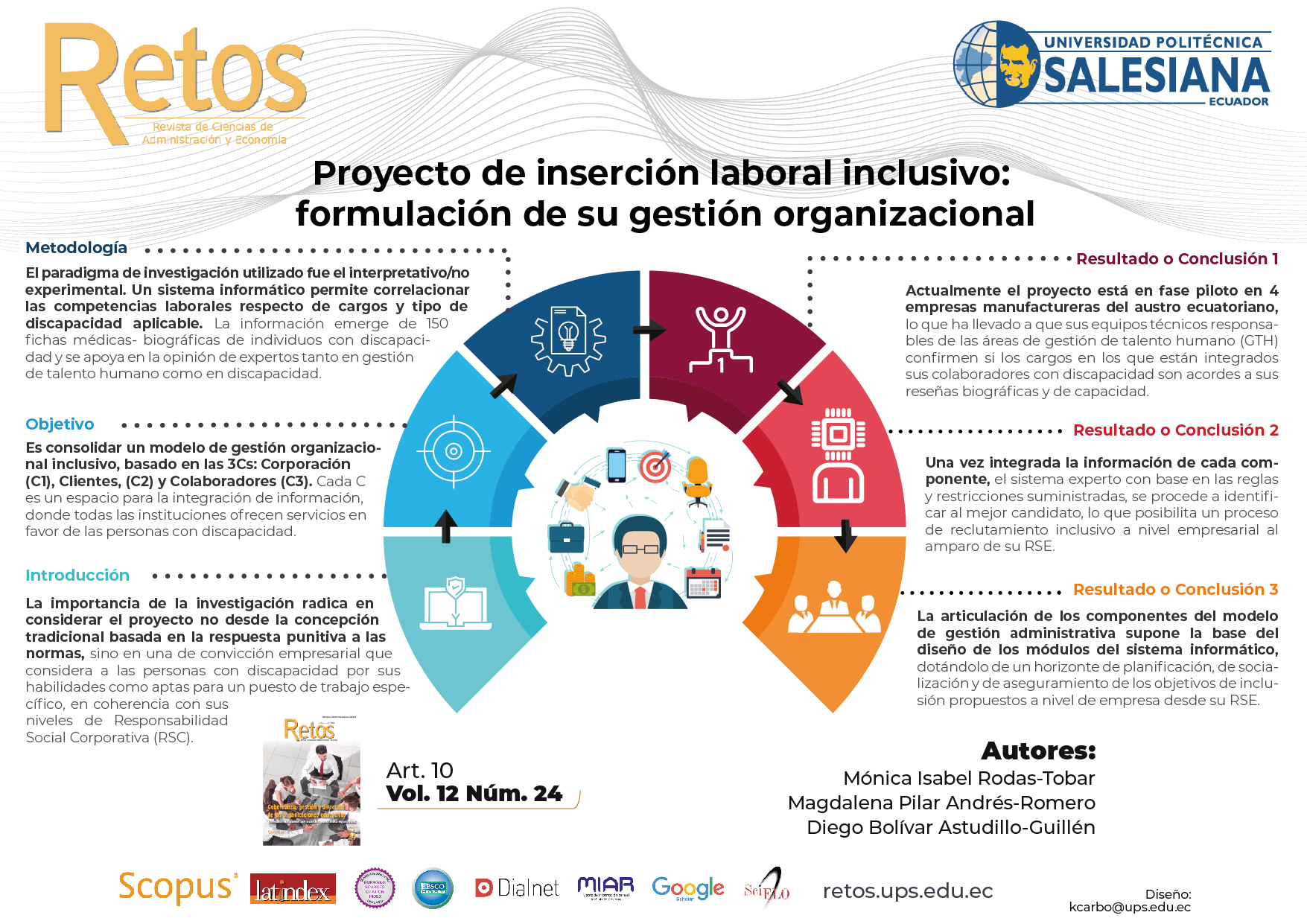
This article details the formulation of a management model applied to a labor inclusion project for people with disabilities. The objective
of this research is to consolidate an inclusive organizational management model based on the 3Cs: Corporation (C1), Clients (C2) and Colleagues
(C3). The methodology triangulates the main information of the company (job profiles, required educational level, necessary behavioural competences),
and the people profile (type of disability and educational level) which are the basis of its strategic planning. The main results are the search
for evidence and the theoretical contribution that support the project. It also includes a digital platform that manages the three components of the
model that allows the socialization of the strategic elements such as mission, vision, values and quality policy (C1), the management of people
profiles with disabilities that correspond to business positions (C2), and the visualization of organizations linked to labor insertion processes in the current working environment (C3). It is concluded that the inclusion project based exclusively on a computer system, even if it is functional would be complete in its intention and scope; thus, by supporting it with organizational management components, it is projected to be in a planning and assurance stage of its objectives.
Article Details

This work is licensed under a Creative Commons Attribution-NonCommercial-ShareAlike 4.0 International License.
Authorship: The list of authors signing must include only those people who have contributed intellectually to the development of the work. Collaboration in the collection of data is not, by itself, a sufficient criterion of authorship. "Retos" declines any responsibility for possible conflicts arising from the authorship of the works that are published.
Copyright: The Salesian Polytechnic University preserves the copyrights of the published articles, and favors and allows their reuse under the Creative Commons Attribution-NonCommercial-ShareAlike 3.0 Ecuador license. They may be copied, used, disseminated, transmitted and publicly displayed, provided that: i) the authorship and the original source of their publication (journal, editorial and work URL) are cited; (Ii) are not used for commercial purposes; Iii) mention the existence and specifications of this license.
References
Alles, M. A. (2007). Desempeño por competencias: evaluación de 360o. Ediciones Granica SA.
Azpurúa, G. (2005). La Escuela de Chicago. Sus aportes para la investigación en ciencias sociales. Sapiens. Revista universitaria de investigación, 6(2), 25-35.
Burgardt, A. (2004). El aporte de Max Weber a la constitución del paradigma interpretativo en ciencias sociales. VI Jornadas de Sociología. http://cdsa. aacademica. org/000-045/506. pdf.
Cecchini, S. (2005). Indicadores sociales en América Latina y el Caribe. Cepal.
Colmenares E, A. M. (2012). Investigación-acción participativa: una metodología integradora del conocimiento y la acción. Voces y Silencios. Revista Latinoamericana de Educación, 3(1), 102-115.
CONADIS, R. E. (2019). https://www.consejodiscapacidades.gob.ec/. Obtenido de https://www.consejodiscapacidades.gob.ec/: https://www.consejodiscapacidades.gob.ec/estadisticas-de-discapacidad/
Constitución de la República del Ecuador. (2018). Constitución de la República del Ecuador. Quito.
Del Val Román, J. L. (2016, March). Industria 4.0: la transformación digital de la industria. In Valencia: Conferencia de Directores y Decanos de Ingeniería Informática, Informes CODDII.
Figueroa, G; Paladines, P; Paladines, J; Caicedo, C; Romero, M. (2017). Modelo de plan estratégico de sistemas para la gestión y organización a través de una plataforma informática (Vol. 1). 3Ciencias.
Garcia, E., Orlando, J., & Calle, J. (2017). Inclusion laboral para personas con discapacidad. SINAPSIS.
González Monteagudo, J. (2001). El paradigma interpretativo en la investigación social y educativa: nuevas respuestas para viejos interrogantes. Cuestiones pedagógicas, 15, 227-246.
González-Arias, K., Gálvez-Quezada, J., Robles-Bykbaev, V., Bermeo-Zambrano, F., & León-Pesántez, A. (2021, March). An intelligent decision support system for educational inclusion of children with disabilities: an approximation for multidisciplinary teams. In 2021 IEEE World Conference on Engineering Education (EDUNINE) (pp. 1-6). IEEE.
Guba, E. G. (1965). Methodological Strategies for Educational Change. ERIC.
Ministerio de Relaciones Labores-CONADIS. (2013). Ministerio del Trabajo. Obtenido de http://www.trabajo.gob.ec/wp-content/uploads/downloads/2013/12/MANUALFIN.pdf
Ministerio del Trabajo. (30 de noviembre de 2017). Suin-juriscol. Obtenido de Suin-juriscol: http://www.suin-juriscol.gov.co/viewDocument.asp?ruta=Decretos/30034338
Mintzberg, H. (1988). Cómo modelar la estrategia. Harvard Deusto business review, (34), 73-84.
Norma SAI SA8000®: 2001
Ohmae, K. (1990). La mente del estratega.
Siles González, J. (2012). Investigación cualitativa y enfermería: una perspectiva epistemológica. Investigación Cualitativa en Ciencias de la Salud.
Steiner, G. (1998). Planificación estratégica, lo que todo director debe saber. En Steiner, G., Planificación estratégica, lo que todo director debe saber. CECSA.
WEBER, Max. “Ensayo sobre metodología sociológica”. Amorrortu editores, 3era reimpresión, 1990. Buenos Aires.
Zarate, R; Rodriguez, D. (2014). Los derechos de las personas en situación de discapacidad: Una respuesta desde la responsabilidad social. Revista Eleuthera, 10, 38-57. https://www.redalyc.org/pdf/5859/585961839004.pdf