

Social return and quality of HEI: wage effect on small firms
Article Sidebar
Main Article Content
Abstract
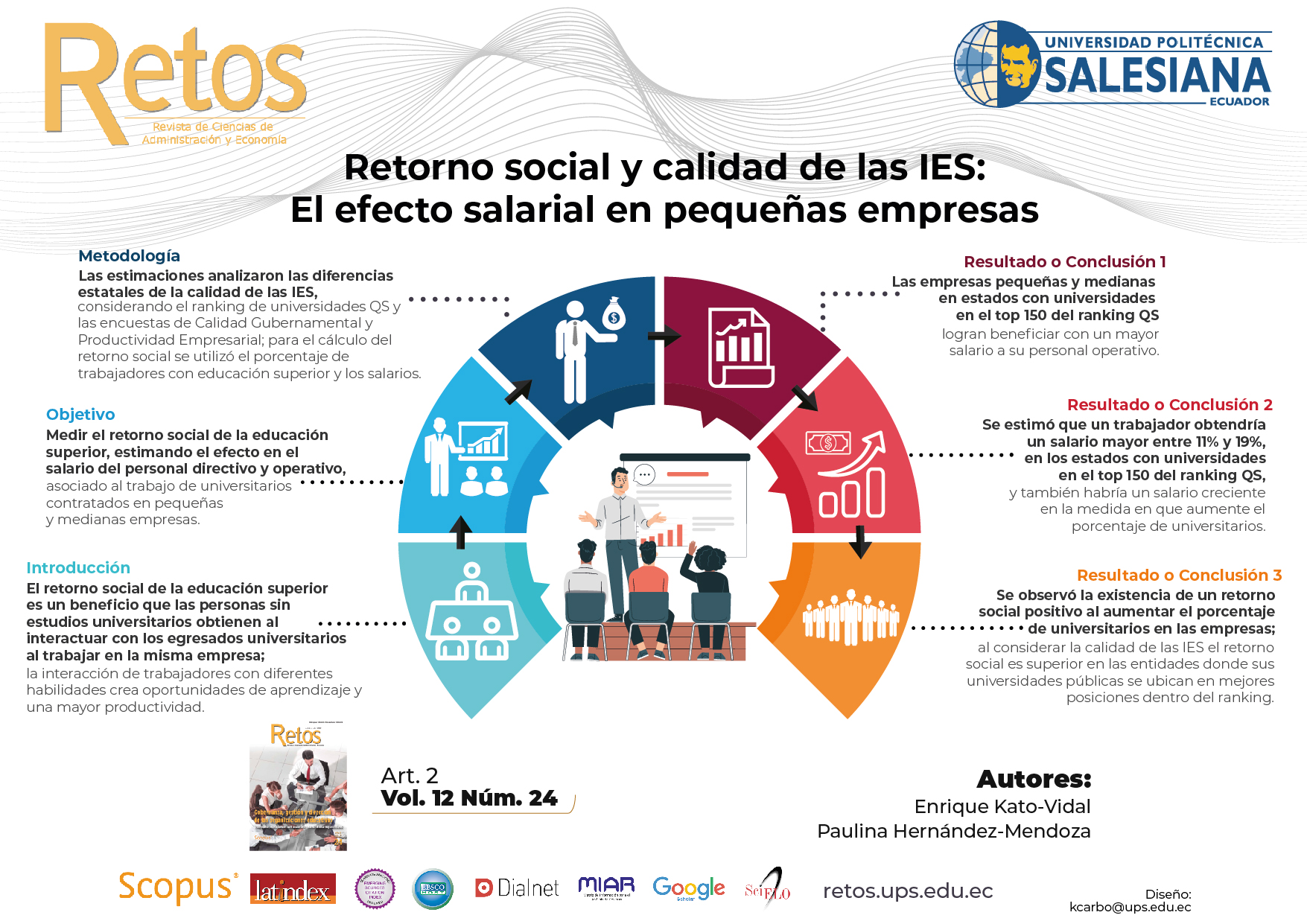
providing an education with the highest possible quality, making efficient use of resources, is a permanent demand for publicly funded universities. It is known that graduates with university studies receive a private benefit (wage), although estimates of the social benefit of higher
education are still lacking, that is, the positive effects that university students create in other workers. In this regard, the aim of this paper is to
measure the social return of higher education, estimating the effect on the wage of managers and workers, associated with the job of university
graduates hired in small and medium-sized companies. The analysis was carried out with data from Mexico, combining official figures from
the Government Quality Survey, which reports satisfaction with university education, and the Productivity Survey, which describes wages and
schooling, among others. The sample was formed with small and medium enterprises. The abundant information available allowed us to use
instrumental variables and a two-stage regression. It was confirmed that tertiary education has a positive social effect and that this effect is greater
in regions with higher quality HEIs. By broadening the perspective towards the quality of HEIs and social return, universities can demonstrate
that their impact exceeds their graduates, reaching workers without university studies through a positive salary effect.
Article Details

This work is licensed under a Creative Commons Attribution-NonCommercial-ShareAlike 4.0 International License.
Authorship: The list of authors signing must include only those people who have contributed intellectually to the development of the work. Collaboration in the collection of data is not, by itself, a sufficient criterion of authorship. "Retos" declines any responsibility for possible conflicts arising from the authorship of the works that are published.
Copyright: The Salesian Polytechnic University preserves the copyrights of the published articles, and favors and allows their reuse under the Creative Commons Attribution-NonCommercial-ShareAlike 3.0 Ecuador license. They may be copied, used, disseminated, transmitted and publicly displayed, provided that: i) the authorship and the original source of their publication (journal, editorial and work URL) are cited; (Ii) are not used for commercial purposes; Iii) mention the existence and specifications of this license.