

Social return and quality of HEI: wage effect on small firms
Article Sidebar
Main Article Content
Abstract
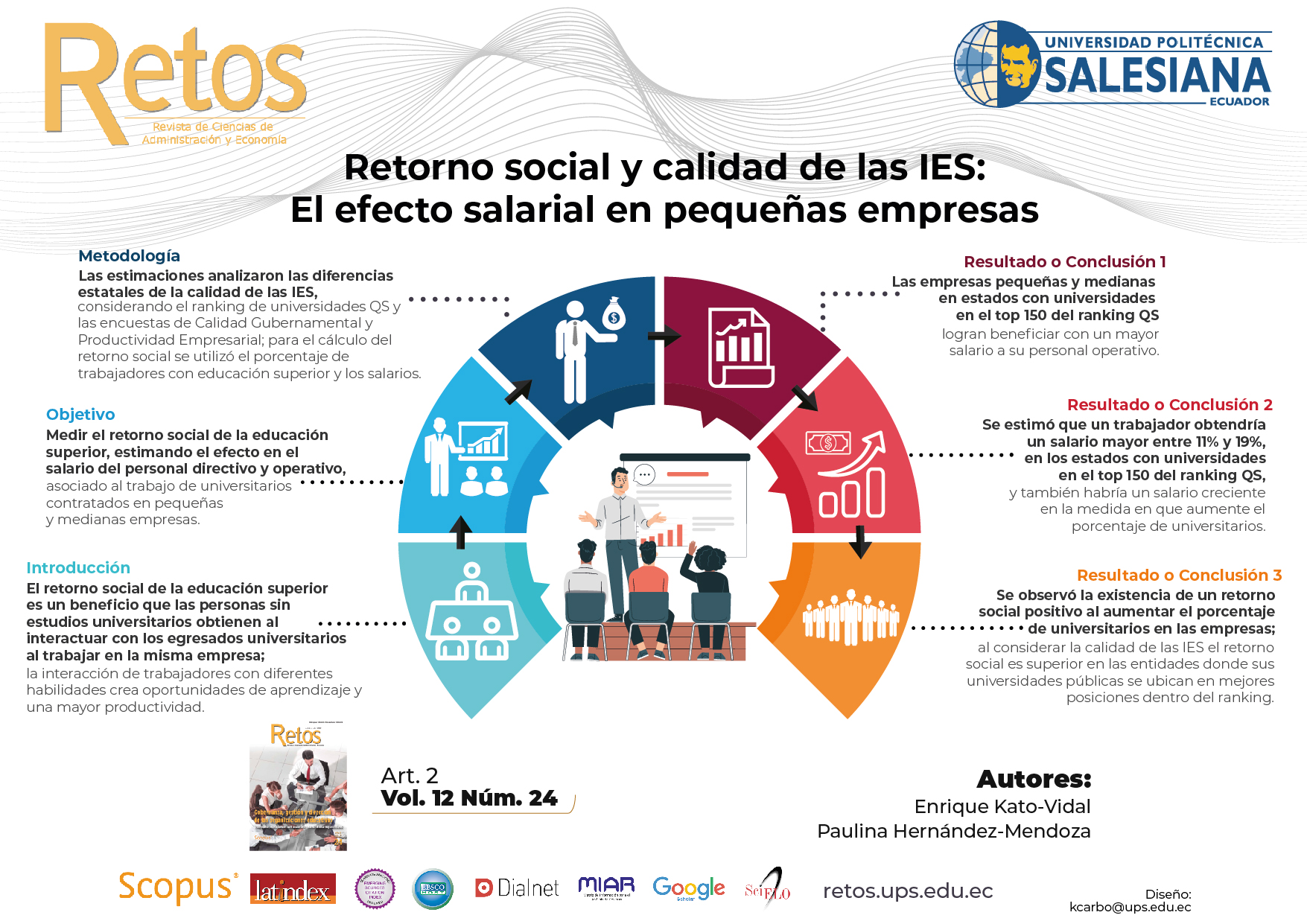
providing an education with the highest possible quality, making efficient use of resources, is a permanent demand for publicly funded universities. It is known that graduates with university studies receive a private benefit (wage), although estimates of the social benefit of higher
education are still lacking, that is, the positive effects that university students create in other workers. In this regard, the aim of this paper is to
measure the social return of higher education, estimating the effect on the wage of managers and workers, associated with the job of university
graduates hired in small and medium-sized companies. The analysis was carried out with data from Mexico, combining official figures from
the Government Quality Survey, which reports satisfaction with university education, and the Productivity Survey, which describes wages and
schooling, among others. The sample was formed with small and medium enterprises. The abundant information available allowed us to use
instrumental variables and a two-stage regression. It was confirmed that tertiary education has a positive social effect and that this effect is greater
in regions with higher quality HEIs. By broadening the perspective towards the quality of HEIs and social return, universities can demonstrate
that their impact exceeds their graduates, reaching workers without university studies through a positive salary effect.
Article Details

This work is licensed under a Creative Commons Attribution-NonCommercial-ShareAlike 4.0 International License.
Authorship: The list of authors signing must include only those people who have contributed intellectually to the development of the work. Collaboration in the collection of data is not, by itself, a sufficient criterion of authorship. "Retos" declines any responsibility for possible conflicts arising from the authorship of the works that are published.
Copyright: The Salesian Polytechnic University preserves the copyrights of the published articles, and favors and allows their reuse under the Creative Commons Attribution-NonCommercial-ShareAlike 3.0 Ecuador license. They may be copied, used, disseminated, transmitted and publicly displayed, provided that: i) the authorship and the original source of their publication (journal, editorial and work URL) are cited; (Ii) are not used for commercial purposes; Iii) mention the existence and specifications of this license.
References
Aboal, D. y Veneri, F. 2016. Entrepreneurs in Latin America. Small Business Economics, 46(3), 503-525. https://doi.org/10.1007/s11187-015-9696-3
Abreu, M., Demirel, P., Grinevich, V. y Karatas-Ozkan, M. 2016. Entrepreneurial practices in research-intensive and teaching-led universities. Small business economics, 47(3), 695-717. https://doi.org/10.1007/s11187-016-9754-5
Acemoglu, D. y Angrist, J. 2000. How large are human-capital externalities? Evidence from compulsory schooling laws. NBER Macroeconomics Annual, 15, 9-59. https://doi.org/10.1086/654403
Balán, J. 2012. Research Universities in Latin America: the challenges of growth and institutional diversity, 741-770. https://doi.org/10.1353/sor.2012.0036
Bernate, J. A., Guataquira Romero, A., Romero Melo, E. N. y Reyes Escobar, P. C. 2020. Satisfacción de la Calidad Educativa en Educación Superior. Podium, 38, 37-50 https://doi.org/10.31095/podium.2020.38.3
Brambilla, I., Dix-Carneiro, R., Lederman, D. y Porto, G. 2012. Skills, exports, and the wages of seven million Latin American workers. The World Bank Economic Review, 26(1), 34-60. https://doi.org/10.1093/wber/lhr020
Brint, S. y Clotfelter, C. T. 2016. US higher education effectiveness. The Russell Sage Foundation Journal of the Social Sciences, 2(1), 2-37. https://doi.org/10.7758/rsf.2016.2.1.01
Bruckmann, S. y Carvalho, T. 2014. The reform process of Portuguese higher education institutions: from collegial to managerial governance. Tertiary Education and Management, 20(3), 193-206. https://doi.org/10.1080/13583883.2014.911950
Carnoy, M. 2011. As higher education expands, is it contributing to greater inequality? National Institute Economic Review, 215, R34-R47. https://doi.org/10.1177/0027950111401142
Charron, N., Lapuente, V. y Annoni, P. 2019. Measuring quality of government in EU regions across space and time. Papers in Regional Science, 98(5), 1925-1953. https://doi.org/10.1111/pirs.12437
Comisión Económica para América Latina -CEPAL-. 2021. Panorama Social de América Latina 2020. CEPAL. Santiago de Chile. https://bit.ly/3AtLUzZ
Consejo Nacional para la Evaluación de la Política de Desarrollo Social -CONEVAL-. 2018. Estudio diagnóstico del derecho a la educación 2018. CONEVAL. https://bit.ly/3OMUUEA
Corak, M. 2013. Income inequality, equality of opportunity, and intergenerational mobility. Journal of Economic Perspectives, 27(3), 79-102. https://doi.org/10.1257/jep.27.3.79
Esquivel, G. y Cruces, G. 2011. The dynamics of income inequality in Mexico since NAFTA. Economía, 12(1), 155-188. https://doi.org/10.1353/eco.2011.0009
García Hernández, Y., García Rojas, J. A., Ramírez Sabino, A. I. y Amador Martínez, M. L. 2020. Formación académica e iniciativa emprendedora de los estudiantes de educación superior tecnológica. Podium, 38, 123-138. https://doi.org/10.31095/podium.2020.38.8
Holmes, C. y Mayhew, K. 2016. The economics of higher education. Oxford Review of Economic Policy, 32(4), 475-496. https://doi.org/10.1093/oxrep/grw031
Hudson, C. 2006. Regional development partnerships in Sweden: A way for higher education institutions to develop their role in the processes of regional governance? Higher Education, 51, 387-410. https://doi.org/10.1007/s10734-004-6416-3
Instituto Nacional de Estadística y Geografía –INEGI–. 2019. Encuesta Nacional sobre Productividad y Competitividad de las micro, pequeñas y medianas Empresas 2018. ENAPROCE. Síntesis metodológica. Aguascalientes. México. https://bit.ly/3yGU5Yk
Instituto Nacional de Estadística y Geografía –INEGI– (varios años). Encuesta Nacional de Calidad e Impacto Gubernamental –ENCIG–, INEGI. https://bit.ly/3bQx3Fk
Instituto Nacional de Estadística y Geografía –INEGI– (varios años). Encuesta Nacional de Ocupación y Empleo –ENOE–, INEGI. https://bit.ly/3ahRzy8
Instituto Nacional de Estadística y Geografía –INEGI– (varios años). Encuesta Nacional sobre Productividad y Competitividad de las Micro, Pequeñas y Medianas Empresas (ENAPROCE 2015 y 2018) https://bit.ly/3IhbKZK
Ireland, R. D. 2015. 2014 Presidential address: our academy, our future. Academy of Management Review, 40(2), 151-162. https://doi.org/10.5465/amr.2014.0534
Kahn, S. y MacGarvie, M. J. 2016. How important is US location for research in science? Review of Economics and Statistics, 98(2), 397-414. https://doi.org/10.1162/REST_a_00490
Keller, K. R. 2010. How can education policy improve income distribution? An empirical analysis of education stages and measures on income inequality. The Journal of Developing Areas, 51-77. https://bit.ly/3eUNp1h
López-Acevedo, G. 2004. Mexico: Evolution of earnings inequality and rates of returns to education (1988-2002). Estudios económicos, 211-284. https://bit.ly/3aiVZoG
Manacorda, M., Sánchez-Páramo, C. y Schady, N. 2010. Changes in returns to education in Latin America: The role of demand and supply of skills. ILR Review, 63(2), 307-326. https://doi.org/10.1177/001979391006300207
Moretti, E. 2004a. Estimating the social return to higher education: evidence from longitudinal and repeated cross-sectional data. Journal of econometrics, 121(1-2), 175-212. https://doi.org/10.1016/j.jeconom.2003.10.015
Moretti, E. 2004b. Workers’ education, spillovers, and productivity: evidence from plant-level production functions. American Economic Review, 94(3), 656-690. https://doi.org/10.1257/0002828041464623
Organización para la Cooperación y el Desarrollo Económicos –OECD– (2022). Population with tertiary education (indicador). https://doi.org/10.1787/0b8f90e9-en
Pandey, I. M. 2004. Governance of higher education institutions. Vikalpa, 29(2), 79-84. https://doi.org/10.1177%2F0256090920040207
Peña-Vinces, J. C. y Urbano, D. 2014. The influence of domestic economic agents on the international competitiveness of Latin American firms: Evidence from Peruvian small and medium multinational enterprises. Emerging Markets Finance and Trade, 50(6), 229-248. https://doi.org/10.1080/1540496X.2014.1013865
QS World University Rankings. 2020. The top 200 universities in Latin America 2020. Quacquarelli Symonds Limited
Rodríguez-Pose, A. y Di Cataldo, M. 2015. Quality of government and innovative performance in the regions of Europe. Journal of Economic Geography, 15(4), 673-706. https://doi.org/10.1093/jeg/lbu023
Summers, L. 2011. Education and Development: The role of higher education. En S. Armstrong y B. Chapman (eds.), Financing Higher Education and Economic Development in East Asia. The Australian National University.
Urzúa, S. 2017. The economic impact of higher education. En M. Ferreyra, C. Avitabile, J. Botero Álvarez, F. Haimovich Paz y S. Urzúa, At a crossroads: higher education in Latin America and the Caribbean (pp.115-148). The World Bank.
Valero, A. y Van Reenen, J. 2019. The economic impact of universities: Evidence from across the globe. Economics of Education Review, 68, 53-67. https://doi.org/10.1016/j.econedurev.2018.09.001
Zamora-Sánchez, R., Rodríguez-Castellanos, A. y Barrutia-Guenaga, J. 2022. Universidades y desarrollo socioeconómico: una propuesta de evaluación de sus proyectos de vinculación con la sociedad. Problemas del Desarrollo, 53(210), 181-205. https://doi.org/10.22201/iiec.20078951e.2022.210.69807