

Behavioral and psychological game theory: a systematic review
Article Sidebar
Main Article Content
Abstract
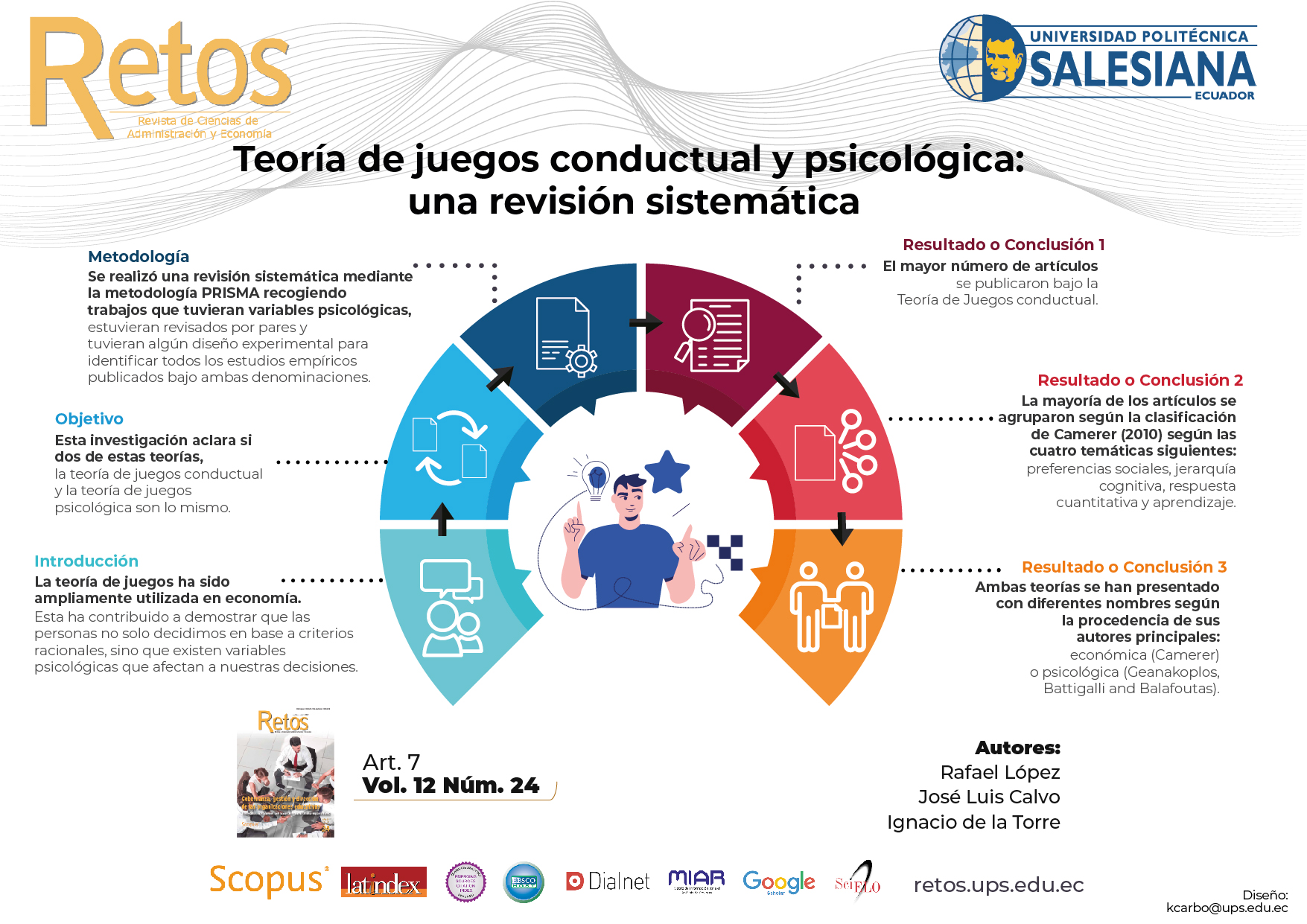
thanks to the game theory we have a better understanding of human behavior in the economy. However, since this theory excludes the
psychological aspect from conduct, a revision of the rationality assumption completes the missed information in some games. As a consequence,
some approaches have emerged including behavioral and psychological aspects in games. This has generated a large amount of literature distributed
in apparently independent lines of research, a fact that could generate confusion. To clarify whether behavioral game theory and psychological game theory are independent approaches, a systematic review was conducted using the PRISMA guidelines to identify all empirical studies published under both names. Papers that (1) had psychological variables, (2) were peer-reviewed, and (3) had any experimental design were collected. From 492 papers searched, 67 were included in this systematic review. They were organized and studied to determine what type of psychological
variables they included and whether there are really two different approaches. The most common term used is behavioral game theory in which variables like guilt, trust, motivation, and reciprocity are widely used. The main conclusion is that the two approaches are really the same and it
is the followers of the main authors of each current who publish under one or the other name.
Article Details

This work is licensed under a Creative Commons Attribution-NonCommercial-ShareAlike 4.0 International License.
Authorship: The list of authors signing must include only those people who have contributed intellectually to the development of the work. Collaboration in the collection of data is not, by itself, a sufficient criterion of authorship. "Retos" declines any responsibility for possible conflicts arising from the authorship of the works that are published.
Copyright: The Salesian Polytechnic University preserves the copyrights of the published articles, and favors and allows their reuse under the Creative Commons Attribution-NonCommercial-ShareAlike 3.0 Ecuador license. They may be copied, used, disseminated, transmitted and publicly displayed, provided that: i) the authorship and the original source of their publication (journal, editorial and work URL) are cited; (Ii) are not used for commercial purposes; Iii) mention the existence and specifications of this license.