

Brand value of Chilean pisco: contributions from the Pisco region of Chile
Article Sidebar
Main Article Content
Abstract
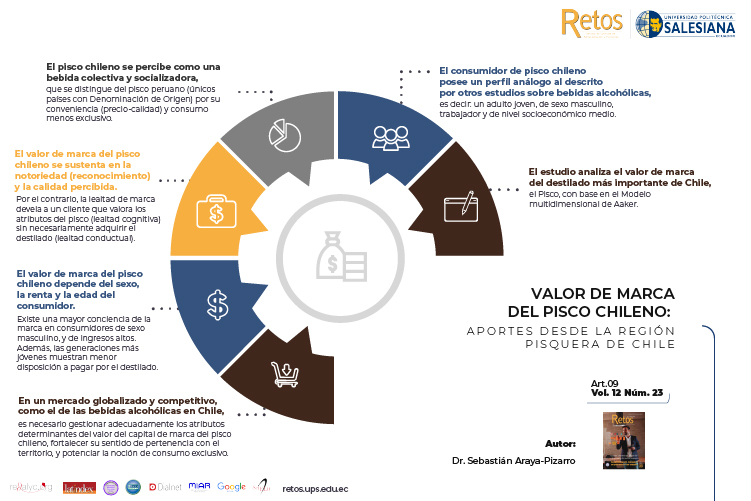
In the current competitive environment of pisco industry, it´s essential to differentiate the offer in the market. In this context, the brand represents an attribute of significant value that allows the consumer to identify the origin of the good and, to the company to differentiate its products and services. The aim of this research was to analyze the brand value of Chilean pisco (the most important Chilean distillate) in the main pisco area of the
country: Coquimbo Region. A questionnaire was developed, based on the multidimensional brand value model of Aaker (1991), which was applied to a probabilistic sample of 254 consumers. The results showed that the factors with the greatest and least relevance are of behavioral type: notoriety and brand loyalty, respectively. This would reveal a customer who recognizes the characteristics of the product (cognitive loyalty), but that doesn’t necessarily buy the product (behavioral loyalty). In addition, the examination of the variables according to the participant’s profile, allowed to find significant differences, according to sex and income (in the notoriety dimension); and age (in the perceived quality and brand associations dimensions). It’s concluded that there are determinant attributes of brand value for consumers, whose right management would allow improving the positioning and competitiveness of Chilean pisco in the market.
Article Details

This work is licensed under a Creative Commons Attribution-NonCommercial-ShareAlike 4.0 International License.
Authorship: The list of authors signing must include only those people who have contributed intellectually to the development of the work. Collaboration in the collection of data is not, by itself, a sufficient criterion of authorship. "Retos" declines any responsibility for possible conflicts arising from the authorship of the works that are published.
Copyright: The Salesian Polytechnic University preserves the copyrights of the published articles, and favors and allows their reuse under the Creative Commons Attribution-NonCommercial-ShareAlike 3.0 Ecuador license. They may be copied, used, disseminated, transmitted and publicly displayed, provided that: i) the authorship and the original source of their publication (journal, editorial and work URL) are cited; (Ii) are not used for commercial purposes; Iii) mention the existence and specifications of this license.
References
Aaker, D. (1991). Managing brand equity. Capitalizing on the value of the brand name. New York: Free Press.
Aaker, D. (1996). Measuring brand equity across products and markets. California Management Review, 38(3), 102–120. doi: https://doi.org/10.2307/41165845
Araya-Pizarro, S. y Ruiz-Vega, E. (2019). Diferencias de género en la valoración de los atributos del pisco. Idesia, 37(1), 25–33. doi: https://doi.org/10.4067/S0718-34292018005002201
Asociación de Productores de Cerveza de Chile. (2018). Evolución per cápita (L) cerveza en Chile. https://bit.ly/3mr411r
Buil, I., De Chernatony, L. y Martínez, E. (2013). La importancia de medir el valor de marca desde la perspectiva del consumidor: Evidencia empírica en España y el Reino Unido. Revista de Ciencias Sociales (Ve), 19(2), 226–237. doi: https://doi.org/10.1080/19401490802590693
Buil, I., Martínez, E. y De Chernatony, L. (2010). Medición del valor de marca desde un enfoque formativo. Cuadernos de Gestion, 10(especial), 167–196. https://doi.org/10.5295/cdg.100204ib
Buzzetti, C. (2017). Evolución de la producción y mercado del Pisco: noviembre de 2017. Santiago de Chile. https://bit.ly/3EicHgO
Colmenares, O., Schlesinger, W. y Saavedra, J. (2009). Conocimiento de marca:una revisión teórica. Técnica Administrativa, 8(2). https://bit.ly/3suHKUj
De Paula, C., García, C. y Durango, A. (2014). Valor de la marca en la aceptación sensorial de consumidores en cuatro tipos de pan tajado blanco. Informacion Tecnologica, 25(1), 127–132. doi: https://doi.org/10.4067/S0718-07642014000100013
Díaz-Sarmiento, C., López-Lambraño, M. y Roncallo-Lafont, L. (2017). Entendiendo las generaciones: una revisión del concepto, clasificación y características distintivas de los Baby Boomers, X y Millennials. Clío América, 11(22), 188–204. doi: https://doi.org/10.21676/23897848.2440
Dick, A. y Basu, K. (1994). Customer loyalty: Toward an integrated conceptual framework. Journal of the Academy of Marketing Science, 22(2), 99–113. doi: https://doi.org/10.1177/0092070394222001
Fajardo, L. (2017, noviembre 10). ¿Cuál pisco se vende más en el extranjero, el peruano o el chileno? BBC. https://bbc.in/3mrJWbl
Forero, M. y Duque, E. (2014). Evolución y caracterización de los modelos de Brand Equity. Suma de Negocios, 5(12), 158–168. doi: https://doi.org/10.1016/s2215-910x(14)70038-2
González, E., Orozco, M. y De la Paz, A. (2011). El valor de la marca desde la perspectiva del consumidor. Contaduría y administración, (235), 217–239. https://bit.ly/3Ebz73e
Green, P. y Krieger, A. (1995). Attribute Importance weights modification in assessing a brand’s competitive potential. Marketing Science, 14(3), 253–270. doi: https://doi.org/10.1287/mksc.14.3.253
Groth, J. (1995). Exclusive value and the pricing of services. Management Decision, 33(8), 22–29. doi: https://doi.org/10.1108/00251749510093905
Gupta, S., Gallear, D., Rudd, J. y Foroudi, P. (2020). The impact of brand value on brand competitiveness. Journal of Business Research, 112, 210–222. doi: https://doi.org/10.1016/j.jbusres.2020.02.033
He, J. y Calder, B (2020). The experimental evaluation of brand strength and brand value. Journal of Business Research, 115, 194–202. doi: https://doi.org/10.1016/j.jbusres.2020.04.03
Heyes, A. y Lashley, C. (2017). Price, exclusivity and luxury: Exploring London’s luxury hotels. Research in Hospitality Management, 7(1), 17–26. doi: https://doi.org/10.1080/22243534.2017.1355470
Keller, K. (1993). Conceptualizing, measuring, and managing Customer-based brand equity. Journal of Marketing, 57, 1–22. doi: https://doi.org/10.1177/002224299305700101
Keller, K. (2013). Strategic Brand Management: Building, Measuring, and Managing Brand Equity. London: Pearson.
Lassar, W., Mittal, B. y Sharma, A. (1995). Measuring customer-based brand equity. Journal of Consumer Marketing, 12(4), 11–19. doi: https://doi.org/10.1108/07363769510095270
Le-Hoang, P. V., Nguyen, G. T., Phung, H. T. T., Ho, V. T. y Phan, N. T. (2020). The relationship between brand equity and intention to buy: the case of convenience stores. Independent Journal of Management & Production, 11(2), 434. doi: https://doi.org/10.14807/ijmp.v11i2.1062
Levy, A. (2020). Un modelo para el análisis estratégico conjunto de los activos intangibles de la marca y el conocimiento: el aporte de las ciencias cognitivas a la estrategia competitiva. Ciencias Administrativas, (16), 066. doi: https://doi.org/10.24215/23143738e066
Lin, W., Ho, J., Sambasivan, M., Yip, N. y Mohamed, A. (2021). Influence of green innovation strategy on brand value: The role of marketing capability and R&D intensity. Technological Forecasting and Social Change, 171(June), 120946. doi: https://doi.org/10.1016/j.techfore.2021.120946
Mancheno, M. y Gamboa, J. (2018). El branding como herramienta para el posicionamiento en la industria cosmética. Universidad y Sociedad, 10(1), 82–88. https://bit.ly/3Ef7K8u
Netemeyer, R., Krishnan, B., Pullig, C., Wang, G., Yagci, M., Dean, D., … Wirth, F. (2004). Developing and validating measures of facets of customer-based brand equity. Journal of Business Research, 57, 209–224. doi: https://doi.org/10.1016/S0148-2963(01)00303-4
Orellana, D. (2016). Determinación del Brand Equity de la marca ‘‘Murano” en el mercado cochabambino. Revista Perspectivas, 19(38), 7–24. https://bit.ly/3pePfgf
Organización Internacional de la Viña y el Vino. (2018). Estadísticas. https://bit.ly/3pgs0Cd
Pappu, R., Quester, P. y Cooksey, R. (2005). Consumer-based brand equity: improving the measurement – empirical evidence. Journal of Product & Brand Management, 14(3), 143–154. doi: https://doi.org/10.1108/10610420510601012
Pappu, R., Quester, P. G. y Cooksey, R. W. (2006). Consumer-based brand equity and country-of-origin relationships: Some empirical evidence. European Journal of Marketing, 40(5–6), 696–717. doi: https://doi.org/10.1108/03090560610657903
Sajtos, L., Cao, J., Espinosa, J., Phau, I., Rossi, P., Sung, B. y Voyer, B. (2021). Brand love: Corroborating evidence across four continents. Journal of Business Research, 126, 591–604. doi: https://doi.org/10.1016/j.jbusres.2020.02.040
Sandhe, A. A. (2020). A descriptive study of brand equity of india’s popular online shopping sites. Independent Journal of Management & Production, 11(2), 324. doi: https://doi.org/10.14807/ijmp.v11i2.1066
Solomon, M. (2018). Consumer Behavior. Buying, Having, and Being. London: Pearson.
Tiwari, R. y Loyalty, B. (2019). An Empirical Study on The Brand Equity of State Bank of India using Aaker Model. Pacific Business Review International, 11(8), 33–49. https://bit.ly/3J9lwNx
Upshaw, D., Amyx, D. y Hardy, M. (2017). The Nature of Exclusivity. Journal of Marketing Development and Competitiveness, 11(2), 46–63. https://bit.ly/3FhS2uG
Valencia, V. y Nicolás, G. (2011). La Relación Entre Lealtad Y Satisfacción De Clientes: El Aporte Del Neuromarketing Al Debate. Revista Nacional de Administración, 2(2), 51–60. doi: https://doi.org/10.22458/rna.v2i2.372
Yoo, B., Donthu, N. y Lee, S. (2000). An examination of selected marketing mix elements and brand equity. Journal of the Academy of Marketing Science, 28(2), 195–211. doi: https://doi.org/10.1177/0092070300282002