

The determinants of trust and perceived risk on bitcoin users
Article Sidebar
Main Article Content
Abstract
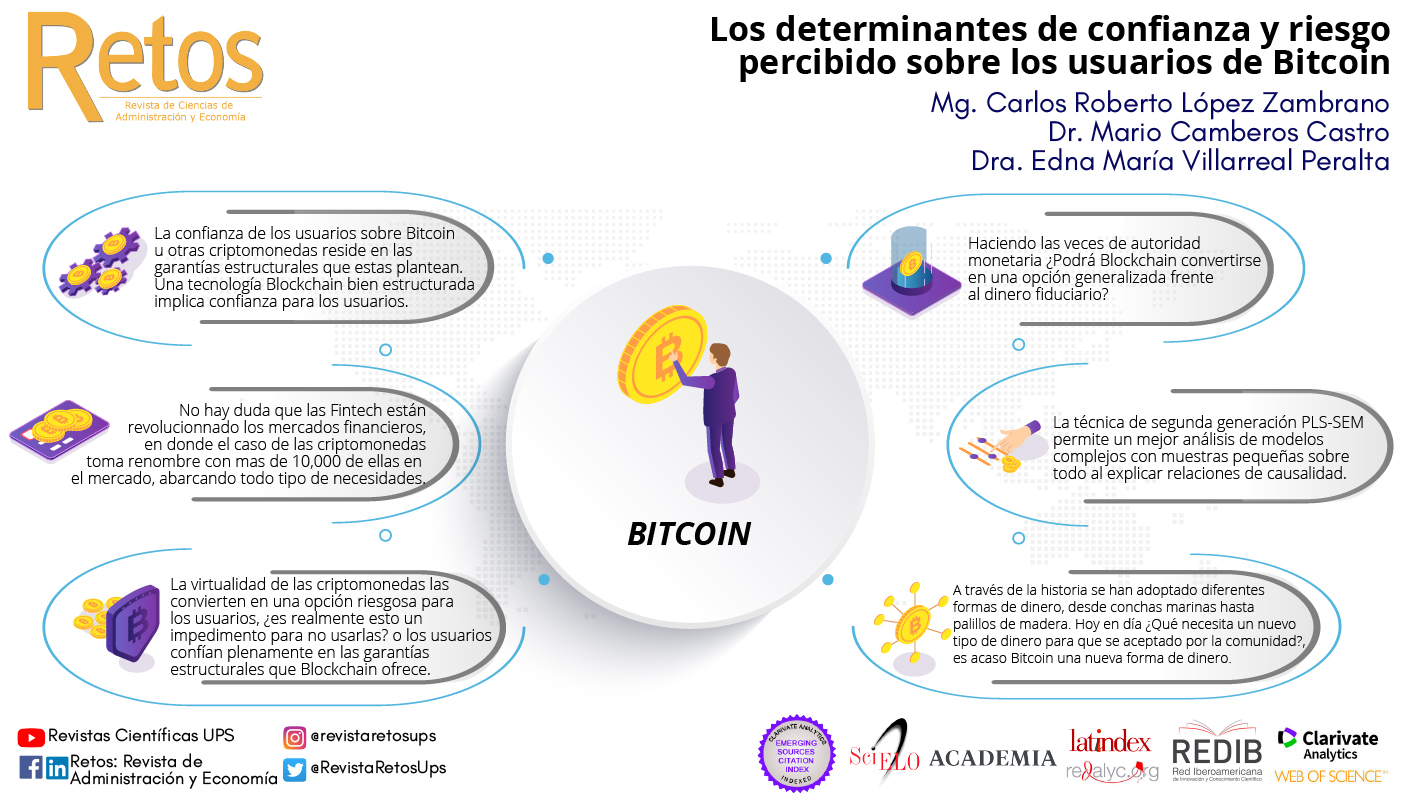
One of the possible determinants of the intention to use bitcoin may be the trust of users because in the short time of validity of the cryptocurrency has proven to be a real option against fiat money. In this regard it should be added that few studies consider trust as a determinant of the use of Bitcoin; therefore, the purpose of this research is to know what are the factors on which trust is based and to know to what extent the perceived risk has a negative connotation on the use of cryptocurrency. To accomplish this, a model is integrated and is analyzed under the methodology of structural equations by partial least squares (PLS-SEM), applied to a sample of 174 bitcoin users. The evaluation of the seven theoretical hypotheses indicates that the key elements of trust are structural guarantees and familiarity since they determine the intention of use and this, in turn, the actual use; unlike calculative-based trust and situational normality, which are not very significant. The perceived risk was shown to have little relation to the intended use. Therefore, Bitcoin-related service providers should focus on generating trust situations for users based on security and regulations and creating environments that generate familiarity.
Article Details
Authorship: The list of authors signing must include only those people who have contributed intellectually to the development of the work. Collaboration in the collection of data is not, by itself, a sufficient criterion of authorship. "Retos" declines any responsibility for possible conflicts arising from the authorship of the works that are published.
Copyright: The Salesian Polytechnic University preserves the copyrights of the published articles, and favors and allows their reuse under the Creative Commons Attribution-NonCommercial-ShareAlike 3.0 Ecuador license. They may be copied, used, disseminated, transmitted and publicly displayed, provided that: i) the authorship and the original source of their publication (journal, editorial and work URL) are cited; (Ii) are not used for commercial purposes; Iii) mention the existence and specifications of this license.
References
Afshan, S., & Sharif, A. (2016). Acceptance of mobile banking framework in Pakistan. Telematics and Informatics, 33(2), 370–387. https://doi.org/10.1016/j.tele.2015.09.005
Alalwan, A. A., Dwivedi, Y. K., & Rana, N. P. (2017). Factors influencing adoption of mobile banking by Jordanian bank customers: Extending UTAUT2 with trust. International Journal of Information Management, 37(3), 99–110. https://doi.org/10.1016/j.ijinfomgt.2017.01.002
Alalwan, A. A., Dwivedi, Y. K., Rana, N. P., & Algharabat, R. (2018). Examining factors influencing Jordanian customers’ intentions and adoption of internet banking: Extending UTAUT2 with risk. Journal of Retailing and Consumer Services, 40(August 2017), 125–138. https://doi.org/10.1016/j.jretconser.2017.08.026
Aljaafreh, A., Gill, A. Q., & Ani, A. Al. (2014). Towards the development of an initial trust model for the adoption of internet banking services in Jordan. Proceedings - Pacific Asia Conference on Information Systems, PACIS 2014, 1–12.
Blandin, A., Pieters, G. C., Wu, Y., Dek, A., Eisermann, T., Njoki, D., & Taylor, S. (2020). 3rd Global Cryptoasset Benchmarking Study. SSRN Electronic Journal, September. https://doi.org/10.2139/ssrn.3700822
Coinmarketcap. (2021). Cryptocurrency Market Capitalizations | CoinMarketCap. Coinmarketcap. https://coinmarketcap.com/
Esmaeilzadeh, P., Subramanian, H., & Cousins, K. (2019). Individuals’ cryptocurrency adoption: A proposed moderated-mediation model. 25th Americas Conference on Information Systems, AMCIS 2019, Saito 2015, 1–10.
Featherman, M. S., & Pavlou, P. A. (2003). Predicting e-services adoption: A perceived risk facets perspective. International Journal of Human Computer Studies, 59(4), 451–474. https://doi.org/10.1016/S1071-5819(03)00111-3
Gefen, D., Srinivasan Rao, V., & Tractinsky, N. (2003). The conceptualization of trust, risk and their electronic commerce: The need for clarifications. Proceedings of the 36th Annual Hawaii International Conference on System Sciences, HICSS 2003, 00(C), 1–10. https://doi.org/10.1109/HICSS.2003.1174442
Gefen, David. (2000). E-commerce: The role of familiarity and trust. Omega, 28(6), 725–737. https://doi.org/10.1016/S0305-0483(00)00021-9
Gefen, David, Karahanna, E., & Straub, Detmar, W. (2003). Trust and TAM in Online Shopping: An Integrated Model. MIS Quarter, 27(1), 51–90. https://doi.org/https://doi.org/10.2307/30036519
Gefen, David, & Straub, D. W. (2004). Consumer trust in B2C e-Commerce and the importance of social presence: Experiments in e-Products and e-Services. Omega, 32(6), 407–424. https://doi.org/10.1016/j.omega.2004.01.006
Gu, D., Khan, S., Khan, I. U., & Khan, S. U. (2019). Understanding mobile tourism shopping in Pakistan: An integrating framework of innovation diffusion theory and technology acceptance model. Mobile Information Systems, 2019. https://doi.org/10.1155/2019/1490617
Hair, J. F., Hult, G. T. M., Ringle, C. M., & Sarstedt, M. (2016). A Primer on Partial Least Squares Structural Equation Modeling (PLS-SEM). En Sage (2nd Editio). SAGE Publications, Ltd.
Hair, J. F., Sarstedt, M., Hopkins, L., & Kuppelwieser, V. G. (2014). Partial least squares structural equation modeling (PLS-SEM): An emerging tool in business research. European Business Review, 26(2), 106–121. https://doi.org/10.1108/EBR-10-2013-0128
Hair, J. F., Sarstedt, M., Ringle, C. M., & Mena, J. A. (2012). An assessment of the use of partial least squares structural equation modeling in marketing research. Journal of the Academy of Marketing Science, 40(3), 414–433. https://doi.org/10.1007/s11747-011-0261-6
Inoue, B. (2016). Performance of Bitcoin Protocol Variants [Nara Institute of Science and Technology]. https://library.naist.jp/mylimedio/dllimedio/showpdf2.cgi/DLPDFR012576_P1_83
Jr, J. F. H., Black, W. C., Babin, B. J., Anderson, R. E., Black, W. C., & Anderson, R. E. (2018). Multivariate Data Analysis. https://doi.org/10.1002/9781119409137.ch4
Kim, G., Shin, B., & Lee, H. G. (2009). Understanding dynamics between initial trust and usage intentions of mobile banking. Information Systems Journal, 19(3), 283–311. https://doi.org/10.1111/j.1365-2575.2007.00269.x
Kim, K. K., & Prabhakar, B. (2004). Initial Trust and the Adoption of B2C e-Commerce: The Case of Internet Banking. Data Base for Advances in Information Systems, 35(2), 50–64. https://doi.org/10.1145/1007965.1007970
Lee, M. C. (2009). Factors influencing the adoption of internet banking: An integration of TAM and TPB with perceived risk and perceived benefit. Electronic Commerce Research and Applications, 8(3), 130–141. https://doi.org/10.1016/j.elerap.2008.11.006
Leyva Cordero, O., & Olague, J. T. (2014). Modelo de Ecuaciones Estructurales por el método de mínimos cuadrados parciales (PLS). En Métodos Y Técnicas Cualitativas Y Cuantitativas Aplicables a La Investigación En Ciencias Sociales (Número April 2015, pp. 479–497).
López Zambrano, C. R., & Camberos Castro, M. (2020). Aceptación y confianza de Bitcoin en México: una investigación empírica. Entre ciencia e ingeniería, 14(28), 16–25. https://doi.org/10.31908/19098367.2011
Mahomed, N. (2017). Understanding consumer adoption of cryptocurrencies. En Master Thesis, Gordon Insititute of Business Science, University of Pretoria. (Número November). https://repository.up.ac.za/handle/2263/64874
Mayer, R. C., Davis, J. H., & Schoorman, F. D. (1995). An Integrative Model of Organizational Trust. The Academy of Management Review, 20(3), 709–734. https://doi.org/https://doi.org/10.2307/258792
Mensah, I. K., Chuanyong, L., & Zeng, G. (2020). Factors determining the continued intention to use mobile money transfer services (MMTS) among university students in Ghana. International Journal of Mobile Human Computer Interaction, 12(1), 1–21. https://doi.org/10.4018/IJMHCI.2020010101
Min, S., So, K. K. F., & Jeong, M. (2018). Consumer adoption of the Uber mobile application: Insights from diffusion of innovation theory and technology acceptance model. Journal of Travel and Tourism Marketing, 00(00), 1–14. https://doi.org/10.1080/10548408.2018.1507866
Nakamoto, S. (2008). Bitcoin: A peer-to-peer electronic cash system, [Online] Available: https://bitcoin.org/bitcoin.pdf. En Pdf [Accessed 27 Aug. 2018]. http://bitcoin.org/bitcoin.pdf
Oliveira, T., Faria, M., Thomas, M. A., & Popovi?, A. (2014). Extending the understanding of mobile banking adoption: When UTAUT meets TTF and ITM. International Journal of Information Management, 34(5), 689–703. https://doi.org/10.1016/j.ijinfomgt.2014.06.004
Oliveira, T., Thomas, M., Baptista, G., & Campos, F. (2016). Mobile payment: Understanding the determinants of customer adoption and intention to recommend the technology. Computers in Human Behavior, 61(2016), 404–414. https://doi.org/10.1016/j.chb.2016.03.030
Owusu Kwateng, K., Osei Atiemo, K. A., & Appiah, C. (2019). Acceptance and use of mobile banking: an application of UTAUT2. Journal of Enterprise Information Management, 32(1), 118–151. https://doi.org/10.1108/JEIM-03-2018-0055
Pavlou, P. A. (2003). Consumer acceptance of electronic commerce: Integrating trust and risk with the technology acceptance model. International Journal of Electronic Commerce, 7(3), 101–134. https://doi.org/10.1080/10864415.2003.11044275
Roos, C. (2015). The motivation and factors driving crypto-currency adoption in SMEs. En Master Thesis, Gordon Insitute of Business Science, University of Pretoria (Número Noviembre). University of Pretoria.
Sadhya, V., Sadhya, H., Hirschheim, R., & Watson, E. (2018). Exploring technology trust in Bitcoin: The blockchain exemplar. 26th European Conference on Information Systems: Beyond Digitization - Facets of Socio-Technical Change, ECIS 2018, 1–16.
Sas, C., & Khairuddin, I. E. (2015). Exploring Trust in Bitcoin Technology. December, 338–342. https://doi.org/10.1145/2838739.2838821
Shahzad, F., Xiu, G. Y., Wang, J., & Shahbaz, M. (2018). An empirical investigation on the adoption of cryptocurrencies among the people of mainland China. Technology in Society, 55(May), 33–40. https://doi.org/10.1016/j.techsoc.2018.05.006
Sun, B., Sun, C., Liu, C., & Gui, C. (2017). Research on Initial Trust Model of Mobile Banking Users. Journal of Risk Analysis and Crisis Response, 7(1), 13. https://doi.org/10.2991/jrarc.2017.7.1.2
Venkatesh, V., Thong, J. Y. L., & Xu, X. (2012). Consumer Acceptance and Use of Information Technology: Extending the Unified Theory of Acceptance and Use of Technology. MIS Quarterly, 36(1), 157–178. https://doi.org/https://doi.org/10.2307/41410412
Vinzi, V. E., Chin, W. W., Henseler, J., & Wang, H. (2010). Handbook of Partial Least Squares Concepts. En Handbook of Statistical Bioinformatics. https://doi.org/10.1007/978-3-642-16345-6
Xie, Q., Song, W., Peng, X., & Shabbir, M. (2017). Predictors for e-government adoption: Integrating TAM, TPB, trust and perceived risk. Electronic Library, 35(1), 2–20. https://doi.org/10.1108/EL-08-2015-0141
Yeong, Y. C., Kalid, K. S., & Sugathan, S. K. (2019). Cryptocurrency acceptance: A case of Malaysia. International Journal of Engineering and Advanced Technology, 8(5), 28–38. https://doi.org/10.35940/ijeat.E1004.0585C19
Zhou, T. (2012). Examining mobile banking user adoption from the perspectives of trust and flow experience. Information Technology and Management, 13(1), 27–37. https://doi.org/10.1007/s10799-011-0111-8
Zhou, T., Lu, Y., & Wang, B. (2010). Integrating TTF and UTAUT to explain mobile banking user adoption. Computers in Human Behavior, 26(4), 760–767. https://doi.org/10.1016/j.chb.2010.01.013