

Analysis of Convergence for the Ecuadorian Case at the Cantonal Level in the Period: 2007-2017
Article Sidebar
Main Article Content
Abstract
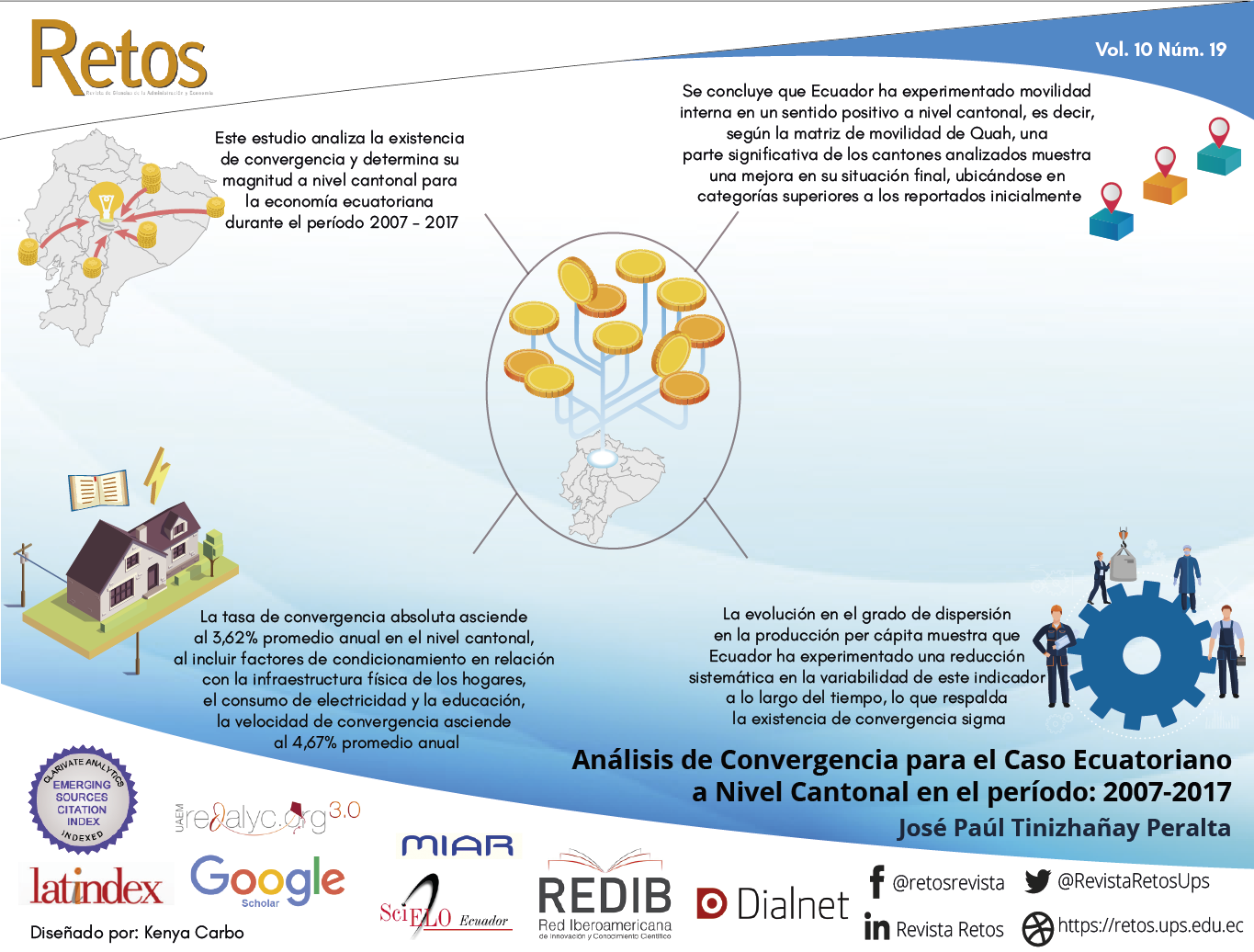
The objective of this study is to analyze the existence of convergence and determine its magnitude at the cantonal level for the Ecuadorian economy during the period 2007 to 2017. Following the methodology proposed by Quah, the transition matrix of the Ecuadorian economy at the cantonal level is estimated and following the postulates of Barro and Sala-i-Martin, the sigma convergence process is identified and an econometric model is estimated using OLS and cross-sectional data, to determine the existence and magnitude of the beta convergence. The main findings indicate that Ecuador shows an improvement in the final mobility situation. Furthermore, the absolute convergence rate amounts to 3.62% annual average at the cantonal level, while, by including conditioning factors in relation to physical infrastructure of households, electricity consumption and education, the speed of convergence amounts to 4.67% average annual, which denotes key areas of intervention, among others, in order to shorten territorial gaps in Ecuador.
Article Details
Authorship: The list of authors signing must include only those people who have contributed intellectually to the development of the work. Collaboration in the collection of data is not, by itself, a sufficient criterion of authorship. "Retos" declines any responsibility for possible conflicts arising from the authorship of the works that are published.
Copyright: The Salesian Polytechnic University preserves the copyrights of the published articles, and favors and allows their reuse under the Creative Commons Attribution-NonCommercial-ShareAlike 3.0 Ecuador license. They may be copied, used, disseminated, transmitted and publicly displayed, provided that: i) the authorship and the original source of their publication (journal, editorial and work URL) are cited; (Ii) are not used for commercial purposes; Iii) mention the existence and specifications of this license.
References
Akaike, H. 1974. A New Look at the Statistical Model Identification. IEEE Transactions on Automatic Control, 19(6), 716-723. https://doi.org/10.1109/TAC.1974.1100705
Alvarado, R. J. 2015, diciembre. Potencial de las empresas petroleras para el desarrollo local amazónico: análisis a partir de su incidencia en el sector agropecuario del cantón la Joya de los Sachas. (Tesis de maestría). Quito: Repositorio Digital FLACSO Ecuador. Recuperado de: https://bit.ly/2HgXyRM
Azzoni, C. 2001. Economic growth and regional income inequality in Brazil. The Annals of Regional Science, 35, 133-152. https://doi.org/10.1007/s001680000038
Barro, R., & Sala-i-Martin, X. 1991. Convergence Across States and Regions. Brookings Papers on Economic Activity, 22(1), 107-182.
Barro, R., & Sala-i-Martin, X. 1992a. Convergence. Journal of Political Economy, 100(2), 223-251. https://doi.org/10.1086/261816
Barro, R., & Sala-I-Martin, X. 1992b. Public Finance in Models of Economic Growth. The Review of Economic Studies, 59(4), 645-661. https://doi.org/10.3386/w3362
Barro, R., & Sala-i-Martin, X. 2004. Economic Growth (2nd ed.). Cambridge: Massachusetts Institute of Technology.
BCE. diciembre de 2009. Banco Central del Ecuador. Recuperado de: https://bit.ly/38o4QyZ
BCE. mayo de 2019. Banco Central del Ecuador. Recuperado de: https://bit.ly/39sh7T6
Biriescu, S., & Babaita, C. 2014. Rural Education, an Important Factor of Regional Development in the Context of Local Government Strategies. Procedia-Social and Behavioral Sciences, 124, 77-86. https://doi.org/10.1016/j.sbspro.2014.02.462
Chapsa, X., Tsanana, E., & Katrakilidis, C. 2015. Growth and Convergence in the EU-15: More Evidence from the Cohesion Countries. Procedia Economics and Finance, 33, 55-63. https://doi.org/10.1016/S2212-5671(15)01693-7
Chimbo, J., & Ñauta, F. 2012. Movilidad de las provincias del Ecuador desde el punto de vista del VAB, 2001-2007. Matriz de Quah. Cuenca: Degree Work, Universidad de Cuenca. Recuperado de: https://bit.ly/2SnA7fQ
Démurger, S. 2001. Infrastructure Development and Economic Growth: An Explanation for Regional Disparities in China? Journal of Comparative Economics, 29(1), 95-117. https://doi.org/10.1006/jcec.2000.1693
Desli, E., & Gkoulgkoutsika, A. 2019. Economic convergence among the world’s top-income economies. The Quarterly Review of Economics and Finance. https://doi.org/10.1016/j.qref.2019.03.001
Duffy-Deno, K. T., & Eberts, R. W. 1991. Public infrastructure and regional economic development: A simultaneous equations approach. Journal of Urban Economics, 30(3), 329-343. https://doi.org/10.1016/0094-1190(91)90053-A
Goetz, S. J., & Hu, D. 1996. Economic growth and human capital accumulation: Simultaneity and expanded convergence tests. Economics Letters, 51(3), 355-362. https://doi.org/10.1016/0165-1765(96)00827-0
INEC. 2019, mayo. Instituto Nacional de Estadísticas y Censos. Recuperado de: https://bit.ly/39CDeGR
Islam, N. 2003. What have We Learnt from the Convergence Debate? Journal of Economic Surveys, 17(3), 309-362. https://doi.org/10.1111/1467-6419.00197
Kruss, G., McGrath, S., Petersen, I.-h., & Gastrow, M. 2015. Higher education and economic development: The importance of building technological capabilities. International Journal of Educational Development, 43, 22-31. https://doi.org/10.1016/j.ijedudev.2015.04.011
Lucas, R. 1988. On the mechanics of economic development. Journal of Monetary Economics, 22(1), 3-42.
Mendieta, R. 2015. La hipótesis de la convergencia condicional en Ecuador: un análisis a nivel cantonal. Retos. Revista de Ciencias de la Administración y Economía, 5, 13-26. https://doi.org/10.17163/ret.n9.2015.01
Miller, S. M., & Upadhyay, M. P. 2002. Total factor productivity and the convergence hypothesis. Journal of Macroeconomics, 24(2), 267-286. https://doi.org/10.1016/S0164-0704(02)00022-8
Moncada, J., & Hincapié, D. 2013. Convergence of the Quality of Life in Medellin 2004–2011. A Spatial Nonparametric Analysis. Ensayos sobre Política Económica, 30(70), 267-314. doi:https://doi.org/10.1016/S0120-4483(13)70034-4
Mora, J. J. 2003. Crecimiento y convergencia: A propósito de Quah. Estudios Gerenciales, 89, 57-72. Recuperado de: https://bit.ly/2SoMmZW
Quah, D. 1993. Empirical cross-section dynamics in economic growth. European Economic Review, 37(2-3), 426-434. https://doi.org/10.1016/0014-2921(93)90031-5
Rebelo, S. 1991. Long Run Policy Analysis and Long Run Growth. Journal of Political Economy, 99(3), 500-521.
Riofrío, L. 2009. Capital humano y procesos de convergencia en el Ecuador. Degree Work. Loja: Universidad Técnica Particular de Loja. Recuperado de https://bit.ly/39x6zlK
Rivza, B., Bikse, V., & Brence, I. 2015. Evaluation of Higher Education Study Programmes and their Development Trends as Drivers of Regional Growth. Procedia Economics and Finance, 26, 643-650. https://doi.org/10.1016/S2212-5671(15)00804-7
Romer, P. 1986. Increasing Returns and Long-Run Growth. Journal of Political Economy, 94(5), 1002-1037.
Sala-i-Martin, X. (1994). Cross-sectional regressions and the empirics of economic growth. European Economic Review, 38(3-4), 739-747.
Schwarz, G. 1978. Estimating the Dimension of a Model. The Annals of Statistics, 6(2), 461-464. https://doi.org/10.1214/aos/1176344136
Silva, A. 2010. Economic Growth and Poverty Reduction in Colombia. Frankfurt Am Main: Peter Lang AG. https://doi.org/10.3726/978-3-653-00274-4
Solow, R. 1956. A Contribution to the Theory of Economic Growth. The Quarterly Journal of Economics, 70(1), 65-94.
Vásquez, M. E. 2015. Propuesta para implementar un ecoturismo rural en la isla San Cristóbal. (Tesis de Pregrado). Guayaquil, Ecuador. Recuperado de: https://bit.ly/31QaN5r
Young, A. 1991. Learning by Doing and the Dynamic Effects of International Trade. The Quarterly Journal of Economics, 106(2), 369-405.