

Signaling and success in campaigns of Latin-American crowdfunding
Article Sidebar
Main Article Content
Abstract
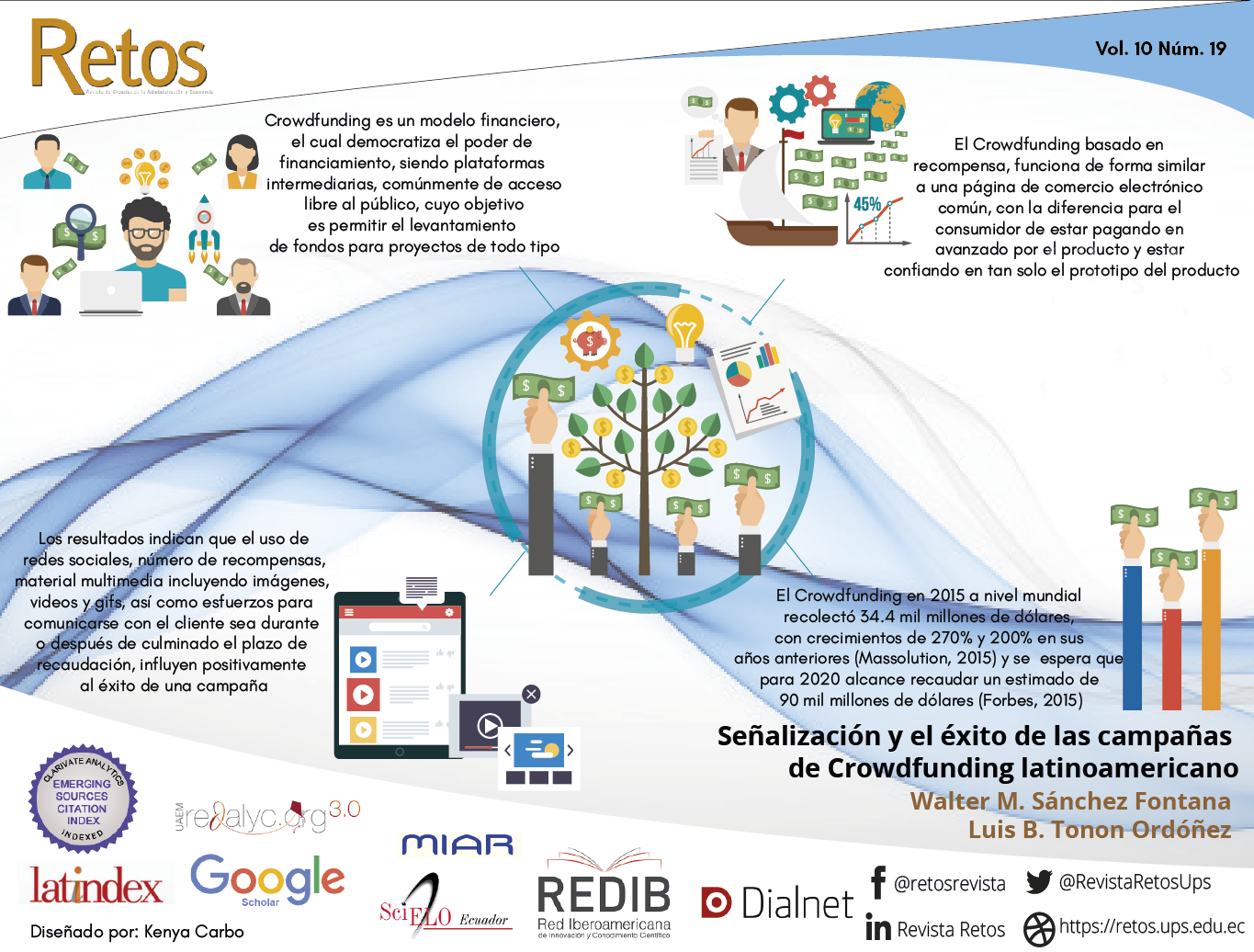
Funding opportunities for entrepreneurships in Latin America are few. Commonly being limited to the use of traditional platforms such as public and private banking, or even informal forms of recollecting recourses, none of this particularly fitted to support early stage entrepreneurship. Because of this, new collection mechanisms have emerged, such as reward-based crowdfunding. However, this mechanism presents large percentages of failure and diminished growth rates in comparison to other regions. This empirical research aims to contribute to the understanding of the factors that make a successful campaign from the perspective of signaling theory. Based on the information collected from 21 804 Latin American campaigns, extracted from eight different countries, of the Catarse, Kickstarter and Idea.me platforms. The results indicate that the use of social networks, number of rewards, multimedia material such as images, videos and gifs, as well as efforts of communication with clients, it being during or after the funding phase; have a positive influence in the success of a campaign. Furthermore, all of these are seldom used by the majority of evaluated campaigns, independent of their country of origin or the nature of the campaign itself. The lessened growth of crowdfunding on the region is understood, is at least in part affected due to the inherent quality
of the projects, where’s a lot of room for improvement to be made.
Article Details
Authorship: The list of authors signing must include only those people who have contributed intellectually to the development of the work. Collaboration in the collection of data is not, by itself, a sufficient criterion of authorship. "Retos" declines any responsibility for possible conflicts arising from the authorship of the works that are published.
Copyright: The Salesian Polytechnic University preserves the copyrights of the published articles, and favors and allows their reuse under the Creative Commons Attribution-NonCommercial-ShareAlike 3.0 Ecuador license. They may be copied, used, disseminated, transmitted and publicly displayed, provided that: i) the authorship and the original source of their publication (journal, editorial and work URL) are cited; (Ii) are not used for commercial purposes; Iii) mention the existence and specifications of this license.
References
Ahlers, Gerrit K.C., & Cumming, D., Günther, C., & Schweiser, D. 2015. Signaling in Equity Crowdfunding. Entrepreneurship: Theory and Practice, 955-980. https://doi.org/10.1111/etap.12157
Banco Mundial. 2013. Crowdfunding’s Potential for the Developing World. Finance and Private Sector Development Department, 1-102.
Belleflamme, P., Lambert, T., & Schwienbacher, A. 2012. Crowdfunding: Tapping the right crowd. Journal of Business Venturing, 29(5), 585-609. https://doi.org/10.1016/j.jbusvent.2013.07.003
Berger, A. N., & Udell, G. F. 1995. Relationship Lending and Lines of Credit in Small Firm Finance. The Journal of Business, 68(3), 351. https://doi.org/10.1086/296668
Canela, M., Lora, M., & Estrella. 2011. Cómo hacer una Regresión Logística binaria “paso a paso” (II): análisis multivariante. Docuweb FABIS, 34.
Cardon, M., Sudek, R., & Mitteness, C. 2009. The impact of perceived entrepreneurial passion on angel investing. Frontiers of Entrepreneurship Research 29. Recuperado de: https://bit.ly/393U5SR
Connelly, B. L., Certo, S. T., Ireland, R. D., & Reutzel, C. R. 2011. Signaling Theory: A Review and Assessment. Journal of Management. Recuperado de: https://bit.ly/3bo1VbH
Courtney, C., Dutta, S., & Li, Y. 2017. Resolving Information Asymmetry: Signaling, Endorsement, and Crowdfunding Success. Entrepreneurship: Theory and Practice, 41(2), 265-290. https://doi.org/10.1111/etap.12267
Chakraborty, S., & Swinney, R. 2016. Signaling to the Crowd: Private Quality Information and Rewards-Based Crowdfunding. Ssrn. https://doi.org/10.2139/ssrn.2885457
Davies, W. E., & Giovannetti, E. 2018. Signalling experience & reciprocity to temper asymmetric information in crowdfunding evidence from 10,000 projects. Technological Forecasting and Social Change, (March), 1-14. https://doi.org/10.1016/j.techfore.2018.03.011
Dehling, S. 2013. Crowdfunding – A Multifaceted Phenomenon. University of Twente. Recuperado de: https://bit.ly/37ehkb7
Etter, V., Grossglauser, M., & Thiran, P. 2013. Launch hard or go home! Proceedings of the First ACM Conference on Online Social Networks-COSN ’13, 177-182. https://doi.org/10.1145/2512938.2512957
Jiang, Z., & Benbasat, I. 2007. Investigating the influence of the functional mechanisms of online product presentations. Information Systems Research, 18(4), 454-470.
Kickante. 2018. Os 10 maiores sites de Crowdfunding no Brasil. Recuperado de: https://bit.ly/2HWpY43
Kim, P. H., Buffart, M., & Croidieu, G. 2016. TMI: Signaling Credible Claims in Crowdfunding Campaign Narratives. Group and Organization Management, 41(6), 717-750. https://doi.org/10.1177/1059601116651181
Kickstarter. 2018. Estadísticas. Recuperado de: https://bit.ly/37QZcpq (2018-09-10).
Kunz, M. M., Bretschneider, U., Erler, M., & Leimeister, J. M. 2017. An empirical investigation of signaling in reward-based crowdfunding. Electronic Commerce Research (Vol. 17). https://doi.org/10.1007/s10660-016-9249-0
Kraus, S., Richter, C., Brem, A., Cheng, C.-F., & Chang, M.-L. 2016. Strategies for reward-based crowdfunding campaigns. Journal of Innovation & Knowledge, 1(1), 13-23. https://doi.org/10.1016/j.jik.2016.01.010
Lambert, T., & Schwienbacher, A. 2010. An Empirical Analysis of Crowdfunding. SSRN Working Paper. Recuperado de: https://bit.ly/2OIBQKs
Lynn, M. 1991. Scarcity effects on value: A quantitative review of the commodity theory literature. Psychology & Marketing, 8(1), 43-57. https://doi.org/10.1002/mar.4220080105
Mason, C. M., & Harrison, R. T. 2004. Improving access to early stage venture capital in regional economies: A new approach to investment readiness. Local Economy, 19(2), 159-173.
Ma, X., Yang, M., Li, Y., & Zhang, J. 2017. Signaling factors in overfunding: An empirical study based on Crowdcube. 14th International Conference on Services Systems and Services Management, ICSSSM 2017 - Proceedings, (2016). https://doi.org/10.1109/ICSSSM.2017.7996208
Massolution. 2015. The crowdfunding industry report. Recuperado de: https://bit.ly/39wqn97
Martens, M. L., Jennings, J. E., & Jennings, P. D. 2007. Do the stories they tell get them the money they need? The role of entrepreneurial narratives in resource acquisition. Academy of Management Journal, 50(5), 1107-1132.
Mollick, E. 2013. The dynamics of crowdfunding: An exploratory study. Journal of Business Venturing, 29(1), 1-16. https://doi.org/10.1016/j.jbusvent.2013.06.005
Nahapiet, J., & Ghoshal, S. 1998. Social Capital, Intellectual Capital, and the Organizational Advantage. The Academy of Management Review, 23(2), 242. https://doi.org/10.2307/259373
Rentería, C. 2016. Las plataformas de crowdfunding en América Latina. Nueva York. https://doi.org/10.13140/RG.2.2.29576.01286/1
Rodríguez, R. 2017. Evolución del ecosistema de crowdfunding en México 2015-2017. Crowdfunding México-BIMCON.
Rojas, L. 2017. Situación del financiamiento a pymes y empresas nuevas en América Latina. CAF. Santiago. Primera Edición. Recuperado de: https://bit.ly/38jSXKD
Spence, M. 1973. Job market signaling. The Quarterly Journal of Economics, 87, 355-374. doi:10.2307/1882010
Tranmer, M., & Elliot, M. 2005. Binary Logistic Regression. Cathie Marsh Centre for Census and Survey Research, (1), 3-43. https://doi.org/10.4135/9781412995627
Thelwall, M. 2001. A web crawler design for data mining. Journal of Information Science, 27(5), 319-325. https://doi.org/10.1177/016555150102700503
Vismara, S. 2018. Signaling to Overcome Inefficiencies in Crowdfunding Markets. The Economics of Crowdfunding. https://doi.org/https://doi.org/10.1007/978-3-319-66119-3_3
Walsh, A. 1987. Teaching Understanding and Interpretation of Logit Regression. Teaching Sociology, 15(2), 178-183. https://doi.org/10.2307/1318033
Wells, J. D., Valacich, J. S., & Hess, T. J. 2011. What signal are you sending? How website quality influences perceptions of product quality and purchase intentions. MIS Quarterly, 35(2), 373-396.