

Identification of the tourist’s perception towards the destination Cuenca-Ecuador, through “Netnography”
Article Sidebar
Main Article Content
Abstract
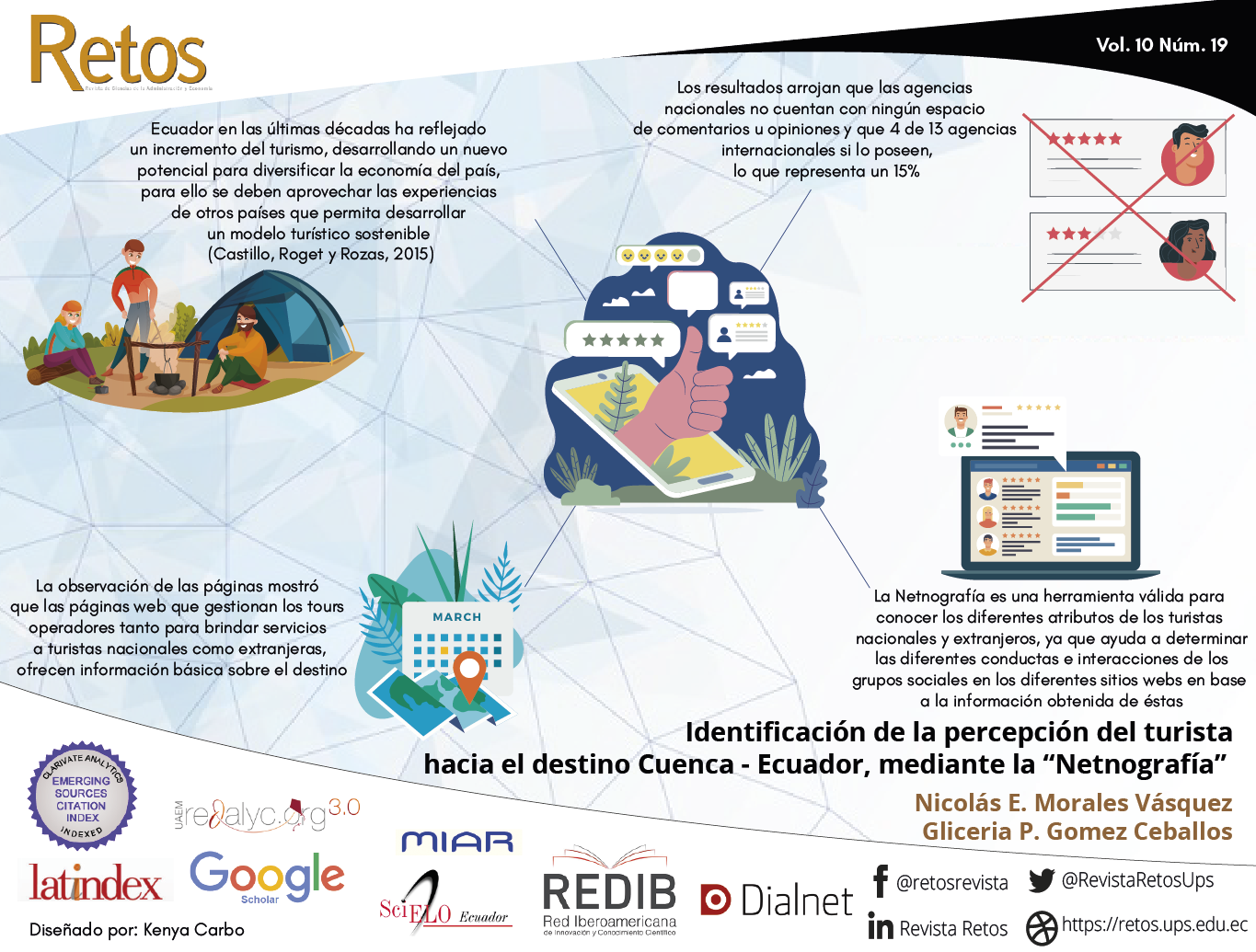
The present investigation analyzes the necessity and convenience of demonstrating that the “Netnography” is a method that contributes to the development of tourism, because it contributes to determine the tastes and preferences in relation to the resources/attractions existing in the locality and the level of satisfaction of the consumer´s needs, the objective general is to identify attributes of the profile of tourists for the destiny Cuenca Ecuador, the methodology selected for the study was the proposed by Vargas (2011), who stablishes as steps of the procedure: the definition of the topic to investing, the virtual communities where the data will extracted and finally, the interpretation of the information. The universe of the research integrated totality of comments extracted from the Facebook´s page Visit Cuenca and the tourist forum of the Cuenca´s city in Trip Advisor. The analysis show as results the perception of the tourists in relation to the attributes offered by the city, the existence of a greater influx of Ecuadorian tourism into the city and the composition by origin foreign segments, including tourists from Latin América and Caribbean, it´s observed that the most important attraction in order of preference was its architectural area and the natural attractions of the environment; findings that can be taken into account for the design of future marketing strategies for the destination.
Article Details
Authorship: The list of authors signing must include only those people who have contributed intellectually to the development of the work. Collaboration in the collection of data is not, by itself, a sufficient criterion of authorship. "Retos" declines any responsibility for possible conflicts arising from the authorship of the works that are published.
Copyright: The Salesian Polytechnic University preserves the copyrights of the published articles, and favors and allows their reuse under the Creative Commons Attribution-NonCommercial-ShareAlike 3.0 Ecuador license. They may be copied, used, disseminated, transmitted and publicly displayed, provided that: i) the authorship and the original source of their publication (journal, editorial and work URL) are cited; (Ii) are not used for commercial purposes; Iii) mention the existence and specifications of this license.
References
Barbery, D. C., Andrade, J., & Zambrano, M. 2018. Internet y prosumers: impacto en la decisión de compra de servicios hoteleros. Revista Espacios, 39(51). Recuperado de: https://bit.ly/2Z5KVk1 [Fecha de consulta: 22 de junio de 2019].
Castillo, E., Roget, F., & Rozas, E. 2015. El turismo en Ecuador. nuevas tendencias en el turismo sostenible. Galega de Economía, 24(2), 69-88.
Celdrán, M., Mazón, J., & Giner, D. 2018. Open Data y turismo. Implicaciones para le gestión turística en ciudades y destinos turísticos inteligentes. Investigaciones Turísticas (15), 49-78. Recuperado de: https://bit.ly/2Ri2aeG
Colordo, D. 2004. Comunidades virtuales.Recuperado de: https://bit.ly/2XOeCJq
Consulting, G. 2011. Plan Estratégico de Desarrollo Turístico. Quito: MINTUR-Fundación Turismo Cuenca.
Dell Innocenti, C. 2012. Las redes sociales digitales como herramientas de marketing. En C. Dell’Innocenti. Mendoza: Universidad de Mendoza.
Desplas, N., & Mao, M. 2014. Análisis paralelo entre e-turismo y e-gobierno: evolución y tendencias.Investigaciones Turísticas (7), 1-22. Recuperado de: https://bit.ly/2KNI4aU
Dina, R., & Sabou, G. 2012. Influence of social media in choice of touristic destination. Cactus Tourism Journal, 3(2), 24-30.
DINARDAP. 2018. Una Ley de Protección de Datos Personales es una oportunidad para el empresario ecuatoriano. Recuperado de: https://bit.ly/2vxpnje
Facebook. 2018. Compromiso de Facebook con la protección de datos y la privacidad en cumplimiento del GDPR. Recuperado de: https://bit.ly/2EGyMvB
Fisher, T. 2009. ROI in social media: A look at the arguments. Journal of Database Marketing & Customer Strategy Management, 16(3), 189-195. https://doi.org/10.1057/dbm.2009.16
García, F., & Vázquez, J. 2018. MIPYMES distribuidoras turísticas: recomendaciones seo a partir del análisis de palabras claves. Cuenca: Grupo Investigación Gestión de las MIPYMES-GIGMP.
Gebera, W. 2008. La netnografía: un método de investigación. Barcelona: EDUCAR. Recuperado de: https://bit.ly/2JAO439 (2018- 01-12). [Fecha de consulta: 12 de enero de 2018].
GIER. 2018. Anuario Estadístico Estudio de Demanda y Oferta Turística en la ciudad de Cuenca. Cuenca: Universidad de Cuenca. Recuperado de: https://bit.ly/2KgMp7f
Gutiérrez, G., Sánchez, M., & Galiano, A. 2018. Redes sociales como medio de promoción turística en los países iberoamericanos. Retos Revista de Ciencias de la Administración y Economía, 15(8), 135-150. https://doi.org/10.17163/ret.n15.2018.09
INEC. 2017. Tecnologías de la información y comunicación. Recuperado de: https://bit.ly/2PS8kRz
Kang, M., & Schuett, M. 2013. Determinants of sharing travel experiences in social media. Journal of Travel & Tourism Marketing, 30(1-2), 93-107. https://doi.org/10.1080/10548408.2013.751237
Marín, P., & Torres, Á. 2017. Gamificación en aplicaciones móviles para servicios bancarios de España. Retos: Revista de Ciencias de la Administración y Economía, VII(13). https://doi.org/10.17163/ret.n13.2017.02
MINTUR (17 de agosto de 2017). Ecuador se promocionará inteligentemente a nivel mundial, con alianza estratégica con Amadeus. Recuperado de: https://bit.ly/2x8pqlX
Montserrat, G. 2014. Impacto de las TIC en el turismo. Valladolid.
Morales, A. P. 2016. Uso de redes sociales como estrategia de promoción de marketing. Cuenca: Universidad de Cuenca.
Prada, J., Armijos, D., Crespo, A., & Torres, L. 2018. El turista cultural: tipologías y análisis de las valoraciones del destino a partir del caso de estudio de Cuenca-Ecuador. Pasos: Revista de Turismo y Patrimonio Cultural, 16(1), 55-72. https://doi.org/10.25145/j.pasos.2018.16.004
Quezada, P. A., Suasnavas, M. G., Chango-Canaveral, P. M., Gonzaga-Vallejo, C., Enciso, L., & Calderón-Cordova, C. A. (2018). Used of Social Networks and web application to design and promote the ecotourism route in the Southern Amazon of Ecuador. 13th Iberian Conference on Information Systems and Technologies, CISTI, june, 27, pp. 1-7. doi:10.23919/CISTI.2018.8399399
Quijano, C., Arellano, A., & Naranjo, K. 2017. (Dis)connection during a tourism trip: The use of smartphones by independent travelers. Guayaquil: ESPOL.
Romeo, A., Abad, J., Forgas, S., & Huertas, R. 2014. La netnografía como herramienta de investigación en contextos on-line. Innovar Journal, 24(52), 89-102.
Sakulsureeyadej, A. 2011. Cómo la tecnología está cambiando el turismo mundial. En OMT, AM Reports: Tecnología y Turismo (Vol. 1). Recuperado de: https://bit.ly/2P2i5uZ
Saura, J., Sánchez, P., & Reyes, A. 2017. Marketing a través de aplicaciones móviles de turismo (m-tourism). Un estudio exploratorio. Madrid.
SENPLADES 2012. Transformación de la Matriz Productiva: Revolución productiva a través del conocimiento y el talento humano (1 ed.). Quito.
Sotiriadis, M., & Van Zyl, C. 2013. Electronic word-of-mouth and online reviews in tourism services: the use of twitter by tourists. Electronic Commerce Research, 13, 103-124. https://doi.org/10.1007/s10660-013-9108-1
Tafur, G., Vélez, C., Machado, O., Zumba, M., & Jácome, J. 2018. Desarrollo tecnológico del sector turístico en la ciudad de Guayaquil (Ecuador). Revista Espacios, 39(44), 3. Recuperado de: https://bit.ly/2XSnJ7n (2019-06-22).
Tamara, F. 2011. Guía para la creación de emprendimientos culturales. Cuenca: Universidad de Cuenca. Recuperado de: https://bit.ly/2sErF1p
TurisConsulting. 2016. Plan Estratégico de Desarrollo Turístico y Mercadeo del destino Cuenca y su área de Influencia 2016-2021 (Vol. 1). Cuenca.
Vargas, G. 2011. Método Netnográfico. En G. M. Vargas, La investigación de mercados online y la Netnografía (pp. 42-43). Santiago de Chile: Universidad de Chile.
Vázquez, J. P. 2018. Aportes al comercio turístico a través de websites: Mejoramiento para la evaluación de calidad. Un espacio para la ciencia, 1(1), 145-168. Recuperado de: https://bit.ly/2KlZrjx
Vidal, B. 2018. Turismo y tecnología: cómo la tecnología revoluciona el sector turístico. Recuperado de: https://bit.ly/2M8ZIDU
Zeng, B., & Gerritsen, R. 2014. What do we know about social media in tourism? A review. Tourism Managment Perspectives, 10, 27-36. https://doi.org/10.1016/j.tmp.2014.01.001